 Ferndale
 Two Different Materials, One Decision
Homeowners in Ferndale often come to us with a specific question already half-answered: "Should I go with the wood-look composite siding, or the fiber cement stuff?" Both are real upgrades over old cedar or aging vinyl. Both hold paint or factory finish well when new. But they are built from fundamentally different materials, and after years of installing, repairing, and tearing off both, we made a decision: we install James Hardie fiber cement siding exclusively. We don't install LP SmartSide, and we think homeowners deserve to know exactly why before they sign a contract with anyone.
This isn't a case of one product being junk and the other being perfect. Engineered wood siding has legitimate strengths. But in a coastal Whatcom County climate — salt air off Bellingham Bay, driving rain off the Strait of Georgia, and a moss season that runs most of the year — the trade-offs tipped hard enough that we stopped offering it.
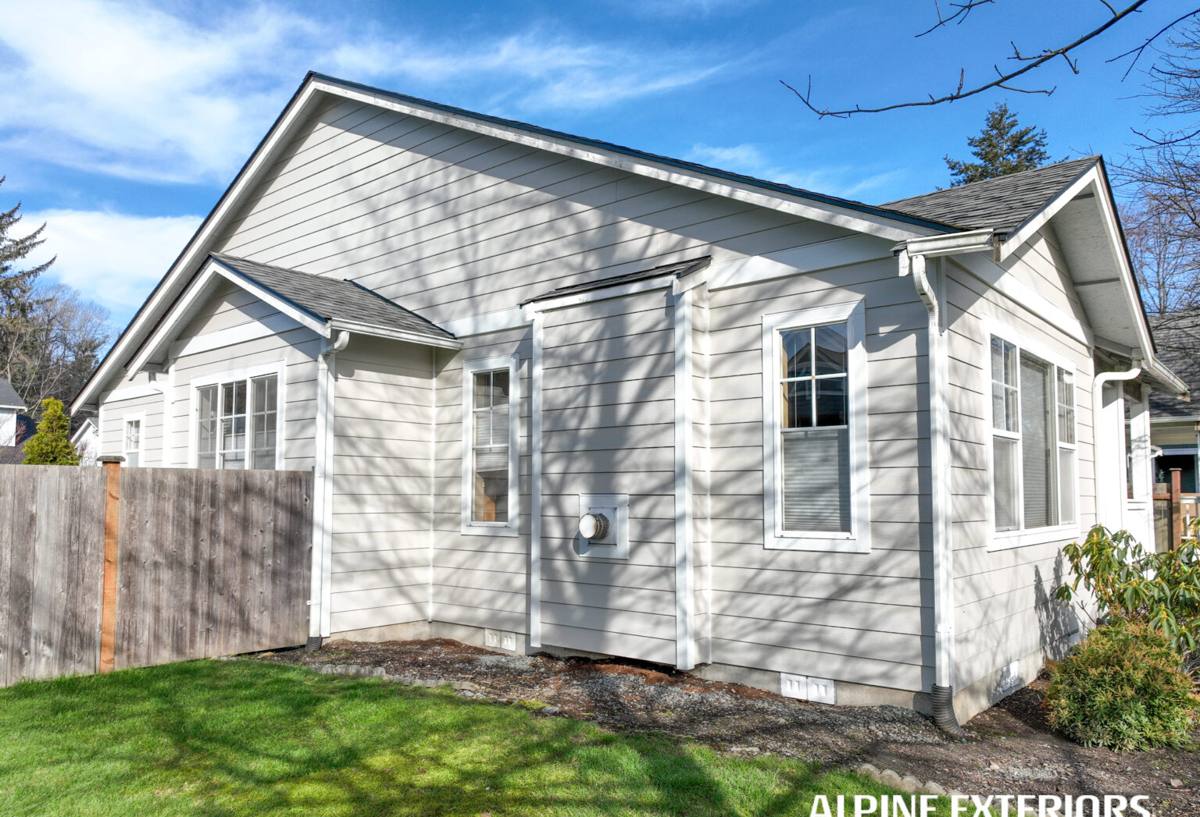
What Engineered Wood Siding Actually Is
LP SmartSide and similar engineered wood products are made from wood strands, usually a mix of sawmill byproducts, bonded together with resin under heat and pressure, then treated with a zinc borate compound intended to resist fungal decay and insects. The panels are pre-primed at the factory and finished on site or shortly after installation. It's a genuine engineering improvement over old-school hardboard siding from the 1980s and 90s, which had a well-documented reputation for swelling and failing at the edges.
Why It's Popular
It's lighter than fiber cement, easier to cut and nail without specialized blades, and generally less expensive to buy. For a contractor working fast on a budget-driven job, those are real advantages. For a homeowner comparing sticker prices, it often looks like the smarter buy up front.
What Fiber Cement Actually Is
James Hardie siding is made from Portland cement, sand, and cellulose fiber, cured into a dense, stable board. There's no wood strand structure to swell or delaminate, because there's no wood in it at all — cellulose fiber is used for reinforcement and workability, not as the structural bulk of the product. It's heavier, requires carbide-tipped blades to cut cleanly, and costs more to buy and install. James Hardie also engineers regional product lines — its HZ5 formulation is built specifically for climates with prolonged moisture exposure, which is exactly the profile of a Ferndale winter.
Where Engineered Wood Gets It Right
Weight and Handling
Engineered wood panels are noticeably lighter, which speeds up installation and reduces strain on a crew working a full day of siding. On some structural retrofits where added dead load is a real concern, that lighter weight is a legitimate technical advantage.
Upfront Cost
Material cost per square foot typically runs lower than fiber cement, and installation labor can be somewhat faster since the boards are easier to cut and fasten. For a homeowner on a tight renovation budget, that difference is not trivial.
Workability
Crews can rip, notch, and fit engineered wood panels around trim and window returns with basic tools. That flexibility matters on complex architectural details.
The Trade-Offs That Matter in a Whatcom County Climate
Moisture at the Edges
Every engineered wood product's biggest vulnerability is still the cut edge and any point where the factory seal is broken — around fasteners, at panel joints, at trim intersections. Zinc borate treatment reduces the risk of rot, but it doesn't eliminate the underlying physics: wood strand material absorbs water at exposed edges faster than solid fiber cement does. Ferndale doesn't get short rainstorms and long dry spells the way inland climates do. It gets months of low-intensity, driving rain pushed in off the Strait, with humidity that rarely lets siding fully dry out between events. That's the exact condition engineered wood is most sensitive to.
Caulking Becomes Load-Bearing
Because the edge sealing on engineered wood does real protective work, maintaining that seal — recaulking joints, touching up any nicked factory coating, keeping paint intact — isn't optional cosmetic upkeep. It's structural maintenance. Skip it for a couple of seasons in a wet climate and you're not just looking at faded paint, you're looking at edge swelling that doesn't reverse.
Moss and Organic Growth
Whatcom County's moss season is long, and moss holds moisture directly against whatever surface it's growing on. On any siding product, moss buildup near ground level, under eaves, or on north-facing walls is a maintenance issue. On a material where sustained moisture at a compromised edge is the primary failure mode, that's a meaningfully bigger deal than it is on a material that doesn't absorb water into its structure.
Salt Air
Homes closer to the water deal with airborne salt that accelerates wear on fasteners, coatings, and exposed wood fiber alike. Fiber cement's factory finish and non-organic composition simply give it less to react to.
Fire Performance
This is one place where the difference between the two materials isn't a matter of maintenance — it's inherent to what they're made of.
| Factor | James Hardie Fiber Cement | Engineered Wood (LP SmartSide) |
|---|---|---|
| Core material | Cement, sand, cellulose fiber | Wood strand, resin |
| Combustibility | Non-combustible | Combustible (wood-based) |
| Factory finish | ColorPlus baked-on finish | Primed, field or factory topcoat |
| Typical warranty | 30-year limited, transferable | Manufacturer-specific, shorter transferable window |
| Edge/moisture sensitivity | Low — no wood structure to absorb water | Higher — exposed cut edges are the weak point |
Non-combustibility matters everywhere, but it carries extra weight for homes near dry summer brush, wood-burning neighbors, or simply anyone who wants one less thing to worry about on the exterior envelope of their home.
Why We Standardized on James Hardie
We didn't stop installing engineered wood because it's a bad product in absolute terms — plenty of it is on the market performing fine on homes that are well-maintained and not in punishing climates. We stopped because our job is to put one product on every home we touch, install it correctly to spec every time, and stand behind it. James Hardie's ColorPlus factory finish means the color is baked on at the factory under controlled conditions, not applied on a job site where weather, temperature, and technique introduce variability. The HZ5 line is engineered for the exact moisture load Whatcom County throws at a home. And the warranty — a 30-year limited warranty that's transferable to a new owner — reflects a manufacturer confident enough in the material's long-term performance to back it that far.
Standardizing on one product also means our crews aren't relearning fastening patterns, cut techniques, and flashing details across multiple systems. That consistency is part of what keeps installation quality high job after job.
Cost Over the Life of the Siding
| Consideration | Fiber Cement | Engineered Wood |
|---|---|---|
| Upfront material + install cost | Higher | Lower |
| Routine maintenance need | Lower — factory finish holds up | Higher — edge sealing, recaulking, repainting cycles |
| Typical repaint interval | Rarely needed with ColorPlus | Every 8-15 years depending on exposure |
| Risk if maintenance is deferred | Low | Moderate to high in wet climates |
The math isn't as simple as "cheaper today." A lower install cost that requires more diligent, more frequent maintenance in a wet coastal climate can close the cost gap — or reverse it — over 15 to 20 years.
What to Ask Before You Choose a Siding Product
- What is the manufacturer's warranty, and does it transfer to a future homeowner if you sell?
- Is the finish factory-applied, or will it need field painting and future repainting cycles?
- How does the product perform at cut edges and panel joints when exposed to sustained moisture?
- Is the product rated non-combustible, or is it a wood-based material?
- Does the installer have specific training and experience with this exact product's fastening and flashing requirements?
- What does routine maintenance actually look like — and are you prepared to keep up with it every year?
Our Bottom Line
Engineered wood siding isn't a scam or a shortcut product — it's a legitimate building material with real strengths, particularly on cost-sensitive projects in drier climates. But we build and repair siding on homes in Ferndale and across Whatcom County, where salt air, driving rain, and moss are simply part of the weather pattern for most of the year. Given that reality, we decided we'd rather install one product exceptionally well than offer several products with different risk profiles and hope every homeowner keeps up with the maintenance each one demands. James Hardie fiber cement, installed to spec, gives us a product we can stand behind for the long haul.
If you're weighing your options for a siding replacement or new build, we're happy to walk your home with you, look at your exposure to weather and sun, and give you a straight answer on what makes sense. Reach out for a free, no-pressure estimate — there's no obligation, and no pressure to choose anything beyond what fits your home.