 Ferndale
 Lummi Nation sits close enough to Bellingham Bay and the Nooksack delta that its homes deal with a specific mix of weather most inland Whatcom County properties don't see as often: salt-laden air off the water, wind-driven rain that hits siding sideways instead of straight down, and a wet season that stretches long enough to turn north-facing walls and shaded rooflines into moss and algae magnets. We've worked on homes throughout this area and the surrounding Ferndale service territory long enough to know that what protects a house in a drier, more sheltered part of the county doesn't always hold up the same way out here.
This page is about what that climate actually does to exterior materials over time, and how we approach siding, roofing, windows, and decks for homes in this part of Whatcom County. We're not going to give you a generic rundown that could apply to any coastal town in the Pacific Northwest — we'll stick to what we know from doing this work locally, and we'll be straightforward about materials and methods rather than making claims we can't back up.
What the Local Climate Does to a House
Three things drive most of the exterior wear we see on homes near Lummi Nation: salt air, sustained wind-driven rain, and moss season that can run from fall through spring.
Salt Air
Proximity to the water means airborne salt settles on siding, trim, and metal fasteners. Over years, that accelerates corrosion on unprotected or poorly coated fasteners and can degrade certain paint films and coatings faster than they'd wear in a purely inland setting. It's not dramatic — it's cumulative, and it shows up as chalking, fading, and eventually failure points at seams and fastener heads.
Driving Rain
Wind off the water doesn't just bring rain, it pushes it. That matters for siding because wind-driven rain finds horizontal laps, butt joints, and penetrations (hose bibs, light fixtures, vents) that would stay dry in a calmer rain event. It also matters for windows and doors, where flashing and sealant details that are "good enough" in a sheltered yard can fail here.
Moss and Algae Season
Shaded walls, north-facing exposures, and roof valleys that don't get much direct sun stay damp for long stretches of the year. That's exactly the environment moss, lichen, and algae need to establish. On roofing it can lift shingles and hold moisture against the deck. On siding it can hold moisture against the substrate at laps and lower courses if the material and finish aren't built to resist it.
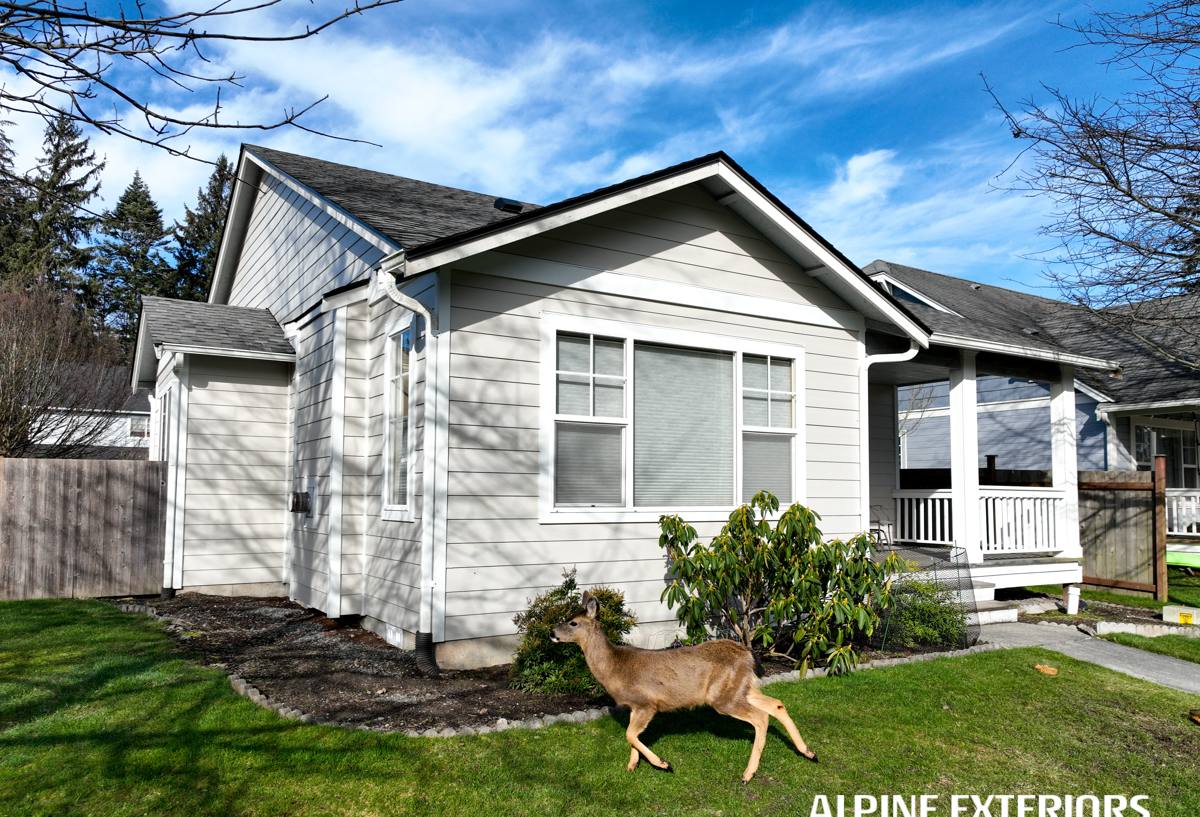
Why We Only Install James Hardie Fiber Cement Siding
We get asked why we don't offer vinyl, LP SmartSide, or other fiber cement brands like Cemplank or Allura. It's a fair question, and the honest answer is that we made a standardization decision based on what holds up best in exactly the conditions described above, and we'd rather do one product line very well than several product lines adequately.
Where Other Products Fall Short Here
Vinyl siding can work fine in a lot of climates, but it's a petroleum-based product that expands and contracts with temperature swings, and in driving-rain conditions its lap-and-J-channel installation style relies heavily on installer precision to keep water out. It also isn't fire-resistant, which matters more every year in the Pacific Northwest. LP SmartSide is an engineered wood product — treated and reasonably durable, but wood-based composites are inherently more moisture-sensitive at cut edges and butt joints than cement-based siding, and this is a location where moisture exposure is nearly constant for months at a time. Other fiber cement brands like Cemplank and Allura aren't bad products on paper, but we don't have the same long-term familiarity with their factory finish warranties and regional performance history that we have with Hardie, and we'd rather stand behind a product line we know inside and out.
What Hardie Gets Right
James Hardie fiber cement is non-combustible, which matters both for wildfire-adjacent risk and for standard home insurance considerations. It's dimensionally stable, so it doesn't swell, warp, or rot the way wood-based products can when they take on moisture at a cut edge or a poorly sealed joint. The ColorPlus factory finish is baked on under controlled conditions rather than field-painted, which gives more consistent coverage and a stronger bond than site-applied paint, and it holds up better against the fading and chalking that salt air and UV exposure cause over time. Hardie also engineers specific product lines (HZ5, HZ10) for different climate zones, so what goes on a home near Lummi Nation is matched to Pacific Northwest moisture and temperature conditions rather than a one-size-fits-all spec.
How We Approach Installation in This Area
Fiber cement siding performs exactly as well as its installation. A great product installed with the wrong flashing details, insufficient clearance, or careless caulking will still fail early — and in a driving-rain environment, those failures show up faster than they would somewhere more sheltered.
- Proper water-resistive barrier and flashing at every window, door, and penetration before siding goes on
- Correct lap and fastener spacing per Hardie's published installation guidelines for our climate zone
- Adequate clearance between siding and grade, decks, and roof lines to avoid wicking moisture
- Factory-finished ColorPlus panels wherever possible to reduce field-painted seams
- Careful attention to inside and outside corners, which are common failure points in wind-driven rain
- Fasteners and trim details chosen with corrosion resistance in mind given the salt air exposure
Roofing Considerations for This Area
Roofing takes the brunt of both driving rain and moss growth. Homes near Lummi Nation with mature tree cover or north-facing roof planes tend to hold moisture longer than homes in more open, sun-exposed parts of Ferndale. That doesn't mean every roof here needs the same treatment — it means we look at the actual exposure, tree canopy, and roof geometry of each home rather than applying a blanket recommendation. Proper underlayment, ventilation, and attention to valleys and flashing details matter more here than in drier microclimates within the same county.
Windows and Moisture Management
Wind-driven rain puts real pressure on window flashing and sealant details that a lot of homeowners never think about until there's a problem inside a wall cavity. When we replace windows in this area, proper flashing integration with the siding and water-resistive barrier is not optional — it's the difference between a window that sheds water for decades and one that quietly lets moisture into the wall assembly for years before anyone notices a stain.
Decks: Built for Wet, Shaded Conditions
Decks near Lummi Nation deal with the same moss and algae pressure as shaded roof sections, plus standing water risk if drainage and board spacing aren't handled correctly at the outset. Material choice, ledger flashing, and joist protection all matter more in a location where a deck might stay damp for days at a stretch during the wet season.
Cost Factors to Understand
Every home is different, but these are the main variables that affect cost on siding, roofing, window, and deck projects in this area. We don't publish fixed pricing because square footage, existing condition, and access all shift the number, but this table gives a sense of what actually drives the estimate.
| Factor | Why It Matters Here |
|---|---|
| Existing siding removal | Tear-off complexity and any moisture damage found underneath affects labor and sheathing repair |
| Home size and wall complexity | Corners, dormers, and multiple gables increase flashing and trim work |
| Product line and finish | Hardie panel vs. lap, and factory-finished ColorPlus vs. field paint, change material cost |
| Access and site conditions | Tree cover, tight lot lines, and staging space affect labor time |
| Flashing and moisture remediation | Wind-driven rain exposure means extra attention (and sometimes extra cost) at windows, doors, and penetrations |
Why a Local Crew Matters
A crew that works primarily in this part of Whatcom County has already seen how salt air, driving rain, and moss season play out on real homes over multiple seasons. That experience shows up in small decisions — how tight to run a fastener schedule, where to add extra flashing attention, which orientation on a given lot needs more moisture consideration — that don't show up in a generic installation manual. It also means we're not learning the local climate on your project.
Get a Free, No-Pressure Estimate
If you're weighing a siding, roofing, window, or deck project for a home near Lummi Nation, we're happy to take a look and walk you through what we'd actually recommend for your home's exposure and condition — no pressure, no obligation. Fill out the form below and we'll get in touch to schedule a time that works for you.