 Ferndale
 Siding Built for Bellingham's Climate
Bellingham sits on the shore of Bellingham Bay in Whatcom County, and that location shapes what your home's exterior has to deal with year-round. Homes here get a mix of marine air off the bay, long stretches of gray, wet weather pushing in off the Pacific, and the kind of persistent shade and moisture that keeps moss and algae established on north-facing walls and rooflines almost year-round. None of that is unusual for this part of the Pacific Northwest, but it does mean the exterior materials on a Bellingham home are working harder than they would in a drier climate, and cutting corners on siding, trim, or flashing tends to show up faster here than it would somewhere less demanding.
We're based just up the road in Ferndale, and Bellingham is core territory for us — not a stretch job we drive in for once a year. We see the same soffit rot, the same swelling trim, and the same moss-stained siding on repeat because the underlying climate factors are consistent across Whatcom County. That familiarity matters when you're deciding what to put on your home and who to hire to install it.
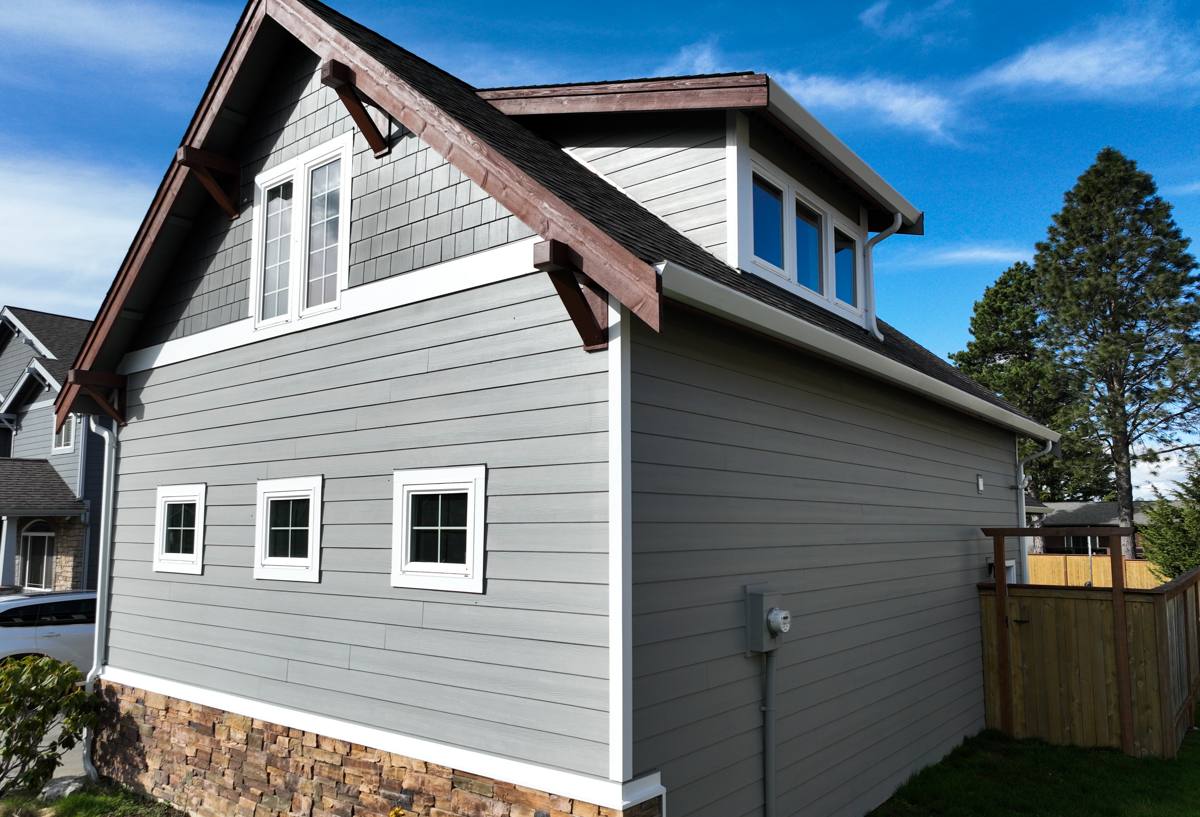
What the Climate Actually Does to Siding
Salt Air and Coastal Moisture
Homes closer to Bellingham Bay get low-level salt exposure carried in on the wind. It's not the same intensity as an oceanfront property, but it's enough to accelerate corrosion on unprotected fasteners, staples, and cheaper metal trim over the years. Combined with the region's humidity, that salt exposure speeds up the breakdown of materials that aren't rated for sustained moisture contact.
Driving Rain
Whatcom County doesn't get the heaviest rainfall totals in the state, but it gets a lot of wind-driven rain — the kind that hits siding at an angle instead of falling straight down. That matters because driving rain finds every gap in flashing, every unsealed seam, and every spot where a butt joint wasn't installed correctly. Materials that swell, warp, or absorb water when saturated are put to the test repeatedly through a typical Bellingham winter.
Moss and Algae Season
Shaded walls, north-facing exposures, and homes tucked under mature trees hold moisture longer, and that's exactly what moss and algae need to get established. Once organic growth takes hold on a wall, it holds even more moisture against the surface underneath it, which becomes a compounding problem on materials that aren't dimensionally stable or that trap moisture behind their finish.
Freeze-Thaw Cycling
Bellingham doesn't see extreme cold most winters, but it does see enough freeze-thaw cycling — nights below freezing followed by wet, warmer days — to stress any siding material that has absorbed moisture. Water that gets into a seam or a cut edge and then freezes expands, and repeated cycles of that over a few seasons will open up cracks and joints that started out tight.
Why We Install Only James Hardie Fiber Cement
We made a deliberate decision as a company to install James Hardie fiber cement siding exclusively — not vinyl, not LP SmartSide, not cedar, not primed spruce, not other fiber cement brands. That's not a marketing angle; it's a standard we hold to because of what we've seen these materials do over time in exactly the climate Bellingham sits in.
Fiber cement is non-combustible, dimensionally stable, and doesn't swell or rot the way wood-based or engineered-wood products can when they take on repeated moisture exposure. James Hardie's HZ5 product line is engineered specifically for the kind of freeze-thaw and moisture conditions the Pacific Northwest sees, which is a meaningful distinction in a county like this one. The factory-applied ColorPlus finish also matters in a place with a long wet season — it's baked on under controlled conditions rather than field-applied, which gives it more consistent resistance to fading, chipping, and moisture intrusion at the finish layer than a job-site paint job can match.
We're not going to tell you every other siding product is worthless — vinyl and engineered wood both have legitimate use cases, and plenty of homes around here have them installed correctly and performing fine. What we will say is that when we weighed long-term moisture performance, fire resistance, and how a product holds up specifically in Whatcom County's marine climate against factors like upfront cost, we landed on Hardie as the one material we're willing to put our name behind for every install.
Full Exterior Services in Bellingham
Siding is our core focus, but exteriors don't fail in isolation — a roof leak eventually shows up as rot in the wall below it, and a failing window seal can wick moisture into the siding around it. We handle four exterior trades so that the whole envelope of your home gets looked at as one system rather than four unrelated projects:
- Siding: James Hardie fiber cement installation, including full re-sides and repair of storm or moisture damage.
- Roofing: Roof installation and repair, with attention to how roof drainage and flashing interact with the siding below.
- Windows: Replacement windows installed with proper flashing and integration into the surrounding siding, which is where a lot of leaks actually originate.
- Decks: Deck construction and repair built to handle the same wet-climate exposure your siding does.
When one crew is responsible for how these systems tie together — where the roof flashing meets the wall, where a window head flashing sits under the siding course above it — you get fewer of the gaps that show up when different trades install their piece without coordinating with the others.
How a Bellingham Siding Project Works
A siding replacement isn't just pulling off old material and nailing up new panels. In a climate like this one, what's underneath the siding matters as much as the siding itself.
1. Assessment
We start by looking at the existing siding, trim, and any visible signs of water intrusion — staining, soft spots, or areas where paint has failed and stayed failed. This tells us whether we're dealing with cosmetic wear or something that's already let moisture into the wall assembly.
2. Tear-Off and Sheathing Check
Once the old siding is off, we can see the wall sheathing directly. This is often the point where hidden rot or water damage from years of a marginal installation becomes visible, and it needs to be addressed before anything new goes back on the wall.
3. Weather-Resistive Barrier and Flashing
A correctly installed weather-resistive barrier and properly lapped flashing around every window, door, and penetration is what actually keeps driving rain out of the wall assembly. This step is invisible once the siding goes up, but it's the difference between a wall that sheds water and one that slowly absorbs it.
4. Installation to Manufacturer Spec
James Hardie siding has specific installation requirements — proper fastener spacing, correct clearances from grade and roof lines, and specific gapping at joints — that have to be followed for the product's warranty to apply and for it to perform the way it's designed to. This is a big part of why installation quality matters as much as the material choice itself.
5. Final Detailing
Trim, caulking at appropriate joints, and touch-up work finish the job. Done correctly, the finished wall should have clean, consistent lines and no exposed gaps where wind-driven rain can get behind the siding.
Comparing Siding Options in a Marine Climate
| Material | Moisture Behavior | Finish | Typical Lifespan Considerations |
|---|---|---|---|
| James Hardie Fiber Cement | Dimensionally stable, doesn't swell or rot from moisture exposure | Factory-baked ColorPlus finish | Long service life when installed to spec; strong transferable warranty |
| Vinyl | Doesn't rot but can warp or crack with temperature swings; seams can allow water behind panels | Color molded through, can fade over decades | Moderate; installation quality and material grade vary widely |
| LP SmartSide / Engineered Wood | Treated to resist moisture but still wood-based; edge and cut exposure is a vulnerability | Factory or field-applied, varies by product | Moderate; performance depends heavily on maintaining sealed edges and joints |
| Cedar / Primed Spruce | Absorbs moisture readily; prone to swelling, cupping, and rot without diligent upkeep | Field-applied paint or stain | Shorter without frequent refinishing; high maintenance burden in wet climates |
What Drives the Cost of a Siding Project
Every Bellingham home is different, and we don't quote sight-unseen, but these are the factors that generally move a siding project's price up or down:
| Factor | Why It Matters |
|---|---|
| Home size and wall complexity | More square footage and more corners, dormers, or gables mean more material and labor |
| Extent of tear-off | Full removal of old siding costs more than installing over an already-sound substrate, but it also lets us inspect and fix what's underneath |
| Hidden sheathing or rot repair | Damage found once old siding comes off — common on older homes exposed to years of marine moisture — adds material and labor |
| Trim and detail level | Additional trim boards, corner details, and accent work add labor time |
| Access and site conditions | Steep lots, limited access, or multi-story walls affect equipment and labor needs |
What to Look for in a Local Contractor
Whatcom County has plenty of contractors who'll drive up from farther south for a job, but a crew that works this area regularly has a better feel for how local moisture, salt exposure, and moss patterns actually affect a wall over time. When you're vetting bids, it's worth checking on more than just price:
- Are they a certified James Hardie installer, and can they explain the manufacturer's spacing and clearance requirements without hesitating?
- Do they inspect and address sheathing condition, not just swap old siding for new?
- Is their bid itemized enough that you can see what's covered — tear-off, disposal, flashing, trim — versus what might be an add-on later?
- Do they carry proper licensing and insurance for work in Washington State?
- Can they show you examples of finished work in this climate, not just renderings or manufacturer stock photos?
- Are they willing to walk your specific home and point out problem areas rather than giving a generic quote over the phone?
Maintaining Your Siding Once It's Installed
Fiber cement siding is low-maintenance compared to wood, but "low-maintenance" doesn't mean "no maintenance," especially with the moss and algae pressure common around Bellingham.
- Rinse shaded, north-facing walls periodically to keep moss and algae from establishing.
- Keep gutters clear so overflow doesn't run down the siding face repeatedly.
- Trim back vegetation and tree branches that keep a wall section shaded and damp longer than the rest of the house.
- Watch caulked joints and trim seams for cracking or separation, and have them addressed before a wet season sets in.
- Have your siding and flashing checked periodically after major windstorms, which are common off the bay.
Ready to Talk About Your Home
Every Bellingham property faces this climate a little differently depending on tree cover, sun exposure, and proximity to the water, so there's no substitute for having someone look at your actual walls. If you'd like an honest assessment of your siding, roofing, windows, or deck, request a free, no-pressure estimate using the form below and we'll take it from there.