 Ferndale
 LP SmartSide Is a Real Product — Here's Why We Still Don't Install It
Homeowners in Ferndale ask us about LP SmartSide often enough that we think it deserves a straight answer instead of a sales pitch. LP SmartSide is an engineered wood siding product — strand-based substrate coated with resin and wax, then finished with a treated overlay. It's not a bad product on paper. It cuts easier than fiber cement, it's lighter to handle, and in dry climates it has a reasonable track record. The problem is that we don't install siding in a dry climate. We install it in Whatcom County, twelve miles off Bellingham Bay, where salt air, driving rain off the Strait of Georgia, and a moss season that runs most of the year put a very specific kind of stress on exterior building materials. That's the context this decision comes from, and it's worth explaining in detail rather than just posting a policy.
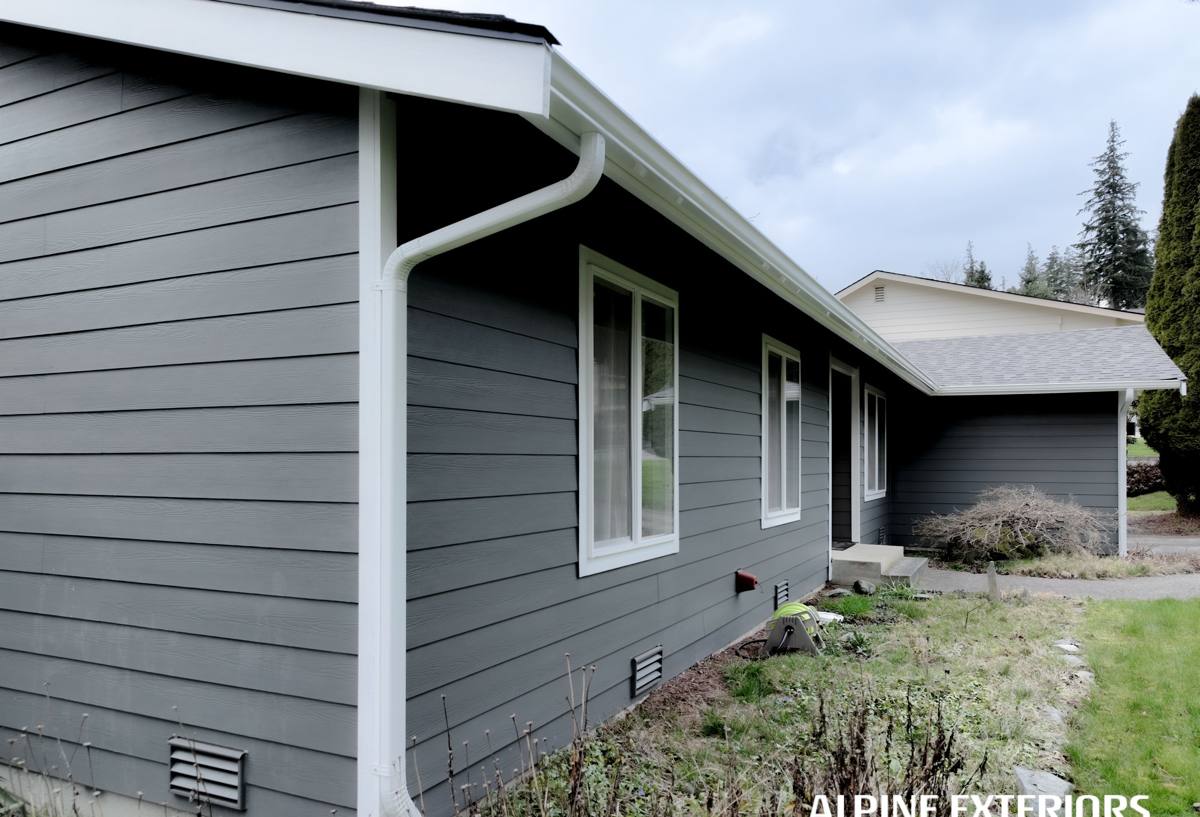
What LP SmartSide Actually Is
LP SmartSide is made from wood strands (not solid lumber) bonded with resin under heat and pressure, then coated with a zinc-borate treatment for insect and fungal resistance, and finished with a proprietary overlay meant to seal the surface. It comes in lap siding, panels, and trim, and it installs with standard carpentry tools and nail guns — no diamond blades, no silica dust protocols. For a crew, that's a real advantage in speed and ease of installation. For a homeowner, it's usually priced somewhat below fiber cement, which is part of why it gets asked about.
The engineering behind it has improved a lot since the OSB-based siding failures of the 1990s that gave engineered wood products a bad name industry-wide. LP has redesigned the product multiple times, and it carries a manufacturer warranty. We're not disputing any of that. Our concern isn't with the product's history — it's with how a wood-based substrate, however well engineered, behaves over decades in a marine climate when the factory seal is compromised at a cut edge, a fastener hole, or a joint that wasn't perfectly caulked and maintained.
The Core Issue: It's Still Wood at Its Core
Every engineered wood siding product shares one fundamental vulnerability that fiber cement doesn't have: the substrate itself is organic material that swells, and eventually decays, when it takes on sustained moisture. The factory coating is the entire line of defense. As long as that coating stays intact everywhere — including every field cut, every nail penetration, every seam — the product performs close to its rated life. The moment that seal is broken and moisture gets into the strand core repeatedly over time, you're dealing with swelling, edge softening, and in the worst cases active rot, and none of that is easily reversible or repairable in place.
Fiber cement doesn't have that failure mode. It's cement, sand, and cellulose fiber cured into a rigid board. It doesn't have an organic core that needs to stay sealed to survive — it can get wet and dry out without swelling or rotting. That single difference is the biggest reason we standardized on Hardie fiber cement rather than any engineered wood product, including LP's.
Why This Matters More in Ferndale Than in Drier Climates
In an inland, low-humidity market, an engineered wood product with a good factory finish can go a long time between maintenance touch-ups because the coating simply isn't under constant assault. That's not the situation on the Whatcom County coast. Ferndale sits close enough to the water that salt-laden air is a routine part of the exterior environment, driving rain off the Strait of Georgia hits siding at an angle that plain vertical rainfall doesn't, and the long gray moss season here means north- and shade-facing walls stay damp for extended stretches every year. All three of those conditions attack a factory coating faster than a dry-climate installation ever experiences, and all three make consistent maintenance — caulking, touch-up paint, gutter and moss control — much more load-bearing to the product's long-term survival.
Maintenance Burden: The Trade-Off That Actually Matters
This is the practical heart of the decision. LP SmartSide's warranty and performance both depend on the homeowner keeping caulked joints, field cuts, and fastener heads properly sealed and painted on an ongoing schedule. Skip a cycle or two — which happens constantly with busy homeowners and rental properties — and you've created the exact condition (broken seal, trapped moisture, organic substrate) that the product is most vulnerable to.
Hardie fiber cement isn't maintenance-free either — it needs periodic repainting and the caulking still matters — but a maintenance lapse on Hardie doesn't risk substrate decay the way it does on an engineered wood product. That difference in what happens when maintenance gets deferred, not the day-one performance, is what drove our decision.
Side-by-Side: What We Weigh
| Factor | LP SmartSide | James Hardie Fiber Cement |
|---|---|---|
| Core material | Engineered wood strand | Cement, sand, cellulose fiber |
| Moisture response | Can swell/decay if seal is breached | Non-organic; doesn't rot |
| Combustibility | Combustible (wood-based) | Non-combustible |
| Factory finish | Resin/overlay coating | ColorPlus baked-on finish, climate-engineered HZ lines |
| Maintenance sensitivity | High — cut edges and joints must stay sealed | Moderate — standard repaint cycle |
| Marine/coastal track record | Improved, but shorter and more coating-dependent | Extensive, formulated for wet climates |
| Installed cost | Generally lower | Moderate premium |
Installation Sensitivity Is Part of the Problem
LP SmartSide's performance is unusually dependent on installation details getting done right every single time: every field-cut edge sealed before it goes up, correct nailing depth so heads don't crush the coating, proper clearance off decks and grade, and flashing details that keep water from sitting against a cut edge. Those requirements aren't unique to LP, but the consequence of getting them wrong is more severe than it is on fiber cement, because the failure mode is substrate decay rather than just cosmetic wear. We install a lot of siding, and we know how much installation quality varies across crews and across a multi-week job in Pacific Northwest weather. We'd rather stand behind a product that's more forgiving of the field conditions we actually work in than one where a missed edge seal on day three of the install becomes a moisture problem five years out.
Combustibility Is a Real Factor Too
It gets less attention than moisture behavior, but it's worth stating plainly: LP SmartSide is a wood-based product and is combustible, while James Hardie fiber cement is non-combustible. For most Whatcom County homeowners this isn't a wildfire-zone concern the way it is east of the Cascades, but it's still a legitimate difference in fire performance, and some insurers reflect that in premiums. We don't oversell this point — it's one factor among several — but it's part of an honest comparison.
Where LP SmartSide Genuinely Makes Sense
To be fair to the product: LP SmartSide has real advantages for certain projects. It's lighter and easier to install on structures where reduced dead load matters, it takes fasteners and cuts without special tools or dust control, and in climates without heavy coastal moisture exposure, well-maintained installations perform reasonably well over a normal ownership horizon. If you're building somewhere dry and you're committed to a disciplined maintenance schedule, it's not an irrational choice. We simply don't think it's the right fit for the specific combination of salt air, driving rain, and prolonged damp moss season that defines exterior conditions in Ferndale and the rest of Whatcom County, and as installers, we only put our name behind work we're confident will hold up here.
What We Install Instead: James Hardie
We install James Hardie fiber cement exclusively, and the HZ5 product line specifically, which Hardie engineers for the freeze-thaw and moisture cycling common to the Pacific Northwest. A few reasons this is where we land:
- Non-organic core — no substrate decay risk from moisture the way wood-based products carry
- Non-combustible — a meaningful difference in fire performance, independent of climate
- ColorPlus factory finish — baked-on color that resists fading and chipping better than field-applied paint, reducing (not eliminating) repaint frequency
- Climate-engineered product line — HZ5 is formulated for the exact wet, coastal conditions we install in
- Strong transferable warranty — backed by a manufacturer with decades of fiber cement manufacturing behind it
- Proven longevity — a long track record on coastal Pacific Northwest homes when installed to Hardie's spec
Installing one product line well, and understanding its details cold, produces better outcomes than installing several products at a surface level. That's the reasoning behind going all-in on Hardie rather than offering a menu of siding brands.
What We'd Tell You to Check Before You Decide
Whatever siding you're considering, a few questions cut through most of the marketing:
- What happens to this product's core material if water gets past the surface finish?
- What does the manufacturer warranty actually require of you to stay valid — and is that maintenance realistic for your household?
- How does the product perform specifically in a marine, high-moisture climate, not just a national average?
- How sensitive is the installed result to field-cut sealing, fastener depth, and flashing detail?
- Is the finish factory-applied or field-applied, and how does that affect repaint frequency?
Get an Honest Look at Your Project
We're not trying to talk anyone out of a product that's right for their situation — we're explaining why, for the climate we work in, we've chosen to install one system and install it well. If you're planning a siding project in Ferndale or anywhere else in Whatcom County, we're happy to walk your home, talk through what we see, and give you a straightforward, no-pressure estimate for Hardie fiber cement siding. Use the form below to get started.