 Ferndale
 The Question Every Homeowner Eventually Faces
At some point, almost every siding job in Ferndale starts with the same question: is this a repair or a replacement? A cracked board, a soft spot near a downspout, or a patch of paint that won't stop peeling can mean very different things depending on what's happening behind the surface. Answering it correctly matters, because fixing the wrong problem — or replacing siding that only needed a repair — wastes money either way.
This page walks through how to tell the difference, what's specific to our climate here in Whatcom County, and how the answer changes depending on what your siding is made of.
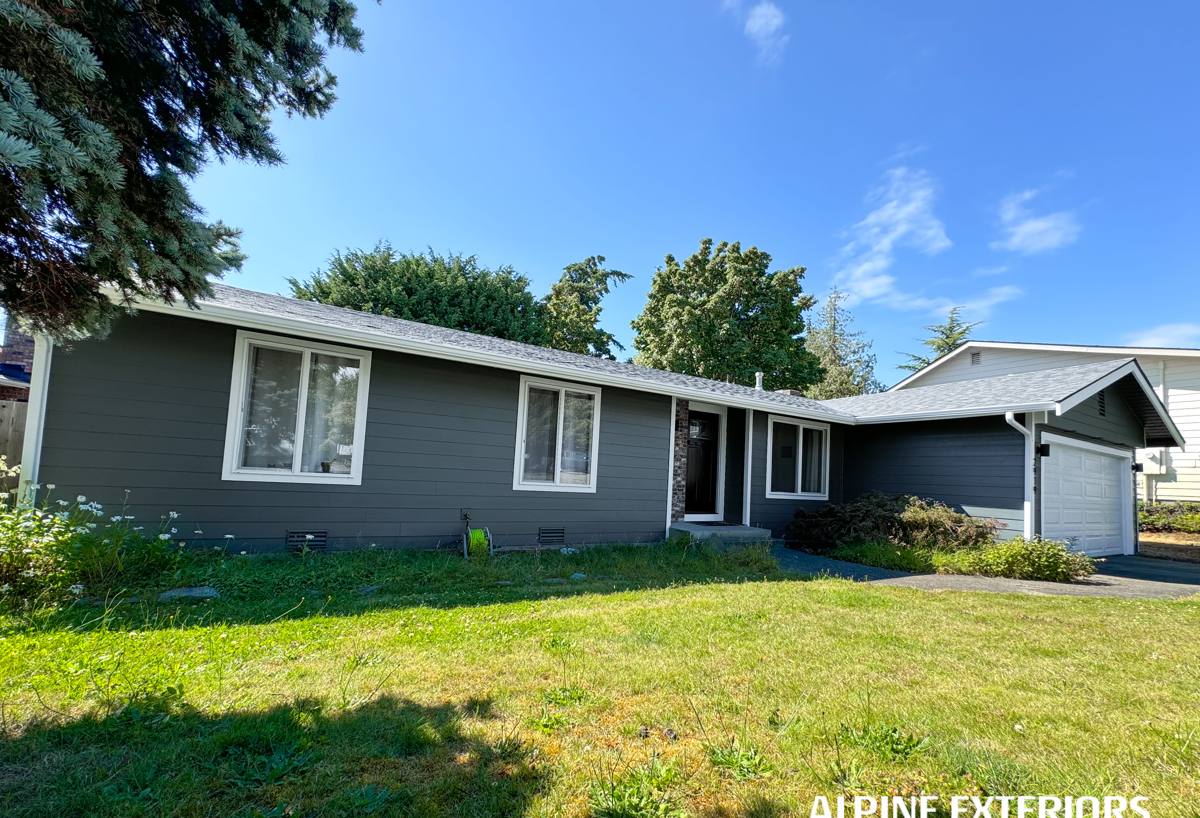
Why Ferndale's Climate Makes This Call Harder
Siding here takes a different kind of beating than siding in a dry inland climate. We get salt-laden air off the Strait of Georgia and Bellingham Bay, long stretches of driving rain that hits west- and south-facing walls at an angle, and a moss and algae season that can run eight or nine months out of the year in shaded, north-facing spots. None of that is dramatic on its own, but it's relentless — and relentless moisture exposure is exactly what turns a small, fixable problem into a structural one if it sits unaddressed.
That combination is also why a repair decision that would be straightforward in Spokane or Yakima isn't always straightforward here. A hairline crack that would stay dry for months in eastern Washington can be wicking water into the wall assembly within a few rain cycles in Ferndale.
Signs Your Siding Just Needs a Repair
Not every problem is a sign of failure. Plenty of siding issues are localized, cosmetic, or the result of one specific event rather than systemic wear. Repair is usually the right call when:
- Damage is limited to one or two boards or panels, not spread across a wall
- The cause is identifiable and one-time — a ladder strike, a falling branch, a lawn equipment mishap
- The siding material itself is still sound where it isn't damaged, with no widespread softness or delamination
- Paint or caulk failure is surface-level and hasn't led to moisture intrusion behind the siding
- The siding is under 10-15 years old and otherwise performing as expected
In these cases, a targeted repair — replacing a board, resealing a joint, addressing a flashing detail — can extend the life of the siding for years without the cost of a full re-side.
Signs You're Looking at Replacement, Not Repair
Replacement becomes the more honest recommendation when the problem isn't isolated — it's systemic. Common triggers include:
- Soft, spongy, or crumbling siding in multiple locations, especially near the bottom of walls or under windows
- Persistent moss, algae, or mildew that keeps returning within weeks of cleaning
- Paint that won't hold, even after proper prep and quality product, across large sections of the house
- Visible warping, buckling, or gaps that have widened over more than one season
- Interior signs — musty odors, staining on interior walls, or soft drywall — that suggest moisture has been getting past the siding for a while
- Siding original to a home built more than 20-25 years ago, particularly if it's a wood-based composite product
When damage shows up in more than one area of the house, that's usually not bad luck — it's the siding telling you the whole system, not just a few boards, is losing its ability to shed water.
The Age Factor: How Old Is Too Old?
Age alone isn't a verdict, but it changes the math. Older siding has absorbed more freeze-thaw cycles, more UV exposure, and more of Whatcom County's rain than newer siding, so the same crack or gap represents more accumulated risk. It's also worth asking whether a manufacturer's warranty is still active, since a repair on siding that's already outside its warranty window carries none of that backstop if problems resurface.
There's also a practical matching problem with older siding: discontinued colors, discontinued profiles, and boards that have weathered unevenly compared to new material. A patch that's structurally fine can still look like a patch for the life of the house.
Repair vs. Replace by Siding Material
How repairable a siding problem is depends heavily on what the siding is made of. Some materials tolerate spot repairs well; others don't, because of how they're manufactured or how they fail.
| Material | How It Typically Fails | Repair Outlook |
|---|---|---|
| Vinyl | Cracking in cold, warping in heat, fading over time | Individual panels can often be swapped, but color-matching aged vinyl is difficult |
| Primed wood (spruce/pine lap) | Rot at joints and butt ends, paint failure, insect damage | Repairable early; once rot sets in it tends to spread faster than it can be patched |
| Cedar | Cupping, splitting, moisture absorption at end grain | Board-by-board repair is possible but labor-intensive and rarely matches weathered tone |
| LP SmartSide (engineered wood) | Edge swelling where cut ends or seams lose factory sealant | Fixable if caught early; swelling that's spread past the original damage point often signals wider seal failure |
| Fiber cement (James Hardie) | Rare — mostly impact damage or installation-error moisture entry | Individual planks replace cleanly without triggering wider material failure |
The pattern across most of these materials is the same: the more a product depends on an intact surface coating or factory seal to keep water out, the more a small breach can turn into a widespread problem once that seal is compromised in more than one place.
What a Proper Inspection Should Cover
Before committing to either path, a real inspection — not a quick look from the driveway — should check:
- Moisture readings at suspect areas, not just visual assessment
- Condition of the wall behind the siding at any spot where siding is removed, including sheathing and framing
- Flashing and caulking at windows, doors, and penetrations, which cause a large share of "siding" failures that aren't actually about the siding itself
- Whether damage patterns cluster on specific exposures (west/south walls, areas under gutters, north-facing shaded zones)
- Overall condition of trim, fascia, and any areas where two materials meet
This last point matters more than homeowners expect: a lot of siding replaced "because it was failing" turns out to have been failing because of a flashing detail or gutter overflow, not the siding material itself. Fixing the water source and repairing the siding can sometimes solve what looked like a replacement-level problem.
A Practical Decision Framework
When the answer isn't obvious, weighing a few cost and risk factors side by side tends to clarify things quickly.
| Factor | Leans Toward Repair | Leans Toward Replacement |
|---|---|---|
| Extent of damage | Contained to one area | Present on multiple walls or elevations |
| Underlying material condition | Sound apart from the damaged section | Soft, delaminating, or degraded broadly |
| Age of siding | Under 10-15 years | Over 20-25 years or original to an older home |
| Moisture history | No signs of past water intrusion | Repeated moisture issues or interior staining |
| Cost over 5-10 years | Repair cost is a small fraction of full re-side | Repeated repairs are approaching replacement cost anyway |
That last row deserves attention. Homeowners sometimes stack two or three "small" repairs a year over several years without tallying the total. At a certain point, the honest comparison isn't repair cost versus replacement cost — it's cumulative repair cost versus a one-time replacement that also resets the clock on warranty coverage and appearance.
When Replacement Is the Right Call, Here's Our Standard
When an inspection points toward replacement rather than another round of patching, the product decision matters as much as the labor. We install James Hardie fiber cement siding exclusively, for reasons that connect directly to everything above: it's non-combustible, it holds a factory-applied ColorPlus finish that doesn't rely on field-applied paint to keep its color, and Hardie's HZ5 product line is engineered specifically for the kind of wind-driven rain and moisture exposure that's normal in a Pacific Northwest climate like ours. It also carries a strong transferable warranty, which matters most exactly in the situation this page is about — a future owner or future contractor doing an inspection years down the road.
We don't say that to talk down every other material listed above. Vinyl, cedar, and engineered wood all have legitimate uses and reasonable homeowners choose them for good reasons. But when we're the ones standing behind the installation, we've standardized on the product that gives Ferndale homes the best odds of never having this repair-or-replace conversation again for a very long time.
Getting a Straight Answer for Your House
The honest version of this page is that no article can tell you, from a distance, whether your specific siding needs a patch or a full tear-off. That takes someone standing at the wall with a moisture meter, pulling a board if needed, and looking at what's actually happening behind the surface. If you're seeing any of the warning signs above — or you're just not sure which category your house falls into — we're happy to take a look and give you a straight answer, whether that answer is "this is a simple repair" or "here's what full replacement would look like." Reach out for a free, no-pressure estimate and we'll walk the house with you.