 Ferndale
 Exterior Work in Sudden Valley
Sudden Valley sits in a different kind of exposure than a lot of Whatcom County neighborhoods. Tucked along Lake Whatcom with heavy tree cover and a lot of elevation change from lot to lot, homes here deal with a specific combination of shade, humidity, and moisture that doesn't dry out the way a more open, sun-exposed property would. Add in the driving rain that rolls through the county for much of the year and the salt-tinged air that reaches inland from the Puget Sound side of the region, and you've got an exterior environment that punishes shortcuts. Ferndale Siding works throughout Whatcom County, and Sudden Valley is one of the areas where we see, consistently, how much the local climate matters to a siding, roofing, window, or deck decision.
This page is about what that climate does to a home over time, how we approach exterior work for a property like this, and why we standardized on one siding product instead of offering the usual menu of options.
What the Climate Does to Homes Here
Shade, moisture, and moss
Tree cover is part of what makes a wooded, lake-adjacent community appealing, but it also means less direct sun on roofs and siding, longer drying times after rain, and a moss season that can run for much of the year rather than just a few winter months. Moss and algae hold moisture against a surface long after the rain has stopped, and on porous or absorbent siding materials that constant dampness is what eventually leads to swelling, soft spots, and paint failure. On roofs, moss buildup traps water under shingles and shortens the life of the roofing system. A north-facing wall or a roof slope shaded by mature trees will always need more attention than a sun-exposed one, and that's true on nearly every property we look at in this part of the county.
Driving rain and wind-driven moisture
Whatcom County doesn't just get a lot of rain — a good portion of it comes in sideways during fall and winter storms. Wind-driven rain finds every gap in flashing, every failed caulk joint, and every seam where siding wasn't lapped correctly. It's a slower kind of damage than a wind event that rips something off, which is part of why it's so often missed until there's a stain on an interior wall or soft trim board outside.
Salt air and coastal influence
Ferndale and the surrounding lowlands sit close enough to Bellingham Bay and the Strait of Georgia that salt-laden air is a real factor for exterior materials, and Sudden Valley isn't immune to it even with the lake and tree buffer. Salt air accelerates corrosion on fasteners and metal flashing and speeds up the breakdown of finishes that aren't built to handle it. It's a slower, cumulative effect — the kind of thing that shows up as premature fading, chalking, or rust bleed years before you'd expect it on a comparable inland home.
Siding: Why We Only Install James Hardie
We get asked fairly often why we don't offer vinyl, LP SmartSide, or other fiber cement brands alongside James Hardie. The honest answer is that we looked at how each of those products actually performs over 15-20 years in a climate like this one, not just what they cost or look like on install day, and we decided we'd rather stand behind one product we trust completely than offer a menu that includes options we have reservations about.
Vinyl siding
Vinyl is inexpensive and easy to install, and that's a legitimate advantage for some budgets and some climates. But it's a thin plastic product that expands and contracts significantly with temperature swings, and in a wet, moss-prone, tree-shaded environment it doesn't hold up the way a denser material does. Seams and J-channels give moisture a path behind the panel, and once that happens, vinyl doesn't tell you — there's no visible sign until rot has already set into the sheathing underneath.
LP SmartSide and other engineered wood
Engineered wood siding has improved a lot over the decades, but it's still a wood-based product at its core, and wood-based products are more vulnerable to the exact conditions Sudden Valley has in abundance: sustained moisture, shade, and long dry-out times. Edge swelling and delamination at cut ends and seams are the failure points we see most, and they're harder to catch early in a shaded, moss-prone setting where a wall stays damp longer after every rain.
Other fiber cement brands
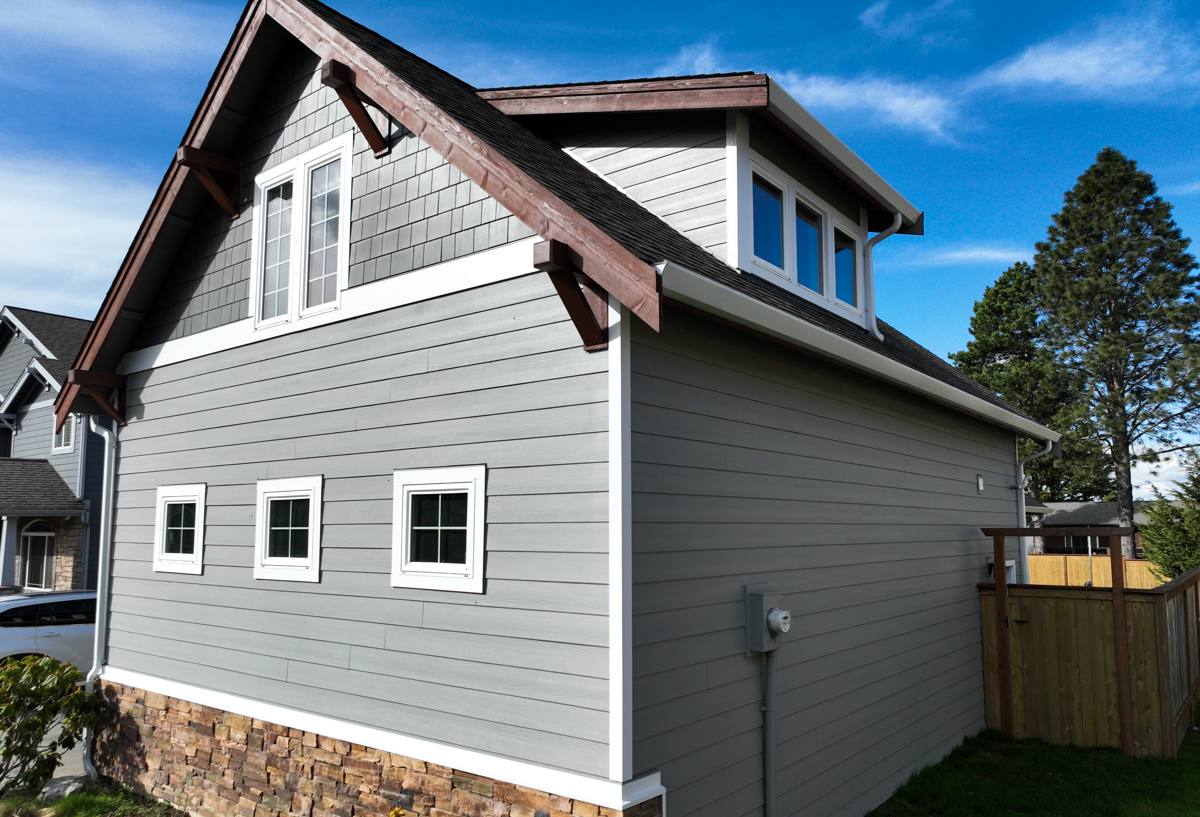
Cemplank and Allura are legitimate fiber cement products, and fiber cement as a category is the right call for this climate — it's non-combustible, dimensionally stable, and doesn't feed moss and mildew the way wood-based products can. Where we've landed is on James Hardie specifically, because of their ColorPlus factory-baked finish, their HardieZone engineering for regional climate conditions, and the depth of installer training and warranty backing behind the product. When we're going to stand behind our own installation for decades, we want the material underneath that installation to be one we have full confidence in.
What James Hardie gets right for this area
- Fiber cement composition resists moisture absorption far better than wood-based siding, which matters in a shaded, moss-heavy environment
- Non-combustible material, a genuine advantage during regional wildfire smoke and ember seasons
- ColorPlus factory finish resists fading and chalking better than field-applied paint, which matters under salt-influenced air
- HZ10 product engineering is built for the Pacific Northwest's wet, moderate climate specifically
- A strong, transferable manufacturer warranty backed by correct installation
Roofing in a Shaded, Moss-Prone Setting
Roofing takes the brunt of Sudden Valley's tree cover and moss pressure. A roof under heavy shade will grow moss faster than an open one regardless of material, and moss left unaddressed lifts shingle edges, holds water against the roof deck, and shortens the service life of even a well-installed system. Proper ventilation, correctly lapped underlayment, and flashing detail at every valley and penetration matter more here than they would on a sun-exposed, open lot, because there's less natural drying to compensate for any weak point in the installation. We look at ventilation and moisture management as part of any roofing conversation in this neighborhood, not as an afterthought.
Windows: Sealing Out Driving Rain
Older windows in wind-driven rain conditions are a common source of the water intrusion we get called out for — not because the glass fails, but because the flashing and sealant around the frame have degraded. Replacement windows with proper flashing integration and quality weatherstripping make a real difference in a property that takes rain from multiple directions across the seasons. We pay particular attention to how a new window ties into the existing wall assembly, since a beautiful window installed with a poor moisture barrier behind it just relocates the problem.
Decks: Built for Shade and Standing Moisture
Decks in shaded, tree-covered settings deal with the same slow-drying conditions as siding and roofing, plus the added factor of standing water on horizontal surfaces. Composite decking resists moisture absorption and doesn't feed moss the way wood does, and proper substructure ventilation and drainage detail keep water from pooling under the deck boards where it can't evaporate. For homeowners who prefer real wood decking, we talk through the maintenance commitment honestly — sealing schedules and moss treatment are more frequent in a shaded lakeside lot than they would be for a comparably sized deck out in the open.
Comparing Siding Options for This Climate
| Factor | Vinyl | Engineered Wood (LP) | Other Fiber Cement | James Hardie |
|---|---|---|---|---|
| Moisture resistance in shade | Moderate; hidden seam risk | Lower; edge swelling risk | Good | Good, HZ10-engineered |
| Moss/algae resistance | Fair | Fair to poor | Good | Good |
| Fire resistance | Poor | Fair | Non-combustible | Non-combustible |
| Finish durability (salt air) | Fades over time | Depends on paint quality | Varies by brand | ColorPlus factory finish |
| Typical install cost | Lower | Mid | Mid to upper-mid | Upper-mid |
What a Sudden Valley Estimate Looks Like
Because lots here vary so much in tree cover, slope, and sun exposure, no two properties get the same recommendation. When we come out, we're looking at things like:
- How much of the exterior sits in consistent shade versus direct sun
- Visible moss or algae growth on siding, roofing, or decking, and how far it has spread
- Signs of moisture behind siding seams, trim, or window frames
- Flashing and sealant condition around windows, roof penetrations, and deck ledger boards
- Fastener and metal condition, given the coastal-influenced air in the broader Ferndale area
- Drainage and grading around the foundation, since standing water at the base of a wall compounds every other issue
Why a Local Crew Matters Here
Sudden Valley's mix of shade, elevation, and lake-effect moisture isn't something a crew unfamiliar with Whatcom County reads correctly on a first visit. Knowing which walls hold moisture longest, how aggressive the moss season really gets under mature tree cover, and how the region's driving rain patterns stress flashing and seams comes from working these properties repeatedly, not from a general playbook. As a Ferndale-based company, we're not driving in from out of the area for a one-off job — we're working in this climate on a regular basis, which is exactly the kind of local knowledge that keeps a Hardie installation performing the way it's designed to for the long haul.
If you're weighing a siding, roofing, window, or deck project in Sudden Valley, we're happy to take a look and walk through what we're seeing on your specific property. Reach out for a free, no-pressure estimate using the form below.