 Ferndale
 Fairhaven sits close enough to Bellingham Bay that the weather off the water shapes almost every exterior decision a homeowner makes here. Salt-laden air, wind-driven rain coming off the Sound, and a moss season that can stretch from October well into spring all put steady pressure on siding, roofing, trim, and anything wood-based on a house. Our crew works this stretch of Whatcom County regularly, and Fairhaven's building stock — a mix of older coastal homes and newer infill construction — gives us a good read on what actually holds up here and what quietly fails behind a fresh coat of paint.
This page covers how we approach siding, roofing, windows, and decks for homes in the Fairhaven area, why we install only James Hardie fiber cement siding, and what local homeowners should know before starting an exterior project.
What Fairhaven's Climate Does to a House
Being near the water is part of what makes Fairhaven a desirable place to live, but that same proximity is hard on exteriors. A few things we see consistently:
- Salt air corrosion — fasteners, flashing, and metal trim near the bay corrode faster than the same materials a few miles inland.
- Driving rain — wind off the water pushes rain sideways into wall assemblies, not just straight down, which stresses siding laps, seams, and window flashing differently than a typical rain event.
- Moss and algae — the long, damp, low-sun stretch of the year lets moss establish on roofs and north-facing siding, and it holds moisture against the surface long after a storm passes.
- Wood rot at the edges — trim boards, fascia, and any wood-based siding product tend to fail first at butt joints, corners, and anywhere caulk has to do the work of keeping water out.
None of this is unique to Fairhaven, but the combination — salt, wind-driven rain, and a long moss season — is more concentrated here than it is further inland in Whatcom County, and it's worth planning around rather than ignoring.
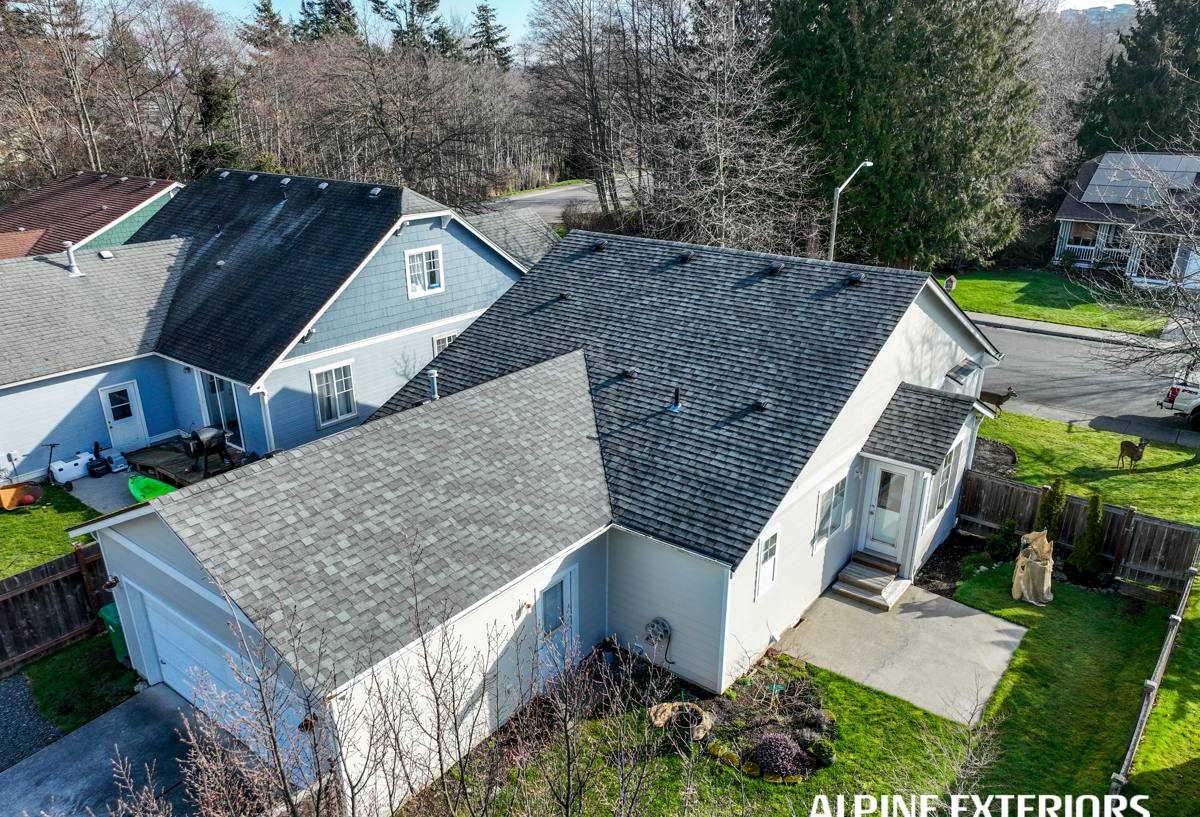
Why We Install Only James Hardie Siding
We get asked fairly often why we don't offer vinyl, LP SmartSide, or other fiber cement brands. The honest answer is that after years of doing exterior work in this climate, we standardized on one product because it holds up more predictably than the alternatives, and we'd rather stand behind one system we know well than juggle several we don't.
What Hardie Gets Right for This Climate
- Non-combustible — fiber cement doesn't burn, which matters as wildfire smoke and dry-season risk have become a bigger concern across Western Washington summers.
- Moisture-stable — fiber cement doesn't swell, delaminate, or absorb water the way wood-based products can at cut edges and seams.
- Factory-applied ColorPlus finish — the color is baked on at the factory under controlled conditions, which holds up better against salt air and UV than field-applied paint, and touch-up is simple rather than a full repaint.
- Climate-engineered HZ product lines — Hardie makes region-specific formulations, and the HZ5 line is built for the freeze-thaw and moisture profile of the Pacific Northwest.
- Strong transferable warranty — a long manufacturer warranty that can transfer to the next owner, which matters if you sell within the coverage period.
Why We Don't Install the Alternatives
Vinyl siding is inexpensive and low-maintenance in theory, but it's a plastic product that can warp in direct sun, crack in cold snaps, and doesn't hold paint if a homeowner ever wants to change the color. LP SmartSide and other engineered wood products perform reasonably well when installation is flawless, but they're wood at the core — any gap in the finish or caulking at a seam becomes a path for moisture, and once wood-based siding starts to swell or delaminate at an edge, it doesn't recover. Given how much wind-driven rain this area sees, that sensitivity to installation quality is a bigger risk than we're willing to take with a client's home. We're not saying these products are without merit — they work fine in the right conditions with perfect upkeep — we're saying we'd rather install one product correctly, every time, than manage the trade-offs of several.
Siding Installation Done Right
Fiber cement siding is only as good as the installation behind it. A large share of the siding failures we're called out to inspect trace back to installation shortcuts, not the product itself.
What Correct Installation Involves
- Proper weather-resistive barrier and rainscreen or drainage gap behind the siding, especially important given how much wind-driven rain this area gets
- Correct fastener type, spacing, and depth — over-driven nails are one of the most common causes of premature siding failure
- Flashing integrated correctly at windows, doors, and roof-to-wall transitions, not just caulked over
- Proper clearance from grade, decks, and roof lines to keep splash-back and standing water away from the bottom course
- Factory-mitered or properly sealed joints, since seams are where moisture problems start
We follow Hardie's published installation specifications closely, because doing so is also what keeps the manufacturer warranty valid — a warranty is only as good as the install underneath it.
Roofing Services for Fairhaven Homes
Roofs in this area deal with the same moss and moisture pressure as siding, plus direct exposure to wind and rain off the bay. We handle roof replacement and repair with attention to the details that matter most in a coastal-influenced climate: proper underlayment, ice-and-water protection at valleys and eaves, ventilation that actually moves moist attic air out, and flashing details at every penetration and wall transition. A roof that sheds water well but traps moisture in the attic will still cause problems — ventilation is not an afterthought here.
Windows That Hold Up to Wind-Driven Rain
Window failures in this area are rarely about the glass — they're about flashing and installation. A window can be top-rated for energy efficiency and still leak if it isn't flashed to shed water correctly against wind-driven rain. When we replace windows, we pay close attention to how the new unit integrates with the surrounding wall assembly and siding, not just the window itself.
Decks Built for a Wet Climate
Decks take a beating from the same moisture and moss pressure as siding and roofing, plus the added stress of standing water pooling on horizontal surfaces. Proper spacing between boards, ledger flashing where the deck meets the house, and material choices that resist rot and moss growth all matter more here than in a drier climate. We build and repair decks with drainage and long-term maintenance in mind, not just how they look on day one.
Comparing Siding Options for a Fairhaven Home
| Factor | James Hardie Fiber Cement | Vinyl | Engineered Wood (e.g. LP SmartSide) |
|---|---|---|---|
| Salt air / moisture resistance | Strong — non-organic, stable material | Doesn't rot, but can warp/crack with temperature swings | Wood-based; vulnerable at cut edges and seams |
| Fire resistance | Non-combustible | Melts/deforms under heat | Combustible |
| Finish durability | Factory ColorPlus finish, long fade resistance | Color molded in, can fade unevenly | Field-applied paint, needs more frequent upkeep |
| Installation sensitivity | Moderate — must follow spec for warranty | Low — but expansion gaps critical | High — any gap in finish invites moisture |
| Warranty | Long, transferable manufacturer warranty | Varies by manufacturer | Varies; often shorter on finish |
What to Know Before You Start a Project
Questions Worth Asking Any Contractor
- Are they licensed and insured to work in Washington, and can they show proof without hesitation?
- Do they follow the manufacturer's published installation specifications, or their own shortcuts?
- Will the manufacturer warranty stay valid with their installation method, and is that documented?
- Do they have experience specifically with coastal-influenced conditions, not just general siding work?
- Will they give you a written scope, not just a verbal estimate?
Signs Your Current Siding Needs Attention
- Soft or spongy spots when pressed, especially near the bottom courses or corners
- Persistent moss or dark streaking that returns quickly after cleaning
- Visible gaps, cracking, or separation at seams and butt joints
- Paint that's peeling or bubbling rather than just fading
- Rising energy bills that might point to a compromised weather barrier
Why a Local Crew Matters
Exterior work in Whatcom County isn't the same job as exterior work in a drier, inland climate. A crew that works this area regularly knows to plan around the wet season, understands how wind off the bay affects flashing and rainscreen decisions, and has seen firsthand what moss and salt air do to different products over time. That local familiarity shows up in the details — where extra flashing goes, how much drainage gap to leave, which corners genuinely can't be cut in this climate even if they'd be fine somewhere drier.
If you're weighing a siding, roofing, window, or deck project for a home in the Fairhaven area, we're happy to take a look and talk through what your house actually needs. Reach out for a free, no-pressure estimate using the form below.