 Ferndale
 Serving the Cordata Area Out of Ferndale
Cordata sits in that stretch of Whatcom County where marine air off Bellingham Bay meets the rolling farmland and tree cover that surrounds Ferndale. It's a mixed neighborhood — newer subdivisions next to older single-family homes, a lot of vinyl and wood siding from different building eras, and a housing stock that has all seen the same weather for years: long wet winters, short bright summers, and a fall-through-spring stretch where the moss never really stops growing. We're based in Ferndale and treat Cordata as one of our regular service areas, not an afterthought tacked onto a route between bigger jobs.
That distinction matters more than it sounds. A crew that works this specific corner of Whatcom County day in and day out knows how the exposure changes block to block — which homes catch more wind-driven rain, which ones sit low and stay damp longer, which roof lines create runoff patterns that punish siding at certain corners. That's not something you get from a general contractor who swings through once a year.
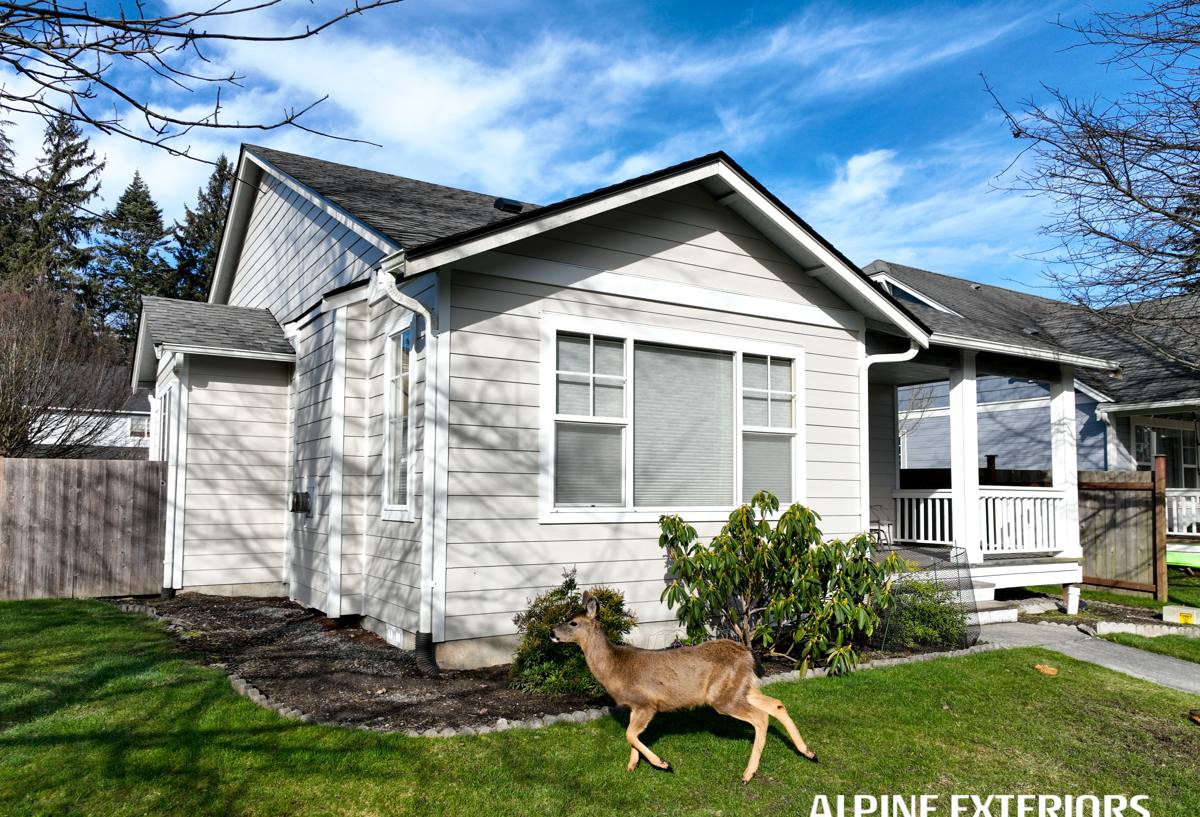
What the Climate Does to Cordata Homes
Three things drive almost every siding and exterior problem we see in this area: salt-tinged marine air, driving rain that comes in sideways off storms tracking through the Strait of Georgia and Bellingham Bay, and a moss season that, realistically, runs most of the year in shaded or north-facing spots.
Salt Air and Slow Corrosion
Homes closer to the water deal with airborne salt that settles on exterior surfaces and accelerates corrosion of fasteners, flashing, and any exposed metal trim. It also breaks down cheaper paint films faster than inland homes ever experience, which is why a lot of older siding in this area looks chalky or faded well before it should.
Driving Rain
This isn't gentle Pacific Northwest drizzle. Storms here regularly push rain horizontally against west- and southwest-facing walls, which stresses every seam, joint, and butt edge in a siding system. Products and installation details that work fine in a drier climate — looser caulking tolerances, minimal flashing, tight-to-the-ground clearances — fail faster here because the water is actively being pushed into every gap, not just falling on it.
Moss, Algae, and Constant Moisture
Shaded lots, mature trees, and short winter daylight mean a lot of exterior surfaces in Cordata simply don't dry out for months at a time. That's ideal growing conditions for moss and algae, which hold moisture against the siding surface and, over years, accelerate rot in anything wood-based and staining in anything with a weak factory finish.
Why We Only Install James Hardie Fiber Cement
We get asked regularly why we don't offer vinyl, LP SmartSide, cedar, or primed spruce siding as options. The honest answer is that we looked at how each of those products actually performs over 15-20 years in exactly the conditions Cordata deals with, and we didn't want to keep repairing or replacing what we'd installed a decade earlier.
- Vinyl can warp and fade under UV and temperature swings, and its seams are a weak point against driving rain — water can work behind panels over time in high-exposure areas.
- LP SmartSide and other wood-strand products perform well when installation and caulking are perfect and stay perfect, but any breach in that seal in a climate this wet lets moisture into the wood fiber core, and that's a slow, hard-to-catch failure.
- Cedar and primed spruce are genuinely attractive materials, but they need active maintenance — restaining, recaulking, repainting — on a schedule most homeowners don't keep up with, and moss/algae exposure here shortens that maintenance window further.
James Hardie fiber cement is non-combustible, doesn't absorb moisture the way wood-based products do, and comes from the factory with a ColorPlus finish that's baked on and warrantied against fading — which matters directly here, since UV and salt air are exactly what breaks down field-applied paint fastest. It's not the cheapest option on day one, but it's the one we're willing to stand behind for the long run in this specific climate.
What We Actually Install
We work across Hardie's product lines depending on the home and budget, and we're glad to walk through the differences during an estimate rather than push one product blindly.
| Product Line | Best For | Notes for This Climate |
|---|---|---|
| HardiePlank Lap Siding | Most single-family homes | HZ10 formulation engineered for the Pacific Northwest's wet, cool climate |
| HardiePanel Vertical Siding | Modern or mixed-material facades | Clean lines, works well paired with accent materials on gables |
| HardieShingle | Craftsman or cottage-style homes | Shingle look without the moisture and moss issues of real wood shingles |
| HardieTrim | Corners, fascia, window trim | Matches durability of the field siding so trim doesn't fail first |
How a Siding Project Runs, Start to Finish
Every job follows roughly the same sequence, whether it's a single wall repair or a full re-side:
- On-site assessment — we look at existing siding condition, moisture damage, flashing details, and how the home is oriented to wind and rain.
- Removal and sheathing inspection — old siding comes off and we check the wall sheathing and framing underneath for rot before anything new goes on. This step catches problems a lot of homeowners don't know exist until it's exposed.
- Weather barrier and flashing correction — this is where a lot of the long-term performance actually gets decided. Proper house wrap, window and door flashing, and drainage planes matter more in driving-rain climates than the siding material itself.
- Hardie installation to manufacturer spec — correct fastener spacing, gapping, and caulking per Hardie's published installation guidelines, not shortcuts.
- Trim, caulk, and paint touch-up — factory ColorPlus finish means minimal field painting is needed, which is part of what keeps the finish consistent over time.
- Final walkthrough — we review the finished work with the homeowner before calling the job done.
Roofing, Windows, and Decks — the Rest of the Envelope
Siding doesn't work in isolation. A roof that's shedding granules or has failing flashing will dump water directly onto new siding and undo the benefit of the upgrade. Old windows with failed seals let moisture track into the wall cavity right next to fresh siding. And decks in this climate take the same driving-rain and moss exposure as walls, just horizontally, which is often worse.
Because we handle siding, roofing, windows, and decks as one crew, we can flag problems in one system that are actually going to undermine another — a roof edge dripping onto a wall, a window that needs re-flashing before new siding goes up around it, a deck ledger board that's been quietly rotting against the house. Homeowners who hire separate contractors for each often don't find out about these interactions until something fails.
Signs Your Exterior Needs a Closer Look
- Soft or spongy spots when you press on siding, especially near the bottom courses
- Persistent moss or algae staining that comes back within weeks of cleaning
- Visible gaps, warping, or buckling at siding seams
- Paint that's chalking, peeling, or fading unevenly on sun/rain-exposed walls
- Water stains on interior walls or ceilings near exterior corners
- Roof granules collecting in gutters or downspouts
- Window frames that feel damp or show discoloration at the sill
Why a Local Crew Matters More Than It Sounds
Whatcom County's microclimates aren't uniform, and Cordata's exposure isn't identical to Ferndale proper or the neighborhoods closer to the water. A crew that works this area regularly builds a feel for which walls need extra flashing attention, how much roof overhang actually helps against the driving rain pattern here, and where moss is going to come back no matter what you do to a north-facing wall shaded by trees. That local knowledge shows up in small decisions during installation that a traveling crew, working from a generic spec sheet, is more likely to miss.
It also matters for warranty follow-through. Hardie's product warranty and our installation workmanship are two different things, and if something needs a look five or ten years down the road, it helps to be dealing with a crew that's still local, still doing this work, and still standing behind what they installed.
Cost Factors to Expect
Every home is different, but a few factors consistently move the number on a Cordata-area estimate:
| Factor | Why It Matters |
|---|---|
| Home size and wall complexity | More corners, gables, and dormers mean more cutting, flashing, and labor time |
| Existing sheathing condition | Rot found during removal adds repair scope before new siding can go on |
| Product line selected | Lap, panel, and shingle profiles have different material and labor costs |
| Trim and accent work | Detailed trim packages add finish quality but also add time |
| Access and site conditions | Steep lots, mature landscaping, or tight setbacks can affect scaffolding and staging |
We give straightforward, itemized estimates rather than vague lump sums, so homeowners can see what's driving the cost before committing.
Getting Started
If you're in the Cordata area and dealing with aging siding, moss you can't seem to get ahead of, or you're just planning ahead for a home you want to stop worrying about, we're happy to come take a look. There's no pressure and no obligation — just an honest assessment of what your home actually needs and what it would take to fix it right. Reach out through the form below to schedule a free estimate.