 Ferndale
 Why Birch Bay Siding Wears Differently Than Inland Homes
Birch Bay sits right on the water, and that changes what siding has to survive out here. Homes a few miles inland in Ferndale deal with plenty of rain and moss, but they don't get the steady salt air coming off the bay or the wind-driven rain that hits waterfront and near-waterfront walls at an angle instead of straight down. That combination is harder on siding than either factor alone, and it's why repair calls in Birch Bay often look different from repair calls in town.
Salt air is corrosive to fasteners and trim metal, and it accelerates the breakdown of anything with a weak factory finish. Driving rain off the bay pushes moisture sideways into laps, seams, and butt joints that were only ever designed to shed water falling straight down. And Whatcom County's long, damp moss season means anything that stays wet gets a head start on organic growth — moss and algae hold moisture against the wall longer, which compounds every other problem. A repair that doesn't account for all three is a repair that comes back.
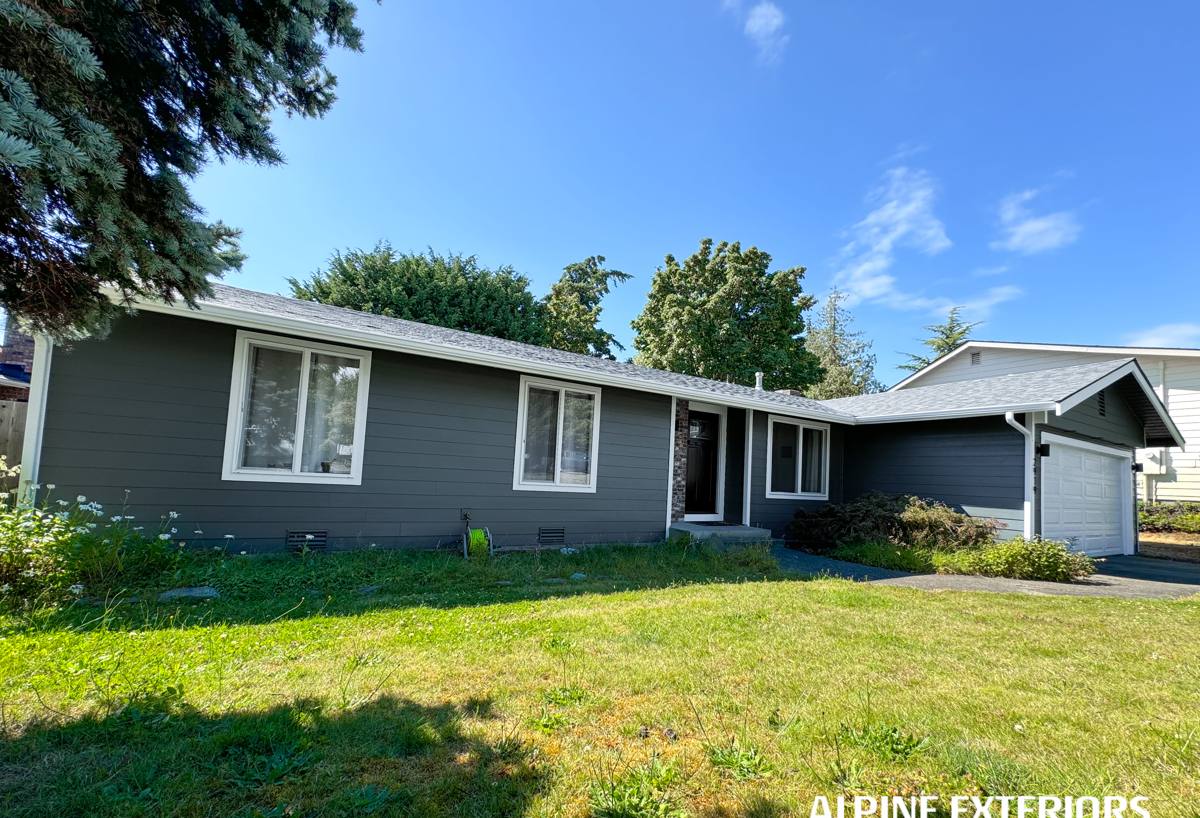
What We Actually Find When We Inspect Birch Bay Siding
Every repair call starts with figuring out why the siding failed in the first place, not just where. On Birch Bay homes specifically, we see a recurring set of issues tied directly to the coastal exposure:
- Fastener corrosion: nails or staples that were fine inland but rust and back out faster this close to salt water, leaving boards loose or cracked around the fastener head.
- Failed caulking at joints and trim: UV and salt air break down sealant faster here, and once a joint opens, wind-driven rain finds it immediately.
- Moss and algae staining that's masking rot: what looks like a cosmetic moss problem is sometimes hiding softened wood or degraded substrate underneath.
- Water intrusion at butt joints and corners: the wall assemblies most exposed to direct bay-facing wind take the brunt of driving rain, and factory-cut joints without proper flashing or sealant are the first to leak.
- Bottom-edge deterioration: siding installed too close to grade, decks, or hardscape holds splashback moisture longer in a marine environment than it would inland.
None of these are unusual problems for siding in general — but the pace at which they show up in Birch Bay is faster, and that's the detail an inland-based crew unfamiliar with the area can miss.
What a Correct Repair Actually Involves
Diagnose Before You Patch
The most common mistake in siding repair — anywhere, but especially here — is treating the visible damage as the whole problem. A cracked board or a stained section is usually a symptom. If water has been getting behind the siding through a failed joint or missing flashing, replacing just the damaged piece without fixing the entry point means the same failure shows up again in a season or two. A proper repair traces the moisture path back to its source: flashing, joint sealant, fastener pattern, or drainage at the base of the wall.
Match the Material and the Installation Method
We repair almost exclusively with James Hardie fiber cement, which is what we install new. Fiber cement doesn't rot, doesn't feed moss the way wood-based products can, and holds up to salt air and driving rain far better than primed wood or engineered wood siding. When we're repairing a home that already has Hardie on it, we match the existing profile and, where possible, the ColorPlus factory finish so the repair blends in rather than standing out as an obvious patch.
Rebuild the Water Management, Not Just the Cladding
Any repair on a bay-facing wall needs to restore — or improve — the drainage plane behind the siding: proper flashing at joints and penetrations, correct fastener placement per manufacturer spec, and sealant rated for exterior exposure. Skipping this step is how a "fixed" wall ends up with the exact same rot complaint eighteen months later.
Repair vs. Replacement: How We Make the Call
Not every issue calls for full replacement, and not every issue can be solved with a patch. Here's how we typically evaluate it:
| Situation | Likely Approach | Why |
|---|---|---|
| Isolated board damage, sound structure underneath | Targeted repair | Localized fix restores protection without disturbing sound siding elsewhere on the wall |
| Failed caulking/flashing at multiple joints, siding otherwise intact | Repair + water management rebuild | Addresses the actual cause of intrusion, not just the symptom |
| Moss staining with soft or spongy substrate over a wide area | Section or full replacement | Underlying rot usually extends beyond what's visible from outside |
| Older wood-based or vinyl siding with recurring bay-side failures | Full replacement recommended | Repeated patching on a product not built for this exposure rarely holds up long-term |
| Widespread fastener corrosion across a bay-facing elevation | Section replacement with corrosion-resistant fasteners | Corroded fasteners are a systemic issue, not a one-board problem |
Why We Only Repair and Install James Hardie
We don't install or repair-in-kind with LP SmartSide, vinyl, Cemplank, Allura, primed spruce, or cedar. That's a standard we hold across every job, and Birch Bay's exposure is a good example of why. Engineered wood products and primed wood siding depend on an intact factory coating and diligent maintenance to keep moisture out — any breach, and the substrate is wood, which softens and rots. Vinyl expands and contracts more than fiber cement and can distort or crack under sustained wind exposure, and its seams and fastening are more vulnerable to the kind of driving rain this stretch of coastline gets. Cedar looks great initially but requires ongoing sealing and refinishing to hold up anywhere, let alone in salt air.
James Hardie fiber cement is non-combustible, doesn't provide the same food source for moss and algae that wood-based products can, and its HZ product lines are engineered for specific climate zones — including the kind of wet, marine-influenced conditions Birch Bay sees. The ColorPlus factory finish is baked on and warrantied against fading and peeling, which matters a great deal in a location where UV and salt exposure are both working against a painted surface. When we repair a home, we want the fix to hold up as long as the rest of the wall — installing anything else would just set up the next repair call.
Our Process for Birch Bay Repair Calls
- On-site inspection of the affected area and a check of adjacent sections for related but less obvious damage
- Moisture and substrate check behind the visible siding to confirm whether rot or water intrusion extends further than what's showing
- Clear explanation of what we found, what caused it, and what the repair will involve — no surprise scope changes after the fact
- Repair using James Hardie fiber cement matched to existing profile and finish where possible
- Correction of the underlying cause — flashing, sealant, fastener pattern, or drainage — so the same failure doesn't recur
- Final check of surrounding trim and joints to make sure the repaired section integrates cleanly with the rest of the wall
What Homeowners Can Check Between Visits
You don't need to be an expert to catch early warning signs. A quick seasonal walk-around can catch problems while they're still small:
- Look for cracked, buckled, or visibly warped boards, especially on bay-facing walls
- Check caulking at joints, corners, and trim for cracking, gaps, or shrinkage
- Watch for moss or dark staining that seems to be spreading rather than staying put
- Press gently on any soft-looking or discolored siding — sponginess usually means moisture has gotten in
- Check fastener heads for rust streaks running down the siding face
- Note any area where splashback from a deck, downspout, or grade keeps the base of the wall consistently damp
Catching these early is the difference between a small, affordable repair and a section that's deteriorated enough to need full replacement.
Why Hiring Local Matters for This Job Specifically
Siding repair isn't a one-size-fits-all trade, and coastal repair work in particular rewards familiarity with the specific conditions of the site. A crew that works Ferndale and the Birch Bay area regularly has already seen how salt exposure, wind direction, and the local moss season interact on homes just like yours — which means less guesswork diagnosing the cause and a repair built to actually hold up in this environment, not a generic fix pulled from an inland job. We're a Whatcom County-based crew, and Birch Bay is part of our regular service area, not an occasional drive-by.
If you've got a section of siding that's cracked, stained, or just not holding up the way it should, we're happy to take a look. Reach out for a free, no-pressure estimate — we'll tell you honestly what we find and what it'll take to fix it right.