 Ferndale
 Why Siding Installation in Everson Is Its Own Job
Everson sits inland from Ferndale in Whatcom County, but it isn't spared the coastal weather pattern that shapes siding decisions all along this part of the Nooksack lowland. Homes here get hit with the same driving, sideways rain off the Pacific systems that roll through Ferndale, the same damp marine air drifting in from Bellingham Bay and Cherry Point, and the same long, gray stretch of fall-through-spring where surfaces simply don't dry out for weeks at a time. Add in tree cover, low winter sun angles, and the humidity that settles into low-lying ground near the river, and you get a near-perfect incubator for moss, algae, and slow moisture intrusion.
That combination is why we don't treat siding installation here as a generic exterior upgrade. It's a moisture-management project first and a cosmetic one second. Get the water management wrong and it doesn't matter how good the siding looks going up — it will fail early, and usually from behind, where nobody sees it until there's rot in the sheathing.
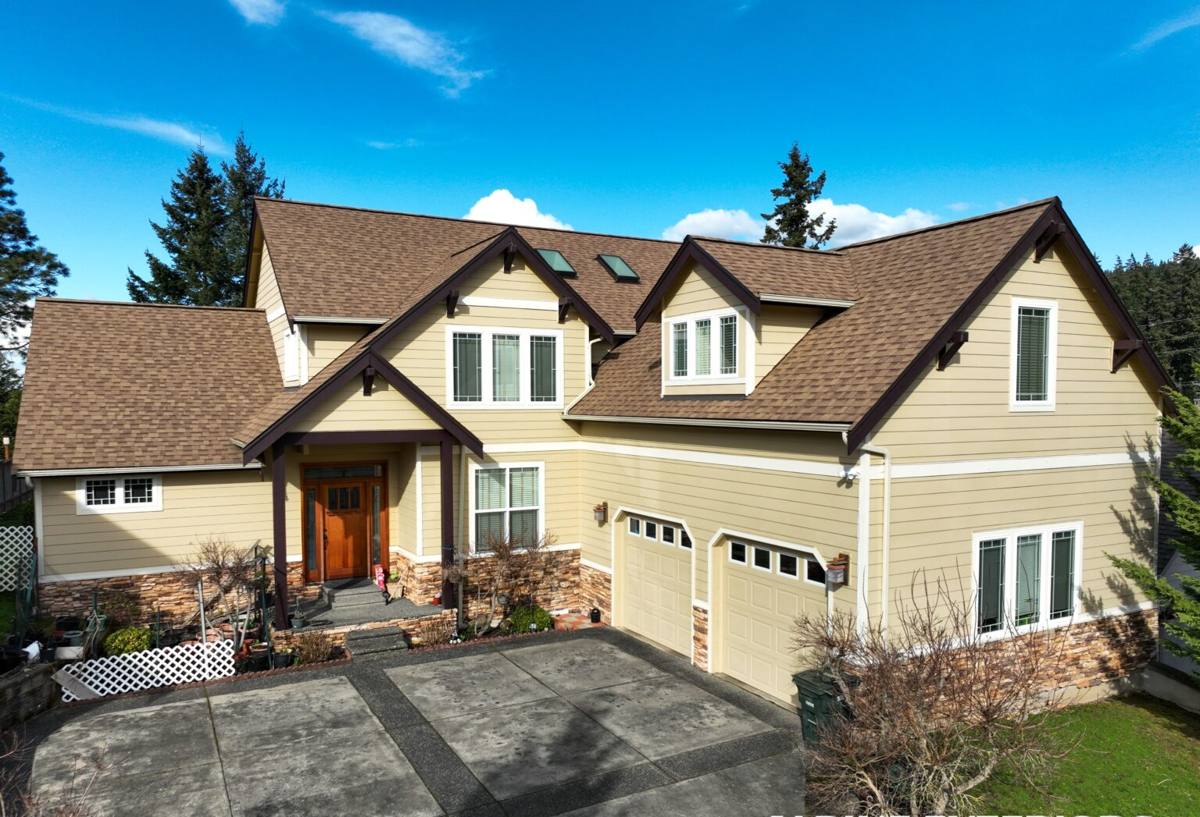
What Everson's Climate Actually Does to a Wall
Driving Rain and Wind-Driven Moisture
Wind-driven rain doesn't just fall on a wall — it gets pushed into every lap, seam, and penetration that isn't properly detailed. On homes without a correctly installed water-resistive barrier and flashing, that moisture works its way behind the siding and into the sheathing, where it can sit for months in our climate before anyone notices a soft spot.
Salt Air and Coastal Exposure
Ferndale-area homes, including those in Everson, sit close enough to Bellingham Bay and the Strait of Georgia that airborne salt is a real factor, especially on west- and south-facing walls. Salt-laden moisture accelerates corrosion on fasteners and trim metal, and it's harder on finishes that aren't factory-cured to resist it.
Moss and Algae Season
Our moss season isn't really a season — on shaded, north-facing, or tree-covered walls it's closer to year-round. Moss and algae hold moisture directly against a surface, and on materials that swell, delaminate, or absorb water at the edges, that constant dampness is what starts the failure clock.
What a Correct Installation Actually Involves
A siding installation that's going to hold up in Everson's conditions isn't just nailing boards to a wall. The parts nobody sees are what determine whether the job lasts fifteen years or fifty.
- A continuous, properly lapped water-resistive barrier behind the siding, with no gaps at seams or penetrations
- Correct flashing at every window, door, deck ledger, and roof-to-wall intersection — the single most common failure point on older homes
- Proper fastening pattern and fastener type, matched to the siding manufacturer's specifications, not "close enough"
- Adequate clearance between the bottom of the siding and grade, decks, patios, and roof lines, so splashback and standing water aren't wicking into the material
- Rain-screen or drainage gap detailing where the wall assembly calls for it, so any moisture that does get behind the siding can drain and dry
- Correctly caulked and sealed joints only where the manufacturer specifies caulk — not as a substitute for proper flashing
Skip any one of these and the siding itself almost doesn't matter — water will find the weak point.
Why We Install Only James Hardie Fiber Cement
We standardized on James Hardie fiber cement siding for every home we side, including in Everson, and we don't install vinyl, LP SmartSide, Cemplank, Allura, primed spruce, or cedar. That's not a marketing position — it's a decision based on what actually holds up against sustained damp, moss exposure, and coastal air over decades, not just the first few years.
Fiber cement is non-combustible, doesn't swell or delaminate the way wood-based and some engineered wood products can when moisture gets past the surface, and doesn't degrade under UV and salt exposure the way vinyl can over a long service life. James Hardie's ColorPlus factory finish is baked on and warranted separately from the substrate, which matters in a climate where a field-painted or site-finished product is fighting mold and moss growth on the surface from day one. Hardie also engineers specific HZ5 product lines for cold, wet Pacific Northwest exposures, which is a meaningfully different design target than a general-purpose product.
None of that means other products are junk — cedar has real appeal, vinyl is inexpensive, engineered wood has its place. We simply won't put our name on an installation using a product we don't think earns its keep in this specific climate, on this specific coastline. Hardie's combination of moisture tolerance, factory finish, non-combustible core, and a strong transferable warranty is what we're willing to stand behind.
How Common Siding Materials Compare in This Climate
| Material | Moisture Behavior | Moss/Algae Resistance | Finish Durability |
|---|---|---|---|
| James Hardie fiber cement | Dimensionally stable, doesn't swell or rot | Resists surface degradation; moss can be cleaned without damaging material | Factory ColorPlus finish, separately warranted |
| Vinyl | Doesn't absorb water but can warp/buckle with heat and age | Can trap moisture behind panels if installed loose | Color is through-body but fades and chalks over time |
| Cedar | Absorbs moisture; needs consistent maintenance to manage it | Prone to moss and mildew without regular treatment | Requires ongoing staining/sealing |
| Primed spruce / wood composites | Vulnerable at cut edges and joints if not fully sealed | Can support moss growth if surface stays damp | Field paint needs more frequent recoating |
Our Installation Process
The process is the same discipline whether it's a single Everson home or several jobs in the area at once — because the steps that matter most aren't optional.
- Walk and assessment: We look at existing siding condition, sheathing where accessible, drainage patterns around the foundation, roof-to-wall details, and any trouble spots specific to the lot — shade, tree cover, low areas that hold moisture.
- Tear-off and sheathing check: Old siding comes off and we inspect the sheathing underneath for soft spots or existing water damage before anything new goes on. Hidden problems get addressed before they get covered up again.
- Water-resistive barrier and flashing: A continuous barrier goes on with correct lapping, and every window, door, and penetration gets properly flashed — this is the step that determines long-term performance more than any other.
- Hardie installation to spec: Panels, planks, or trim go up following James Hardie's fastening, clearance, and joint-treatment specifications, not generic siding practice.
- Trim, caulking, and final details: Only the joints Hardie specifies get sealed, corners and trim are finished, and clearances at grade, decks, and roofs are verified.
- Final walkthrough: We review the finished work with the homeowner and go over what maintenance, if any, the specific product line needs going forward.
Cost Factors for Siding Installation
Every Everson home is different, but the same handful of factors drive most of the cost variation we see on siding installation projects.
| Factor | Why It Matters |
|---|---|
| Existing siding removal and disposal | Tear-off labor and material disposal scale with the size and layers of what's coming down |
| Sheathing repair, if needed | Rot found during tear-off has to be addressed before new siding goes on — this can't be estimated with certainty until the old siding is off |
| Home size and wall complexity | Dormers, multiple gables, and cut-up wall lines take more labor and material per square foot than a simple rectangular footprint |
| Siding profile and trim detail | Lap siding, board-and-batten, and panel systems have different material and labor costs, as does the amount of trim work involved |
| Access and site conditions | Tree cover, tight lot lines, and multi-story sections affect scaffolding and staging needs |
We give straightforward, itemized estimates rather than a single vague number, so homeowners can see what's driving the price.
Living With Moss Season After Installation
A correctly installed Hardie siding job doesn't mean moss never appears in Everson — shaded, north-facing walls will still see some growth over a long, wet winter. What changes is what that moss can do to the wall. On a properly installed fiber cement system, surface moss and algae can be gently washed off without compromising the material underneath. The bigger point is that the installation itself — the barrier, the flashing, the clearances — is what keeps that surface moisture from ever becoming a structural problem, which is a very different outcome than moss taking hold on a product that absorbs water or wasn't sealed correctly at the seams.
Why a Crew That Already Works in Everson Matters
Siding installation done right depends on knowing how a specific climate behaves on a specific type of lot — which walls stay damp longest, where moss tends to establish first, how much clearance really is needed given local rain patterns, and which flashing details actually get tested by weather here versus somewhere drier. A crew that regularly works Ferndale and the surrounding Whatcom County communities, including Everson, isn't guessing at those answers from a spec sheet. That local familiarity shows up in the details — how flashing is lapped, where extra attention goes on a shaded wall, how clearances are set at grade — the things that separate a siding job that looks fine at handoff from one that's still performing correctly a decade later.
What to Ask Before You Hire
- Do you install James Hardie fiber cement to the manufacturer's specifications, and can you explain your flashing and water-barrier approach?
- Will you inspect the sheathing during tear-off, and how do you handle repairs if you find rot?
- What clearances will you set at grade, decks, and roof lines for this specific home?
- Is your estimate itemized, and what happens if hidden damage is found once old siding comes off?
- Do you regularly work in this area, and can you speak to how this climate affects your installation choices?
If you're weighing a siding installation project on your Everson home, we're glad to walk the property, look at what's there now, and put together a clear, no-pressure estimate — just fill out the form below to get started.