 Ferndale
 Lummi Island's Climate Is Harder on Siding Than Most of Whatcom County
Lummi Island sits out in the salt water off the Whatcom County coast, reachable only by a short ferry crossing to the mainland near Ferndale. That location is beautiful, but it's also a tougher environment for exterior building materials than a typical inland lot. Homes here take on a combination of stresses that don't all show up together anywhere else in the county: constant salt-laden air off the water, driving rain that comes in sideways during winter storms, and a long, damp moss season that can run from early fall through late spring.
Any one of those factors will wear down the wrong siding material over time. Together, they accelerate problems fast. We've seen it play out the same way again and again on marine-exposed homes: paint fails early, seams open up, moisture gets behind the cladding, and by year ten or fifteen the homeowner is looking at a full replacement instead of routine upkeep. Fiber cement siding, installed correctly for this specific environment, is what holds up against that combination without demanding constant attention.
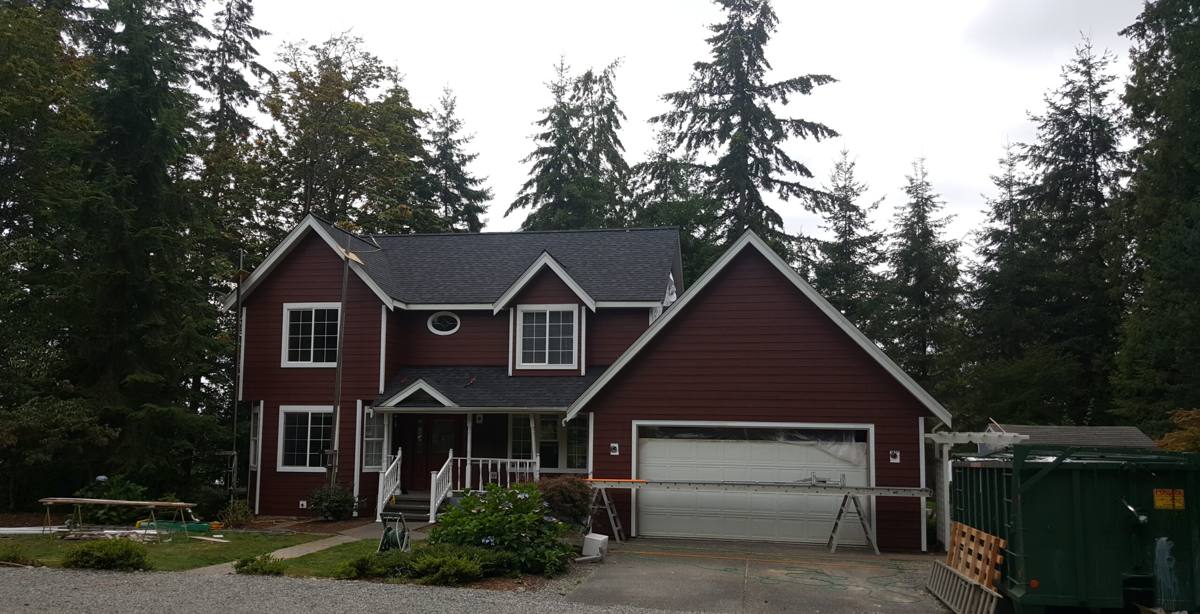
Why Salt Air, Driving Rain, and Moss Are a Combined Problem
Salt Air
Airborne salt is corrosive to metal fasteners, flashing, and trim, and it's abrasive to paint and finish coatings over time. On an island property, that exposure is near-constant rather than occasional, which means every material and fastener choice on the exterior needs to be rated for it — not just the siding itself.
Driving Rain
Wind-driven rain off open water doesn't just fall on a wall, it gets pushed into it. Lap joints, butt seams, window and door flashing, and any gap in the water-resistive barrier become entry points under that kind of pressure. A siding job that would perform fine in a sheltered inland yard can leak on an exposed island wall if the water management details weren't built for wind-driven conditions.
Moss Season
Whatcom County's wet season already runs long; on Lummi Island, shaded and north-facing walls stay damp even longer because of the marine humidity. Moss and algae need moisture and organic debris to take hold, and once established they hold water against the siding surface, which is exactly the condition that rots wood-based products and stains paint.
Why We Only Install James Hardie Fiber Cement on Island Homes
We install James Hardie fiber cement siding exclusively — we don't offer vinyl, LP SmartSide, primed wood, or cedar. That's a deliberate standard, not a lack of options, and it matters even more on a property like Lummi Island than it does elsewhere in our service area.
- Non-combustible core: fiber cement doesn't feed a fire the way wood-based siding can, which matters on a property where fire response may take longer to arrive.
- Dimensionally stable in damp, salty air: unlike wood-based composite products, Hardie's cement-based composition doesn't swell, delaminate, or wick moisture the way engineered wood siding can when it's exposed to marine humidity year-round.
- Factory-applied ColorPlus finish: the finish is baked on under controlled conditions and backed by its own finish warranty, which holds up better against UV and salt exposure than field-applied paint that has to be reapplied every several years.
- Climate-engineered product line: James Hardie makes HardieZone HZ5 products specifically engineered for the Pacific Northwest's wet, wind-driven climate — this isn't a one-size-fits-all product shipped in from a dry climate region.
Vinyl siding can crack in cold snaps and gap at the seams under the kind of wind load an open-water lot sees. Primed wood and cedar need repainting and recaulking on a schedule that gets harder to keep up with on an island property where every trip involves a ferry crossing. LP SmartSide and other engineered wood products perform reasonably well when perfectly sealed, but any breach in that seal lets moisture into a wood-based substrate — a real risk in a climate that stays damp for months at a time. We'd rather put a product on your home that tolerates this environment by design than one that depends on a homeowner keeping up with maintenance that a ferry-access property makes genuinely inconvenient.
What Correct Installation Looks Like on a Marine-Exposed Home
Fiber cement siding is only as good as its installation. On a wind- and salt-exposed wall, a handful of details separate a job that lasts decades from one that fails early:
Water Management Behind the Siding
We install a proper water-resistive barrier and, where the wall assembly calls for it, a rainscreen gap that lets any moisture that does get past the cladding drain and dry out instead of sitting against the sheathing. On a wall that regularly takes wind-driven rain, that drainage plane isn't optional — it's the difference between a wet event that dries out harmlessly and one that leads to rot behind the wall.
Flashing and Sealant Details
Every window, door, and penetration gets flashed to shed water downward and outward, not caulked as an afterthought. Caulk is a backup, not a primary defense, and on a property that takes this much wind-driven rain, we don't rely on sealant alone to keep water out.
Fastener Selection
Corrosion-resistant fasteners rated for coastal exposure are non-negotiable here. The wrong fastener will corrode and stain the siding, or lose holding strength, well before the siding itself shows any wear.
Clearances and Gaps
James Hardie specifies minimum clearances from grade, roofing, and decking, and gaps at butt joints to allow for expansion. Skipping these is one of the most common shortcuts we see in poorly installed fiber cement jobs, and it's exactly what causes moisture problems and paint failure at the seams.
Choosing the Right Hardie Product for Your Home
Most Lummi Island homes we work on use HardiePlank lap siding as the primary field material, sometimes combined with HardiePanel for accent sections or HardieTrim around windows, corners, and fascia. The right combination depends on the home's existing architecture and exposure.
| Product | Best Use | Why It Fits This Climate |
|---|---|---|
| HardiePlank Lap Siding | Primary wall cladding | Traditional lap profile sheds water efficiently when installed with correct overlap and clearance |
| HardiePanel Vertical Siding | Accent walls, gable ends, modern facades | Fewer horizontal joints means fewer potential water entry points on high-exposure elevations |
| HardieTrim Boards | Corners, window and door surrounds, fascia | Matches the siding's moisture and salt resistance at the most vulnerable transition points |
We also help homeowners choose between factory ColorPlus finish colors versus a primed product intended for field painting. On an island property, we almost always recommend ColorPlus — the factory finish is more consistent and better protected against UV and salt exposure than anything applied on-site, and it removes a recurring maintenance task from a home that's genuinely less convenient to service than a mainland property.
How We Handle Lummi Island Projects
Working on the island adds logistics that a mainland job doesn't have, and we plan around them rather than treating them as an afterthought:
- On-site assessment: we walk the exterior, check existing siding and sheathing condition, and identify exposure levels on each elevation before quoting anything.
- Material and scheduling plan: because every trip involves a ferry crossing, we plan material deliveries and crew scheduling to minimize back-and-forth trips and keep the project moving efficiently.
- Weather-aware sequencing: we time tear-off and open-wall stages around forecasted weather so the home isn't left exposed to driving rain mid-project.
- Installation to manufacturer spec: water-resistive barrier, flashing, fastening, and clearances installed to James Hardie's requirements for HZ5 coastal exposure.
- Final walkthrough: we review the finished work with the homeowner and confirm every detail before calling the job complete.
A crew that already has island logistics figured out — ferry timing, material staging, weather windows — gets your project done with fewer delays than a crew that's working out those logistics for the first time on your home.
Maintaining Fiber Cement Siding in a Salt-Air, Moss-Prone Environment
Correctly installed James Hardie siding needs far less upkeep than wood or vinyl, but it isn't entirely maintenance-free — especially in this climate. A simple annual routine keeps it performing the way it should:
- Rinse the siding down once or twice a year to clear salt residue, especially on elevations facing open water
- Keep gutters and downspouts clear so water isn't overflowing onto wall sections below
- Trim back vegetation and branches that keep a wall shaded and damp longer than it needs to be
- Check caulking at trim and penetrations annually and re-caulk any joints that have opened up
- Address any moss or algae growth early with a gentle wash rather than letting it establish and hold moisture against the surface
- Watch for any chalking, fading, or finish wear and address it promptly rather than letting it progress
None of this is heavy labor, but on a ferry-access property it helps to plan it around trips you're already making rather than treating it as a separate project.
What Affects the Cost of a Lummi Island Siding Project
Every home is different, but a few factors consistently move the price on island projects specifically, beyond the standard drivers of square footage and product selection:
| Factor | Why It Matters |
|---|---|
| Site and ferry access | Material delivery and crew logistics take more planning than a mainland job, which factors into scheduling and cost |
| Existing siding removal | Tear-off of old wood, vinyl, or damaged siding adds labor, especially if there's hidden moisture damage to address underneath |
| Wall complexity | Multiple stories, dormers, and cut-up facades take longer to flash and finish correctly than a simple rectangular wall |
| Wind exposure of the site | Open, water-facing elevations may call for additional flashing and drainage detailing compared to sheltered walls |
| Finish selection | Factory ColorPlus finish versus a primed product for field painting affects both material cost and long-term maintenance |
We walk through all of this during the estimate so there aren't surprises once work starts — you'll know what's driving the number, not just what the number is.
Why Hiring a Crew That Already Works on Lummi Island Matters
Fiber cement siding is a forgiving product when it's installed to spec and an unforgiving one when it isn't — the failures from skipped clearances, wrong fasteners, or missing drainage details often don't show up for a few years, by which point they're expensive to fix. On an island property, that risk is compounded: a contractor unfamiliar with marine exposure may not adjust flashing and fastener choices for the added salt and wind load, and a crew unfamiliar with ferry logistics can turn a straightforward project into a drawn-out one. Working with a crew that already understands both the product and the island's specific demands means fewer surprises, a tighter schedule, and a siding job built for the environment it actually has to survive in — not a generic installation dropped onto a coastal lot.
If you're planning a siding project on Lummi Island, we're happy to take a look at your home and walk you through what it actually needs. Reach out for a free, no-pressure estimate using the form below.