 Ferndale
 Marietta's Siding Problem Isn't Like Everywhere Else in Whatcom County
Marietta sits low, close to the water, and squarely in the path of weather coming off Bellingham Bay. That combination — tidal air, wind-driven rain, and a wet season that runs far longer than most homeowners expect — puts more stress on exterior siding here than it does even a few miles inland. A siding replacement in Marietta isn't just a cosmetic project. It's a decision about which material and which installation details will actually hold up against salt-laden air, near-constant moisture, and the moss and algae growth that comes with both.
We work on homes throughout Ferndale and the surrounding Whatcom County communities, and Marietta consistently shows patterns you don't see as often on higher, drier lots: faster paint failure on wood and composite products, more consistent moss coverage on north- and west-facing walls, and corrosion on fasteners and trim that weren't rated for a marine-influenced environment. None of that is unusual for the area — it's just what the climate does, and it's exactly what a correct siding job needs to be designed around.
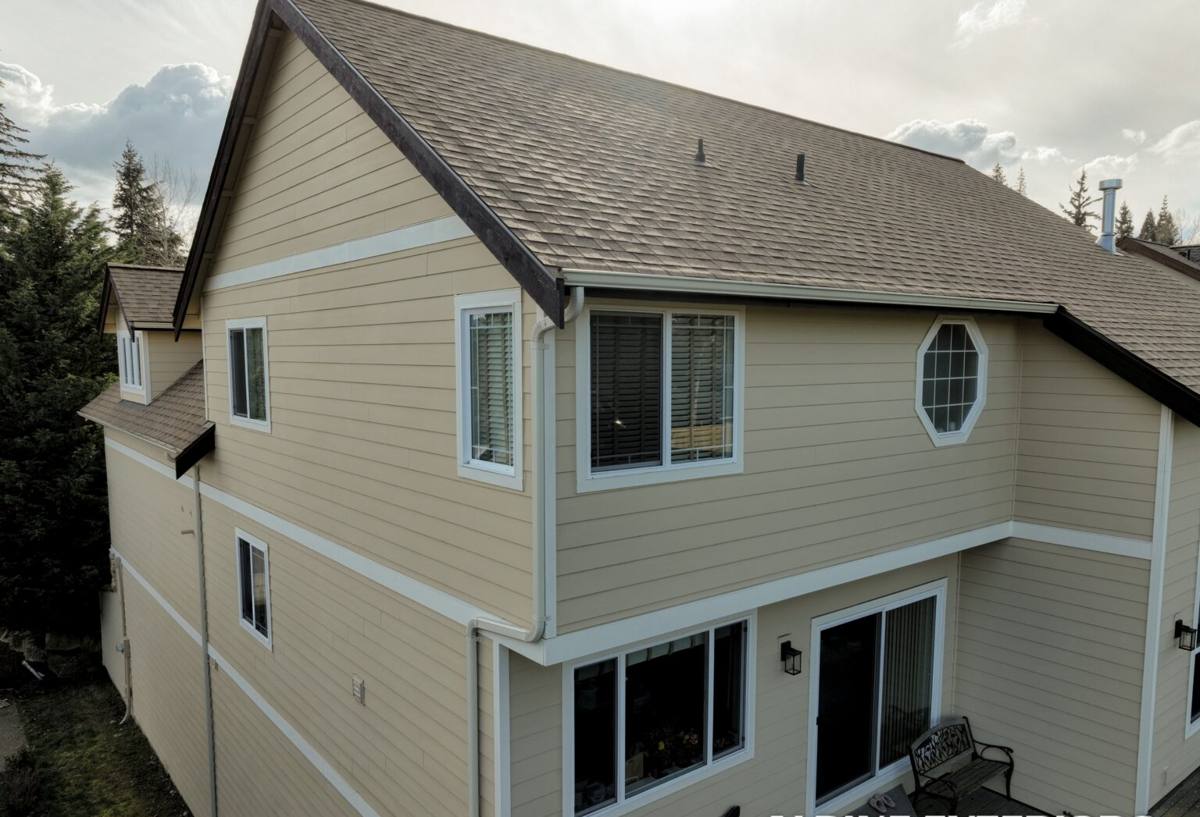
What Salt Air, Driving Rain, and Moss Actually Do to Siding
Salt Air
Even a mile or two inland from the bay, airborne salt settles on exterior surfaces and accelerates the breakdown of unprotected metal fasteners, corner trim, and lower-grade paint finishes. Over years, this shows up as rust streaking, pitted hardware, and premature chalking or fading on siding that wasn't built to resist it.
Driving Rain
Wind off the bay doesn't just bring rain straight down — it drives it sideways into wall assemblies, lap joints, and butt seams. Siding and flashing details that would be adequate on a sheltered inland lot can let water track behind the cladding here, especially at penetrations like hose bibs, light fixtures, and vent terminations.
The Long Moss Season
Whatcom County's wet months stretch from fall through spring, and Marietta's proximity to the water keeps humidity elevated even between rain events. Shaded, north-facing walls stay damp longer, which is exactly the condition moss and algae need to establish. Once organic growth takes hold on a porous or absorbent siding surface, it holds moisture against the substrate and speeds up rot, delamination, or coating failure underneath.
Signs a Marietta Home Needs Siding Replacement, Not Another Repair
- Soft or spongy spots when you press on the siding, especially near the bottom courses or around windows
- Paint or factory finish that's peeling, bubbling, or chalking heavily on the sides facing prevailing weather
- Visible moss or algae that returns within a season or two of cleaning
- Warping, cupping, or separation at seams on wood-based or composite siding
- Rust streaks running down from fasteners, corner trim, or flashing
- Rising utility bills or noticeably colder interior walls, which can point to a failed water barrier behind the siding
- Visible gaps or caulk lines that keep reopening no matter how often they're resealed
Any one of these can sometimes be handled with a repair. Several of them together, especially on a home that's had multiple bouts of moss or paint failure, usually mean the underlying material has reached the end of what it can reasonably protect the wall assembly.
Why We Only Install James Hardie Fiber Cement Here
We've standardized on James Hardie fiber cement siding for every home we side, including in Marietta, and the reasoning is directly tied to what this environment does to a wall over time. Fiber cement is non-combustible, dimensionally stable, and doesn't feed organic growth the way wood-based products can. Hardie's ColorPlus factory finish is baked on and warranted specifically against fading and chipping, which matters on a coastal-influenced lot where UV, salt, and moisture all work on a finish at once.
Just as important, Hardie engineers specific product lines (their HZ5 line, for instance) for climates with more moisture exposure, and that engineering shows up in how the board is formulated and how it's meant to be installed — not just in marketing language. When we install Hardie in Marietta, we're following the manufacturer's climate-specific installation requirements, not treating every lot in Whatcom County the same way.
What We Don't Install, and Why
We don't install vinyl, LP SmartSide, cedar, primed spruce, Cemplank, or Allura. Each of those products has legitimate strengths, but none of them hold up as consistently to Marietta's specific combination of salt air, driven rain, and long-duration moisture the way fiber cement does. Wood-based and engineered-wood products remain more vulnerable to moisture intrusion at cut edges and seams; vinyl can warp and fade faster under sustained UV and temperature swings and offers less protection at penetrations; and lower-cost fiber cement alternatives don't carry the same factory finish warranty or climate-specific product engineering that James Hardie backs its HZ lines with. We'd rather explain that trade-off honestly upfront than sell a product we know will underperform on this kind of lot.
What a Correct Siding Replacement Actually Involves
The siding itself is only part of the job. In a location like Marietta, the assembly behind the siding does most of the real work of keeping water out.
- Full tear-off and substrate inspection. We remove the existing siding down to the sheathing so we can actually see the condition of the wall, not guess at it. This is where hidden rot or old water damage from prior driving-rain intrusion typically turns up.
- Repair of any damaged sheathing or framing. Any soft or rotted material gets replaced before anything new goes back on — covering damage with new siding just hides the problem.
- Weather-resistive barrier installed correctly. The house wrap or building paper has to be lapped and sealed to shed water downward and outward, especially at seams facing the prevailing wind and rain direction.
- Flashing at every penetration and transition. Windows, doors, vents, hose bibs, and roof-to-wall intersections all need proper flashing detail — this is one of the most common failure points we find on older Marietta homes.
- Correct fastening schedule and clearances. Hardie siding has manufacturer-specified nailing patterns, gaps at trim and foundation lines, and minimum clearances from grade, decks, and roof lines. Skipping these is one of the fastest ways to void the warranty and invite moisture problems.
- Corrosion-resistant fasteners and trim. Given the salt-air exposure, we use hardware rated for that environment rather than standard interior-grade fasteners.
How We Approach the Job on a Marietta Property
We start with an on-site assessment, not a phone estimate, because the exposure on a Marietta lot depends on which direction the home faces and how close it sits to open water or wind corridors. From there:
- We document existing damage and take moisture readings where rot is suspected
- We walk the homeowner through what's driving the recommendation — repair versus full replacement — with plain language, not a sales script
- We plan the tear-off and installation around the wettest parts of the year where possible, since drying time matters for the substrate
- We follow James Hardie's published installation specifications exactly, including fastening, clearances, and flashing details, so the manufacturer's warranty stays intact
- We clean up and haul away all debris — old siding, packaging, cut-offs — before we consider the job finished
Comparing Siding Options for a Marietta Lot
| Factor | Vinyl | Wood / Engineered Wood | James Hardie Fiber Cement |
|---|---|---|---|
| Salt air resistance | Moderate; can fade and become brittle over time | Weak; finish and substrate both vulnerable | Strong; factory ColorPlus finish resists fading and chalking |
| Moisture / rot resistance | Doesn't rot but can trap moisture behind panels | Vulnerable at seams and cut edges | Non-combustible, dimensionally stable, engineered moisture resistance |
| Moss / algae susceptibility | Low growth, but seams collect debris | Higher; porous surfaces hold moisture | Lower; factory finish sheds surface moisture |
| Finish warranty | Varies by manufacturer, often prorated | Depends on field-applied coating | Factory-backed ColorPlus finish warranty |
| Typical lifespan when installed to spec | 20-30 years | 15-25 years, shorter in wet exposure | 30+ years |
Why Hiring a Crew That Already Works Marietta Matters
Siding installation quality depends heavily on whether the crew understands the specific exposure of the lot. A crew used to working sheltered, inland neighborhoods can install technically "correct" siding that still underperforms on a Marietta property, because the flashing and clearance details that matter most change with wind direction, water proximity, and sun exposure. A crew that's already worked homes in this part of Whatcom County knows which walls typically take the worst of the driving rain, where moss tends to establish first, and how to sequence a tear-off around the wet season rather than getting caught mid-project by it.
It also matters for permitting and code compliance — Ferndale and Whatcom County both have requirements around exterior work, and a local crew already has that process built into how they schedule and run a job, rather than treating it as an afterthought.
What to Ask Before You Hire
- Do you install James Hardie fiber cement, and are your installers factory-trained on it?
- Will you remove the existing siding fully, or install over it?
- How do you handle flashing at windows, doors, and penetrations?
- What fastener and trim materials do you use given the salt-air exposure here?
- Can you show me the manufacturer's clearance and fastening requirements you'll be following?
- How do you handle sheathing repair if you find hidden damage during tear-off?
If a contractor can't answer these directly, that's worth noting before you sign anything.
If your Marietta home is showing signs of siding failure — recurring moss, paint breakdown, soft spots, or rust streaking — we're happy to take a look and walk you through what we're seeing, no pressure and no obligation. A short on-site visit is usually enough to tell you whether you're looking at a repair or a full replacement, and you can request a free estimate using the form below.