 Ferndale
 Point Roberts' Marine Climate and What It Does to a Deck
Point Roberts sits right on the water, exposed to wind and salt spray off the Strait of Georgia and Boundary Bay in a way most of Whatcom County simply isn't. That exposure changes how a deck ages. Salt-laden air accelerates corrosion on anything metal — nails, screws, joist hangers, bolts — long before the wood itself shows real damage. Add driving rain that comes in sideways off the water, and moisture gets driven into joints, end grain, and fastener holes that a more sheltered deck would rarely see soaked.
Then there's moss. Whatcom County's mild, damp winters already grow a long moss season, and a deck near the water — shaded by fencing, trees, or the house itself — holds that dampness even longer. Moss doesn't just look bad on decking boards; it holds water against the wood surface for weeks at a time, which is exactly the condition that causes rot, cupping, and fastener failure. A deck built or repaired without accounting for all three of these — salt, driving rain, and moss — tends to need real work again within a few years, not a few decades.
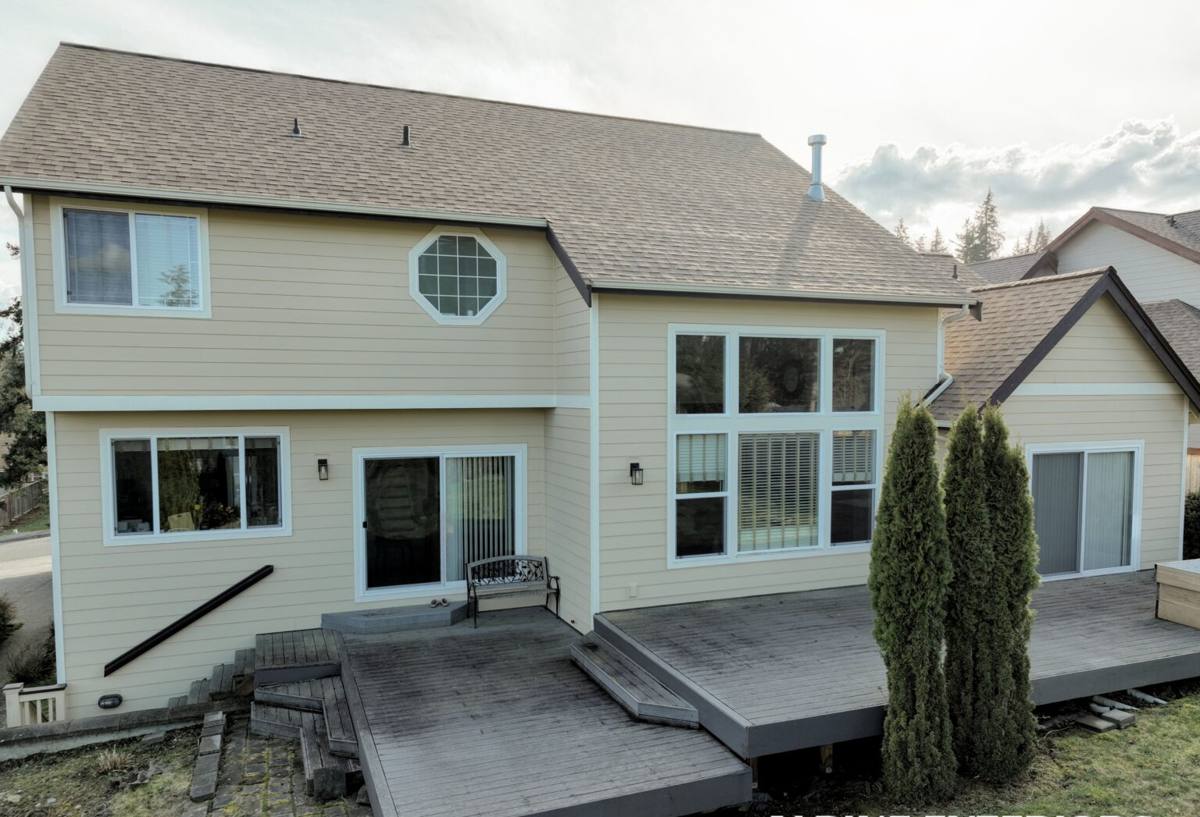
Where Point Roberts Decks Actually Fail
The Ledger Board Connection
The ledger board — where the deck attaches to the house — is the single most common failure point on any deck, and it's worse in a wet, salty environment. Flashing that wasn't installed correctly, or has started to corrode, lets water track behind the band board and into the house framing. This is usually hidden until the deck starts to feel spongy or pull away from the house.
Posts, Beams, and Footings
Support posts that sit in or near standing water, or that were never properly isolated from concrete footings, take on moisture from the ground up. Combined with driving rain soaking them from above, these members can be compromised well before the visible decking shows any sign of trouble.
Decking Boards and Moss Growth
Horizontal surfaces are where moss takes hold first, especially on the shaded side of a deck or anywhere debris collects in the gaps between boards. Moss-covered boards trap moisture against the wood fibers, which softens them and accelerates surface rot even on treated lumber.
Fasteners and Hardware
Standard galvanized fasteners and hardware corrode noticeably faster in salt air. Once a nail or screw starts rusting, it loses grip strength, and rust stains bleed into the surrounding wood — a cosmetic problem that's also an early warning sign of a structural one.
Signs Your Deck Needs Attention
Most deck problems give some warning before they become safety issues. Walk your deck and check for:
- Soft or spongy spots underfoot, especially near the house or stair landings
- Visible gaps or movement where the deck meets the ledger board
- Rust streaks bleeding from nail or screw heads
- Moss or dark green-black staining on decking boards, especially shaded areas
- Cupped, splitting, or graying boards that feel damp days after the last rain
- Wobble in the railing or stair stringers
- Visible daylight or gaps between joists and the beam or ledger
- A musty smell coming from underneath the deck
Any one of these on its own might just mean routine maintenance. Several together, especially involving the ledger board or support posts, usually means it's time for a proper inspection.
Repair or Replace? What Actually Decides It
Homeowners often assume a deck with visible problems needs full replacement, but that's frequently not the case. The framing — ledger, joists, beams, posts — is the expensive part to replace and is often still sound even when the decking boards on top look rough. The decision usually comes down to how much of the structure is actually compromised versus how much is cosmetic wear.
| Factor | Favors Repair | Favors Replacement |
|---|---|---|
| Framing condition | Solid, no rot at connections | Soft or rotted joists, beams, or ledger |
| Age of structure | Under 15-20 years | Original deck approaching or past typical service life |
| Extent of damage | Isolated to a few boards or fasteners | Widespread across multiple structural members |
| Code compliance | Railings, stairs, footings already meet current code | Undersized footings, missing hardware, or outdated railing spacing |
| Budget goal | Extend life at lower cost | Want a longer-term, lower-maintenance surface |
As a broad range, targeted repairs (ledger flashing correction, board replacement, hardware upgrades) tend to run a few hundred to a few thousand dollars depending on scope, while a full tear-off and rebuild is a much larger project. We'll always tell you honestly which side of that line your deck falls on — we don't upsell a rebuild when a repair will genuinely hold up.
What a Correct Deck Repair Actually Involves
A repair that actually lasts in this climate isn't just swapping out the boards that look bad. It starts with pulling enough decking to inspect the framing underneath, because surface damage and hidden framing damage don't always match up. From there, a proper repair addresses:
- Correcting or replacing ledger board flashing so water sheds away from the house rather than behind the band board
- Replacing corroded fasteners and hardware with corrosion-resistant options suited to a marine environment
- Sistering or replacing any joists, beams, or posts showing soft spots or rot, not just patching around them
- Re-establishing proper drainage and airflow underneath the deck so moisture doesn't get trapped
- Addressing the moss-holding conditions on the surface, not just replacing the boards moss has already damaged
Skipping the inspection step and just replacing visible boards is the most common shortcut we see, and it's why some decks need the "same" repair again within a couple of years.
Our Process for Point Roberts Deck Repairs
- On-site assessment. We walk the full deck, check the ledger connection, probe framing for soft spots, and look at drainage and moss patterns specific to how your property sits relative to sun and wind.
- Honest scope and estimate. You get a clear picture of what's structural, what's cosmetic, and what your real options are — repair, partial rebuild, or full replacement — with no pressure toward the more expensive path.
- Repair work. We open up only what needs to come out, correct the root cause (flashing, drainage, corroded hardware), and rebuild with materials suited to salt air and standing moisture.
- Cleanup and walkthrough. We clear debris and walk the finished work with you so you know exactly what was done and what to watch for going forward.
Materials and Fasteners We Choose For This Climate
Not every fastener or lumber grade holds up the same way a few hundred feet from saltwater. We choose materials based on how they'll actually perform here, not just on upfront cost.
| Component | Standard-Grade Option | What We Use in Coastal/Salt-Air Areas |
|---|---|---|
| Fasteners | Galvanized nails/screws | Stainless or high-grade coated fasteners rated for coastal exposure |
| Joist hangers | Standard galvanized hardware | Heavier-coated or stainless hardware where budget allows |
| Ledger flashing | Basic metal flashing | Corrosion-resistant flashing with proper water-shedding overlap |
| Decking surface | Standard pressure-treated lumber | Pressure-treated lumber or composite, chosen based on your maintenance preference and budget |
We're not against pressure-treated wood — it's a proven, economical choice when detailed correctly. Composite decking costs more up front and trades that for less surface maintenance, but it still depends entirely on the framing and fasteners underneath being done right. The material on top only performs as well as the structure it's fastened to.
Why It Matters That We Already Work in Point Roberts
Point Roberts is unusual: it's separated from the rest of Whatcom County by water and Canadian territory, so getting a crew and materials there isn't as simple as driving down the road. A contractor who doesn't already work this area regularly has to plan around that every single time — scheduling, border crossings, and material logistics all add friction that shows up as delays or last-minute cost surprises for you.
Because we already work in Point Roberts, that logistics planning is routine for us, not a special case. We also know, from repeated work in the area, which failure patterns actually show up on Point Roberts decks versus decks further inland — which matters when you're deciding how much of a repair is worth doing now versus later. That familiarity translates into a more accurate estimate and fewer surprises once we start opening things up.
Keeping a Repaired Deck in Good Shape
Once a deck is repaired correctly, a little routine attention keeps it that way. Clear leaves and debris from between boards and off the surface regularly, especially heading into fall and winter. Treat or scrub back moss before it gets a foothold rather than after it's established. Take a look underneath once a year for standing water or new soft spots, and check that fasteners near the ledger and stairs aren't showing early rust. None of this takes long, and it's far cheaper than letting small issues turn into structural ones.
If your deck is showing any of the warning signs above, or it's just been a long time since anyone looked at the framing underneath, we're happy to come take a look. Reach out for a free, no-pressure estimate — the form below gets you started.