 Ferndale
 Why Point Roberts Decks Wear Out Faster
Point Roberts sits out on its own peninsula, surrounded on three sides by water and cut off from the rest of Whatcom County by the international border. That geography is part of what makes the place special, but it's also why decks here take more punishment than decks just a few miles inland. Salt-laden air blows in off the water almost constantly, driving rain comes in sideways during fall and winter storms, and the tree cover on many lots keeps shaded sections of decking damp for days after a storm passes. That combination — salt, moisture, and shade — is a tough environment for wood, fasteners, and even a lot of composite products if they weren't installed with drainage and airflow in mind.
We've replaced decks all over this stretch of Whatcom County, and the pattern is consistent: decks here don't fail because the homeowner neglected them. They fail because they were built, or last rebuilt, without accounting for what a marine climate actually does to a structure over ten or fifteen years. A deck replacement done right in Point Roberts isn't just swapping old boards for new ones — it's addressing the moisture path, the ventilation underneath, and the hardware that holds the whole thing together.
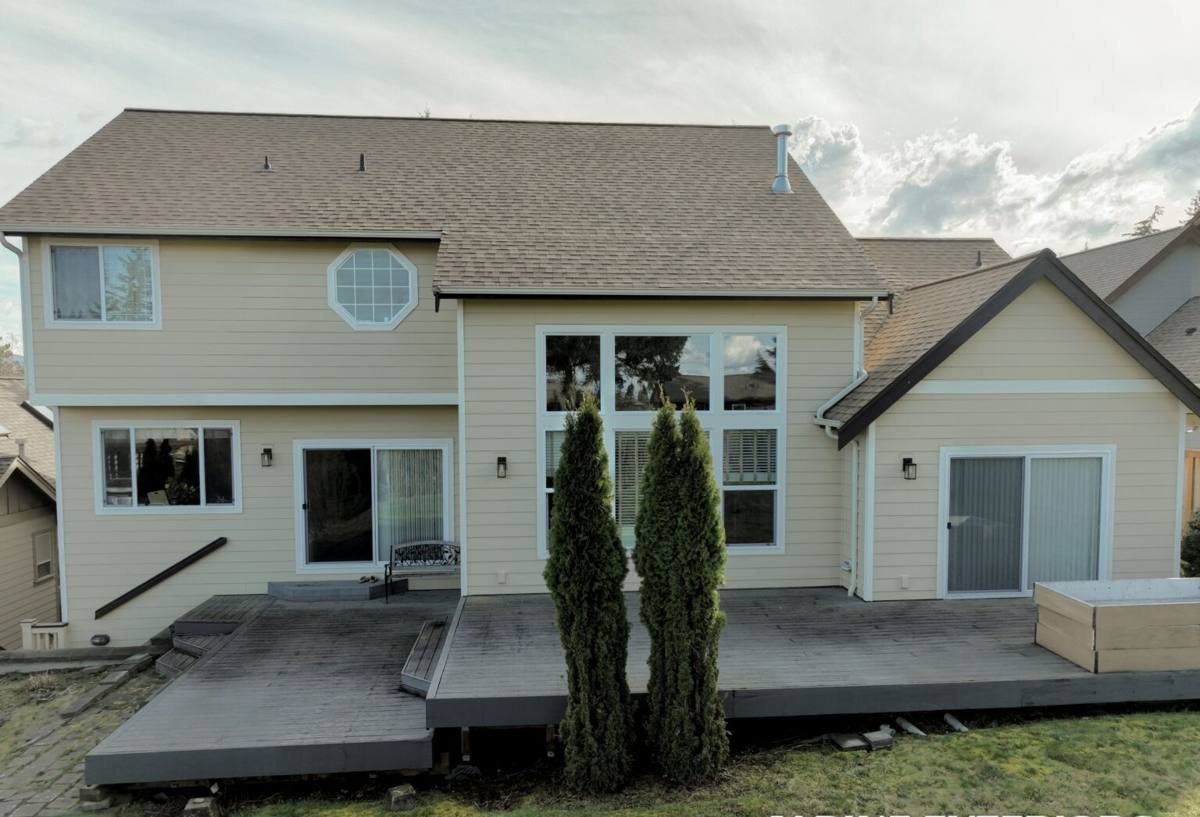
Signs You Need a Replacement, Not Another Repair
Plenty of Point Roberts decks get patched year after year — a board here, a repainted rail there — long past the point where patching still makes sense. Here's how we tell homeowners the difference.
- Soft or spongy spots in the decking, especially near the house or in shaded corners, usually mean rot has reached the joists underneath, not just the surface boards.
- Rust streaks bleeding out from screw heads or joist hangers are a sign the hardware is corroding — common here given the salt air, and something surface fasteners can't fix once it starts.
- A deck that feels bouncy or shifts slightly when you walk on it often has a compromised ledger board connection or failing footings, not a cosmetic issue.
- Persistent moss or algae that comes back within weeks of cleaning points to a drainage or airflow problem built into the structure, not a maintenance failure on your part.
- Gaps opening up between boards, or fasteners backing out repeatedly, usually means the lumber has reached the end of its useful life and is moving as it dries and swells with the seasons.
If what you're seeing is limited to a board or two on an otherwise sound structure, repair is the honest answer and we'll tell you that. Replacement makes sense when the framing, ledger, or footings are compromised, or when repeated repairs are becoming a pattern rather than an exception.
What a Proper Deck Replacement Actually Involves
Below the Decking
The part of a deck nobody sees is the part that determines how long it lasts. That means confirming the ledger board attachment to the house is flashed and sealed correctly — a common failure point on older Point Roberts homes where the ledger was never properly flashed to begin with, letting water track into the rim joist for years unnoticed. It means checking footings for frost heave and adequate depth, since ground conditions here can shift with seasonal saturation, and it means sizing and spacing joists to current code, not just matching what was there before.
Hardware and Fasteners
In a salt-air environment, hardware grade is not a place to cut corners. We use fasteners and structural connectors rated for coastal or salt-exposed conditions, not standard interior-grade hardware that looks fine going in but starts corroding within a couple of seasons. This is one of the most common shortcuts we find when we tear out an old deck — perfectly good lumber held together with the wrong screws.
Decking Surface and Drainage
Whatever surface material you choose, the framing underneath needs enough airflow to dry out between rain events, and any spots where the deck meets the house or a wall need real drainage, not just a hopeful gap. Decks that trap moisture against the house are also a siding and moisture-barrier concern — something we pay close attention to given the rest of our work is exterior cladding.
Choosing a Decking Material for This Climate
There's no single right answer here — it depends on your budget, how much upkeep you want to do, and how the deck is used. What we can tell you honestly is how each option tends to perform once it's been through a few wet Whatcom County winters.
| Material | How It Handles Salt Air & Moisture | Maintenance | Typical Lifespan |
|---|---|---|---|
| Pressure-treated fir/hem-fir | Decent if sealed and maintained; end grain and fastener holes are the weak points | Re-stain or seal every 1–2 years | 10–15 years |
| Cedar | Naturally rot-resistant, ages gracefully, but softens over time in constant damp shade | Periodic oiling or staining to hold color and resist splitting | 15–20 years |
| Composite decking | Very good — doesn't absorb moisture the way wood does, resists salt corrosion | Occasional cleaning, no staining or sealing | 25–30 years |
| PVC/capped polymer | Best moisture and salt resistance of the common options | Low — mostly rinsing off debris and pollen | 25–30+ years |
We install all of these depending on what a homeowner wants, but we'll always tell you upfront how a given choice tends to behave in this specific climate rather than just quoting a general product spec sheet. On a shaded, moss-prone lot near the water, for example, we'll usually steer the conversation toward composite or PVC — not because wood is a bad product, but because the maintenance burden of keeping wood looking good in that spot is real and ongoing.
Our Replacement Process
- On-site assessment. We walk the existing deck, check the framing and ledger from underneath where possible, and give you a straight read on repair versus replacement.
- Design and material selection. We talk through decking material, railing style, and layout, with honest tradeoffs for each based on how exposed your specific lot is.
- Permitting. Deck replacements in Whatcom County typically require a permit, especially for structural work tied to the house. We handle that process rather than leaving it to you.
- Demolition and disposal. Old decking, framing, and hardware are removed and hauled off — nothing left for you to deal with.
- Framing and structural work. New or repaired footings, joists, and ledger flashing, built to code with salt-rated hardware throughout.
- Decking, railing, and finish work. Installed with proper spacing and drainage in mind, not just visually straight boards.
- Final walkthrough. We go over the finished deck with you and explain anything you'll want to do to maintain it.
Why Local Experience in Point Roberts Matters
Point Roberts is an unusual place to build. It's part of Washington and Whatcom County, but the only land route in and out runs through Canada, which means materials, equipment, and crews all have to cross the border to get there. A contractor who doesn't work this area regularly has to factor that logistics reality into every job — and often doesn't plan for it well, which shows up as delays or rushed work. We've built our scheduling and material ordering around what it actually takes to get a job done on the peninsula, so a Point Roberts deck replacement doesn't turn into a longer, more disrupted project than it needs to be.
There's also a lot of value in knowing the area's conditions firsthand — which lots see the worst wind exposure, where moss and shade are a persistent problem, which older homes tend to have outdated ledger flashing. That's the kind of knowledge that only comes from having worked on decks and siding throughout this part of Whatcom County, not from a one-time visit.
Maintaining Your New Deck
A well-built deck in this climate still needs some seasonal attention. A little consistency goes a long way toward getting the full lifespan out of the materials.
- Sweep debris and standing leaves off the surface regularly, especially in fall, so moisture doesn't sit trapped against the boards.
- Rinse off salt residue and grime a few times a year, particularly on decks close to the water.
- Check railing and stair connections annually for any looseness before it becomes a safety issue.
- For wood decking, plan on re-sealing or staining on the schedule appropriate to that species — don't let it go past the point where the finish has fully broken down.
- Keep gutters and downspouts near the deck clear so runoff isn't dumping extra water onto or under the structure.
What Affects the Cost
Every deck replacement is priced around the specifics of the job, but these are the factors that move the number most.
| Factor | Why It Matters |
|---|---|
| Deck size and shape | More square footage and complex angles mean more material and labor |
| Decking material chosen | Composite and PVC cost more upfront than wood but less over the deck's life |
| Condition of the framing/footings | Rot or undersized footings found during demo can require structural rework |
| Height and railing requirements | Elevated decks need code-compliant railings, which adds labor and material |
| Site access | Waterfront or tight lots can slow material staging and demo hauling |
We give a written estimate before any work starts, and if we find something during demo that changes the scope — a rotted ledger, undersized footings — we'll show you what we found and talk through the options before proceeding, not after.
If your deck is showing its age or you're just not sure whether it needs a repair or a full replacement, we're happy to take a look and give you a straightforward assessment. Use the form below to request a free, no-pressure estimate for your Point Roberts property.