 Ferndale
 Sudden Valley Decks Face a Specific Kind of Wear
Homes around Sudden Valley deal with a combination of conditions that a lot of decking products simply weren't designed for. You've got salt-laden air drifting in off the Sound, long stretches of driving rain that don't let up for days, and a moss season that can run from fall through spring. None of these things are dramatic on their own, but stacked together year after year, they're exactly what breaks down a poorly built or poorly chosen deck faster than it should fail.
Salt air accelerates corrosion on fasteners, brackets, and any exposed metal hardware. Constant moisture works its way into end grain, seams, and ledger connections if they're not detailed correctly. And moss doesn't just look bad — it holds water against the deck surface and substructure far longer than open air and sun would allow in a drier climate. In Whatcom County, a deck isn't judged by how it looks in July. It's judged by how it holds up in February.
Why Composite Makes Sense for This Climate
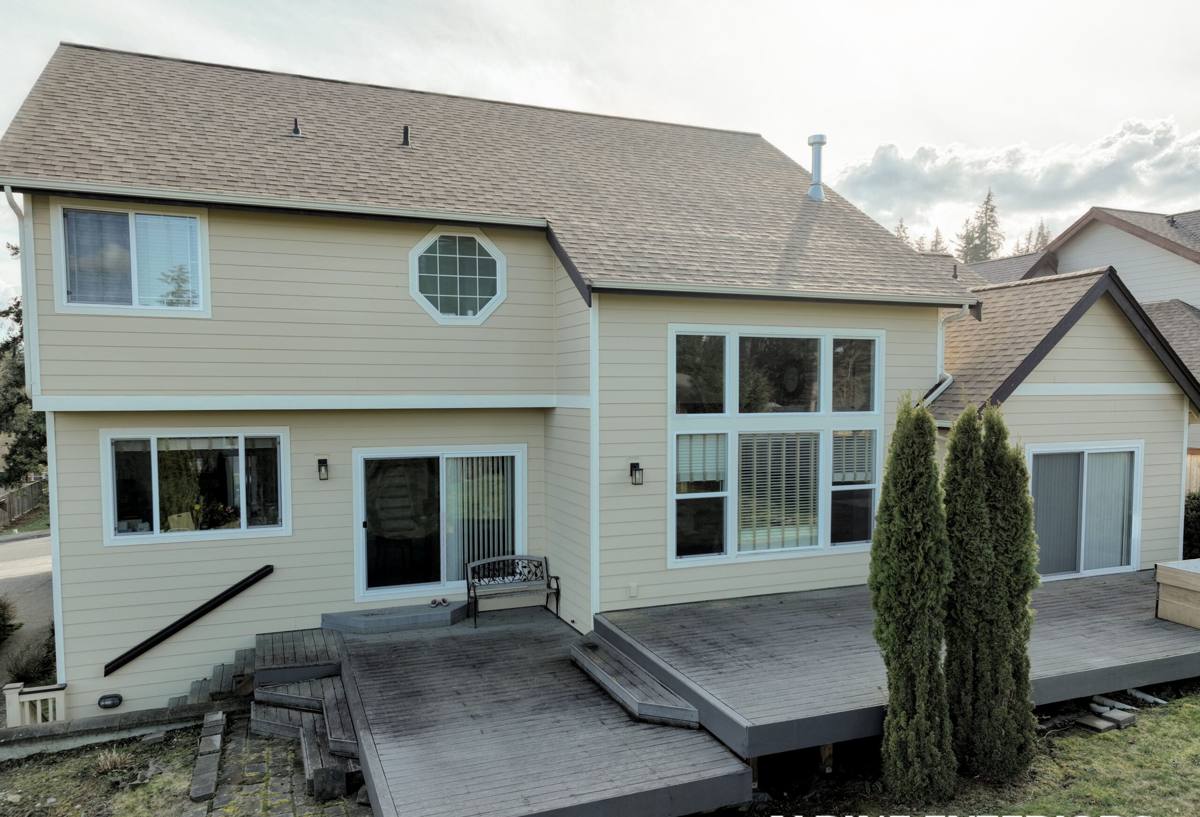
Composite decking was developed largely to solve the problems wood has in wet, humid environments — and Sudden Valley is a good example of the kind of location where that matters. A quality composite board resists moisture absorption, doesn't splinter or cup the way wood does when it swells and dries repeatedly, and holds up to the kind of low-angle winter sun and near-constant dampness that this area gets for months at a time.
That said, "composite" isn't one product. There's a real range in quality, core construction, and how well a given board resists mold and algae growth in a shaded, damp yard. Part of doing this job right is knowing which composite lines actually perform in this climate versus which ones look good in a showroom but weren't tested for a place that stays wet from October to May.
What We Look for in a Composite Board Here
- A capped or fully encapsulated board — an uncapped composite core will wick moisture over time, especially with the rainfall totals we see
- A manufacturer with a documented mold and mildew warranty, not just a fade warranty
- Grooved-edge boards compatible with hidden fastener systems, which reduce the fastener exposure that salt air attacks first
- A surface texture that still gives traction when wet — smooth, glossy composite can get dangerously slick under moss film and rain
What a Correctly Built Composite Deck Requires
The decking material only performs as well as what's underneath it. Most composite deck failures we're called out to inspect aren't actually the boards failing — they're a substructure or flashing detail that was never right in the first place.
Substructure and Framing
Composite is heavier than wood and behaves differently under load, so joist spacing has to match the manufacturer's specification for the exact board being installed — not a generic "16 inches on center" assumption. On a deck that will see standing water or shaded, slow-drying conditions much of the year, we also treat every cut end of the substructure and use fasteners and hardware rated for coastal or high-moisture exposure, not standard interior-grade hardware.
Ledger and House Connection
Where the deck attaches to the house is the single most common point of hidden water damage. Flashing has to shed water away from the band board, not just sit against it. In a climate with this much sustained rainfall, we won't attach a ledger without proper flashing tape and metal flashing integrated correctly with the house's water resistive barrier — sealant alone is not a substitute for flashing, no matter how good the caulk is.
Drainage and Airflow Underneath
Moss and algae need moisture and stagnant air to establish. A deck built low to the ground with poor ventilation underneath will stay damp longer after every rain, which speeds up organic growth on the surface and can encourage rot in the substructure even under composite boards. Proper grading below the deck, adequate clearance, and gapping between boards for airflow all matter more here than in a drier region.
Composite vs. Other Decking Materials for This Area
| Material | Moisture Performance | Moss/Algae Resistance | Long-Term Maintenance |
|---|---|---|---|
| Pressure-Treated Wood | Absorbs water, prone to swelling/cupping | Needs regular cleaning and sealing to resist growth | Annual staining/sealing recommended |
| Cedar | Naturally moisture-resistant but still needs upkeep | Better than treated pine but still needs cleaning | Periodic sealing, replacement of worn boards |
| Capped Composite | Highly resistant, doesn't absorb or swell | Strong resistance with a quality capped board | Occasional washing, no staining or sealing |
| Uncapped Composite (older style) | Can wick moisture at cut ends and edges | More prone to surface mold than capped boards | More frequent cleaning; shorter practical lifespan |
Our Process for Sudden Valley Composite Deck Projects
We approach every deck the same methodical way, adjusted for the specific site conditions of that yard — sun exposure, drainage, tree cover, and how close the property sits to salt air influence.
- On-site assessment — we look at grading, existing structure (if replacing a deck), sun/shade pattern, and how water currently moves around the area
- Board and hardware selection — matched to that specific site's exposure, not a one-size-fits-all recommendation
- Demo and structural prep — including addressing any rot or hardware corrosion found during teardown, which is common on older wood decks in this area
- Framing and flashing — built to the load and moisture standards described above, inspected before boards go down
- Composite installation — hidden fastener systems where the product allows, correct board spacing for expansion and drainage
- Final walkthrough — covering care expectations specific to composite in a wet, mossy climate
What Drives Cost on a Composite Deck Here
| Factor | Why It Matters Locally |
|---|---|
| Substructure condition | Older decks in wet-prone yards often need more framing replaced, not just resurfacing |
| Board tier and brand | Higher-tier capped composites cost more upfront but resist moss and moisture better long-term |
| Site drainage and grading | Poor drainage under or around a deck footprint can require added grading or gravel work before building |
| Railing and fastener hardware | Coastal-rated hardware costs more than standard hardware but resists corrosion from salt air |
| Deck size and height | Multi-level or elevated decks require more structural engineering and labor |
We give honest, itemized estimates rather than a flat per-square-foot number, because two decks the same size in Sudden Valley can have very different substructure and drainage needs depending on the lot.
Mistakes We Commonly See on Existing Decks
- Composite boards installed directly over an old wood deck's framing without checking that framing for rot first
- Standard interior-grade screws and brackets used instead of corrosion-resistant hardware
- No gap left between deck boards and the house siding, trapping moisture against the wall
- Boards installed tight against each other with no expansion gap, causing buckling
- Low clearance underneath the deck with no ventilation, leading to persistent moss and mildew on the underside
Caring for a Composite Deck in This Climate
One of the real advantages of composite is how little maintenance it needs compared to wood — but "low maintenance" doesn't mean "no maintenance," especially with a long moss season. A periodic wash with a soft-bristle brush and a composite-safe cleaner keeps organic buildup from getting a foothold, particularly in shaded corners or under furniture that blocks airflow. Pressure washing is fine on most composite boards but should be done at the right distance and pressure setting — too aggressive and you can damage the cap layer, which is what's providing the moisture and mold resistance in the first place.
Gutters and downspouts that drain onto or near the deck should be checked each fall, since redirected rainfall concentrated in one spot will keep that section wetter and mossier than the rest of the deck.
Questions Worth Asking Any Contractor Before You Hire
- Will you inspect and, if needed, replace deteriorated framing before installing new decking?
- What hardware and fasteners are you using, and are they rated for coastal or high-moisture exposure?
- How will the deck be flashed where it meets the house?
- What's the manufacturer's warranty on mold and mildew resistance for the specific board you're proposing?
- How will you handle drainage and airflow underneath the deck?
Why Local Experience in Sudden Valley Matters
A crew that mostly builds decks in drier parts of the state can still build something that looks right on installation day. Whether it holds up depends on details that only show their worth after a few wet Whatcom County winters — flashing, fastener choice, ventilation, and board selection matched to real conditions instead of a catalog default. Working regularly in and around Ferndale means we've seen how these decks actually age here, not just how they're supposed to perform on paper.
If you're planning a new composite deck or replacing one that hasn't held up to the salt air and rain, we're happy to take a look and give you a straightforward, no-pressure estimate for your Sudden Valley property. Use the form below to get started.