 Ferndale
 New Construction Is a Different Job Than Replacement
Homeowners and builders in Bellingham often lump "window installation" into one category, but new-construction windows and replacement windows are installed by completely different methods, and mixing them up is where a lot of long-term water problems start. On a new build or a full-tear-off addition, you have open stud walls, no existing siding to work around, and a chance to build the water-management system correctly from the studs out. That's a real advantage if the crew doing the work understands what they're building, and a real liability if they don't.
Flanged Windows and the Water-Management System
New-construction windows use a nailing flange around the perimeter of the frame that gets integrated directly into the wall's weather-resistive barrier, not caulked on top of finished siding after the fact. That flange is only as good as the flashing sequence around it. In a climate like ours, where wind-driven rain comes off the Strait of Georgia and Bellingham Bay for weeks at a stretch, a sloppy flashing lap is the difference between a window that sheds water for 30 years and one that's rotting the sheathing behind it by year five, invisibly, until someone opens up a wall.
Working With the Frame, Not Around It
Because the wall isn't finished yet, we're not fighting existing trim, brick mold, or old caulk lines. That means the window gets fastened, shimmed, and squared directly to the rough opening, with shims set at the right load points so the frame doesn't bow under its own weight or wind pressure over time. Done right, this is actually easier and more precise than a retrofit — but it has to be done in the right order, before the siding crew shows up, or corners get cut that nobody sees again until there's a problem.
What Bellingham-Area Homes Are Up Against
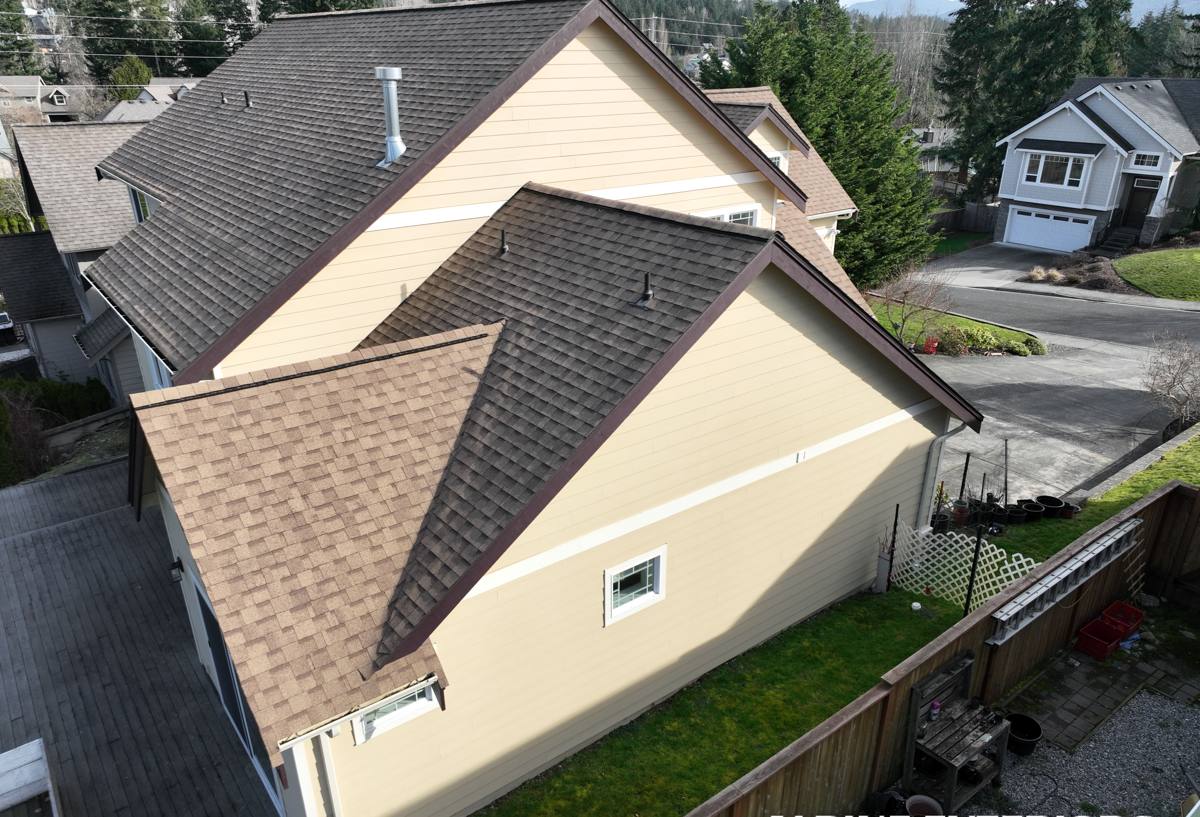
Whatcom County sits right where the Pacific marine layer, the Strait of Georgia, and the Nooksack lowlands all meet, and Bellingham gets the full effect of it. New-construction windows here have to handle three things at once, year-round, not just in a bad storm season.
- Salt air: Homes closer to Bellingham Bay and the surrounding shoreline deal with airborne salt that accelerates corrosion on fasteners, hardware, and unprotected metal flashing.
- Driving rain: Winter storms push rain sideways, not straight down, which means water is tested against vertical seams and side flashing just as much as head flashing.
- A long moss and algae season: Persistent damp, shaded conditions common on Bellingham lots let moss and algae establish on sills, trim, and low-slope surfaces for most of the year, which holds moisture against the window assembly if it isn't detailed to shed water and dry out.
None of that is exotic — it's just steady, cumulative exposure. New-construction windows aren't fighting one hard freeze or one big storm; they're fighting months of low-grade dampness that finds any weak point in the install and works on it slowly.
Getting the Water Management Right the First Time
This is the part of a new-construction window job that homeowners rarely see and almost never get to inspect once it's covered by siding — which is exactly why it has to be right the first time.
Sill Pans and Sloped Sills
Every opening should get a sloped sill pan that directs any water that gets past the exterior cladding back outside, not into the framing. On a marine climate build, we treat this as non-negotiable, not an upgrade.
Flashing Sequence
Flashing has to lap correctly with the weather-resistive barrier in a shingle-style sequence — sill pan first, then the window flange, then jamb flashing, then head flashing, each layer lapping over the one below it so water is always directed outward and down, never trapped behind a layer above it.
Drip Caps and Head Flashing
Above every window, a proper drip cap breaks the water's path so it can't run down the face of the wall and pool at the top of the frame — a detail that matters more here than in drier parts of the state, given how many consecutive rain days Bellingham sees in a typical fall and winter.
Sealant Selection and Placement
Sealant is a backup to good flashing, not a substitute for it. We use exterior-rated sealants suited to marine air exposure, and we're deliberate about where sealant goes — some manufacturers actually specify gaps at the bottom of the flange so any water that does get in has somewhere to drain back out, rather than being sealed in place.
Choosing the Right Window for a Bellingham Build
Frame material matters more here than in a dry inland climate, mostly because of how each material handles moisture cycling and salt exposure over decades, not just how it performs on day one.
| Frame Material | Moisture & Salt Air Behavior | Maintenance | Typical Fit |
|---|---|---|---|
| Vinyl | Won't rot or corrode; performs well in coastal air | Low — occasional cleaning | Most new builds, budget-conscious projects |
| Fiberglass | Dimensionally stable through wet/dry and temperature swings; excellent salt-air resistance | Low | Larger openings, higher-end builds, energy-focused projects |
| Wood-clad | Good performance if the cladding and joints are detailed correctly, but exposed end grain and joints are vulnerable in persistent damp conditions | Higher — finish and seal checks over time | Traditional or historic-style architecture where the look matters |
| Aluminum | Prone to condensation and corrosion in marine air unless thermally broken | Moderate | Commercial or specific architectural applications, less common on residential new builds here |
We'll talk through glass packages too — most new construction in Whatcom County benefits from a low-E, argon-filled double-pane unit at minimum, sized and rated for our marine climate zone rather than a generic national default. If a build has a lot of west or southwest exposure catching driving rain directly, that's worth factoring into both the glass package and the flashing detail, not just the frame material.
Our New-Construction Window Installation Process
Before Install Day: Coordinating With the Builder
New-construction window work only goes smoothly when it's coordinated with the framing and weather-barrier schedule. We check rough openings against window schedules before delivery, confirm the weather-resistive barrier is installed and lapped correctly, and flag any framing issues — out-of-square openings, missing headers, incorrect rough opening sizing — before they become install-day problems.
Install Day
- Verify each rough opening is square, plumb, and correctly sized
- Install sloped sill pan flashing
- Set the window, shim to level and square, and fasten per manufacturer spec
- Flash jambs and head in proper shingle-lap sequence, tied into the weather-resistive barrier
- Apply sealant at manufacturer-specified points only, leaving drainage paths intact
- Check operation — every sash and lock — before moving to the next opening
After Install: Inspection and Sign-Off
Before siding or trim goes on and covers the work, we walk the openings and confirm flashing laps, fastener patterns, and sealant placement are correct. This is the last point anyone can visually confirm the water-management detail before it's permanently hidden, so we treat it as a hard checkpoint, not a formality.
Common Mistakes We See on New-Construction Jobs
Most window failures on new builds don't trace back to a bad window — they trace back to installation shortcuts that were invisible the day the siding went up. On inspections and repair calls around Bellingham and Ferndale, the same handful of issues come up repeatedly:
- Sill pans skipped or installed flat instead of sloped
- Flashing lapped in the wrong order, directing water inward instead of outward
- Fasteners driven through the flange without hitting solid framing
- Sealant used to "fix" a bad flashing detail instead of correcting the flashing
- Rough openings shimmed out of square, straining the frame and hardware over time
- No drainage path left for incidental water that gets past the cladding
Any one of these can sit quietly for years in a wetter climate before it shows up as a stain, soft trim, or a window that's suddenly hard to operate. Catching them requires knowing what correct looks like before the siding goes on.
Cost Factors for New-Construction Windows
Pricing on a new build depends heavily on window count, size, frame material, and glass package, so we won't quote a number without seeing the plans — but these are the factors that move the price up or down.
| Factor | Effect on Cost |
|---|---|
| Frame material (vinyl vs. fiberglass vs. wood-clad) | Vinyl is typically the most budget-friendly; fiberglass and wood-clad run higher |
| Window size and configuration | Large openings, bays, and multi-unit combinations cost more per opening |
| Glass package | Upgraded low-E coatings or triple-pane glass add cost but improve comfort and efficiency |
| Number of openings | Per-window cost typically drops on larger orders due to shared setup and labor |
| Site access and building height | Multi-story builds or difficult site access add labor time |
We're happy to walk a builder or homeowner through where their plans land on that range once we've seen the window schedule.
Why Hire a Crew That Already Works Bellingham
Installation methods that work fine in a dry inland climate can leave a home under-protected here, and it's not something you can tell by looking at a finished wall. A crew that regularly works Bellingham and the rest of Whatcom County has already seen how driving rain, salt air, and a long damp season expose weak flashing details over time — and builds for that from the start instead of learning it from a callback. We also know the practical side of working here: typical builder schedules, common framing conventions in local new construction, and how to sequence our work so we're not holding up the rest of the crew.
As a Ferndale-based contractor, this isn't a market we drive into occasionally — it's the region we work in every week, on new builds and additions from Ferndale through Bellingham and the surrounding county.
Maintaining New-Construction Windows in a Marine Climate
A correctly installed window still needs occasional attention in this climate. Sills and tracks should be checked periodically for moss or algae buildup, especially on shaded elevations, since organic growth held against the frame keeps moisture in contact with the assembly longer than it should be. Exterior sealant joints are worth a visual check every year or two, since sealant is a wear item even when the flashing behind it is doing its job correctly. And hardware — locks, hinges, rollers — benefits from an occasional wipe-down and light lubrication given the salt content in the air near the coast.
If you're planning new construction or an addition in the Bellingham area and want windows installed the way this climate actually demands, we'd be glad to take a look at your plans and walk the site. Use the form below to request a free, no-pressure estimate.