 Ferndale
 Siding Repair Built for Sudden Valley's Climate
Sudden Valley sits in a heavily wooded pocket of Whatcom County on the south shore of Lake Whatcom, and that setting shapes what happens to siding here faster than in a lot of other neighborhoods we work in. Tree canopy holds moisture against exterior walls long after a storm passes. The lake microclimate keeps humidity elevated through fall, winter, and much of spring. And the broader marine air that moves through this part of Washington carries fine salt content that settles on painted and coated surfaces over time, slowly breaking down caulk and finish even on homes well inland from saltwater. Add in driving rain that comes sideways off the water during winter storms, and you have a set of conditions that punishes weak spots in a siding system faster than a drier, more open neighborhood would.
None of that means Sudden Valley homes need exotic repair work. It means the repair work needs to be done correctly the first time, with attention to moisture paths that aren't always obvious from the ground. A patch that looks fine but doesn't actually stop water movement behind the wall plane will fail again within a season or two here.
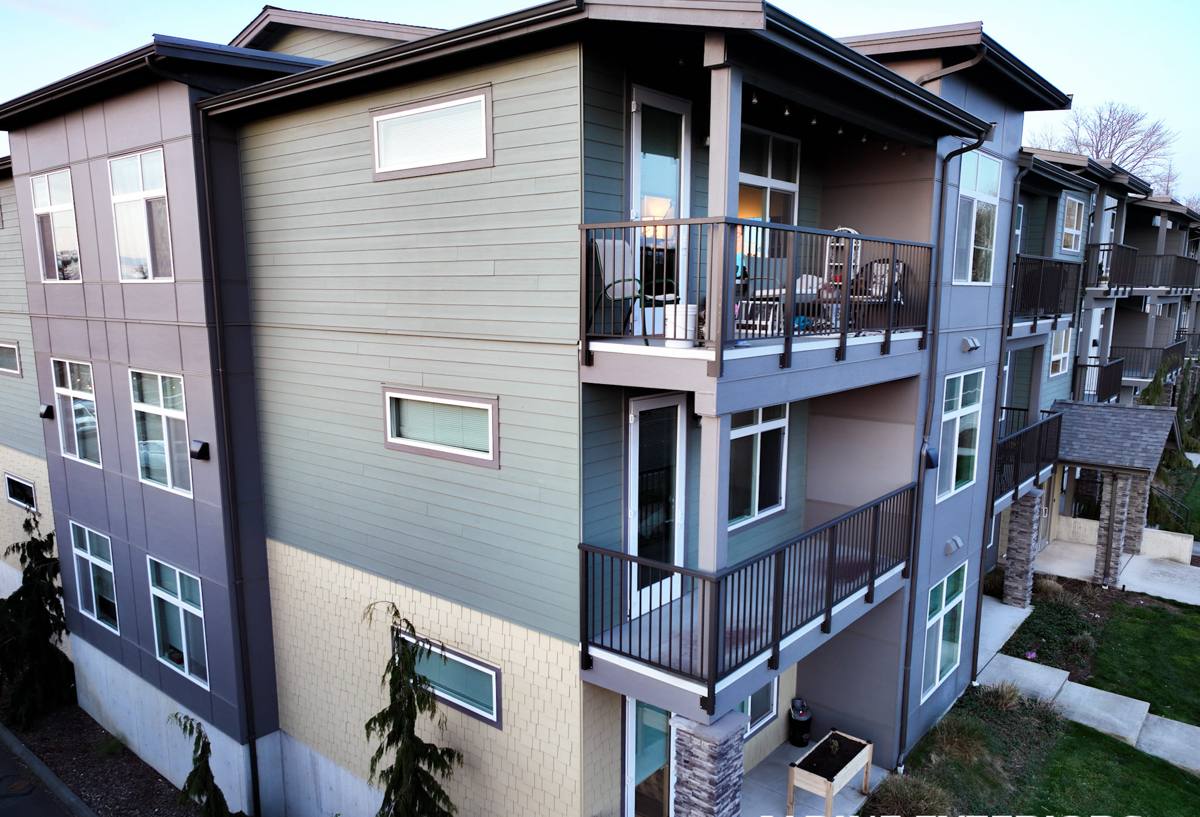
The Damage We See Most Often in This Neighborhood
Moss and algae growth at shaded wall sections
Any wall facing north, or shaded by the tree cover common throughout Sudden Valley, stays damp longer after rain and grows moss and algae faster than a sun-exposed wall. On siding materials that absorb moisture, that growth isn't just cosmetic — it holds water against the surface and accelerates whatever damage is already starting underneath.
Soft or swollen boards at seams and butt joints
Horizontal siding fails most often where one course meets the next, or where a board butts against trim, a window, or a corner. If those joints weren't caulked, flashed, or overlapped correctly during the original install, water finds its way in during the long wet season and doesn't fully dry out before the next storm arrives.
Impact and storm damage
Falling branches and wind-driven debris are a fact of life in a tree-heavy neighborhood like this one. Cracked boards, dented corners, and dislodged trim pieces are common after a bad winter storm, and they need attention quickly — a cracked board is an open door for the moisture we just described.
Caulk and sealant failure
Caulk is the first line of defense at every joint, corner, and penetration, and it's also the first thing to fail. UV exposure, temperature swings, and the general dampness of this climate shorten caulk's working life. Once it cracks or pulls away, the gap behind it becomes a direct path for water.
Why Small Damage Doesn't Stay Small Here
In a drier climate, a small crack or gap might sit for a year or two without causing real harm because the wall has time to dry between rain events. Sudden Valley's long wet season and heavy shade don't give a wall that recovery time. Moisture that gets behind siding here tends to stay behind siding, which means minor damage becomes sheathing rot, insulation damage, or interior wall problems on a shorter timeline than homeowners expect. This is the single biggest reason we tell Sudden Valley homeowners not to wait on visible siding damage, even when it looks minor from the driveway.
What a Correct Siding Repair Actually Involves
Diagnosing past the visible damage
A proper repair starts by pulling back the damaged section, not just patching over it. We check the house wrap or building paper underneath, the condition of the sheathing, and whether water has already traveled beyond the boards you can see are damaged. Repairing the surface without checking what's behind it just hides a problem that will resurface.
Matching material, profile, and finish
Repairs that don't match the existing siding's exposure, profile, and color stand out immediately and can also create water-shedding mismatches at the seams. We match board profile and, where the home is finished in James Hardie ColorPlus, we work from the same color and texture library so a repair blends rather than patches.
Flashing and water management first, cosmetics second
Every repair gets proper flashing or house wrap integration at the repair boundary before a single new board goes up. This is the step that gets skipped in a rush repair and is exactly what determines whether the fix lasts five years or fifteen.
Repair or Replace: How We Make the Call
Not every damaged section needs a full re-side, and we don't push a full replacement when a targeted repair will genuinely hold up. The decision comes down to how much of the wall is affected and what we find once we open it up.
| Factor | Favors Repair | Favors Replacement |
|---|---|---|
| Extent of damage | Isolated to one or two wall sections | Spread across multiple elevations |
| Sheathing condition | Dry and sound behind the damaged boards | Soft, rotted, or water-stained sheathing found |
| Siding material | Still-available match, structurally sound elsewhere | Failing material (LP, cedar, older composite) with a documented pattern of issues |
| Age of existing siding | Relatively recent install, isolated failure | Original siding is decades old and past its service life |
| Underlying cause | A one-time event, like storm impact | Systemic — a moisture path built into the original install |
Our Sudden Valley Siding Repair Process
- On-site inspection of the damaged area and a check of the rest of the exterior for related issues, since one bad section often points to others nearby.
- Careful removal of the affected boards and inspection of the house wrap and sheathing underneath.
- Repair or replacement of any damaged sheathing or wrap before new siding goes on.
- Installation of matched James Hardie boards, properly flashed and fastened to manufacturer spec.
- Caulking and finish work matched to the existing ColorPlus color where applicable.
- A final walk-through so you know exactly what was found and what was done.
Why We Repair With James Hardie, Not Whatever's on Hand
We install and repair with James Hardie fiber cement exclusively, and that matters as much on a repair job as it does on a full re-side. Hardie's HZ product lines are engineered for exactly the wet, humid conditions Sudden Valley deals with — the boards don't absorb and swell the way wood-based or wood-adjacent products can, and they're non-combustible, which matters in a tree-dense neighborhood where wildfire risk is a real seasonal concern in Washington summers. Because Hardie's ColorPlus finish is a factory-applied, consistent product line, a repair section painted or coated on-site would never match as cleanly as sourcing the correct matched board and color. That consistency is a big part of why a Hardie repair blends in rather than becoming a visible patch a few months later.
Why It Matters Who You Hire for This Job
Sudden Valley's tight, wooded streets and lakeside lots aren't like working a flat, open subdivision — access, drainage patterns, and shade coverage vary house to house even on the same street. A crew that's already worked in this neighborhood knows what to check for before a ladder goes up: which elevations hold moisture longest, where moss tends to establish first, and how the tree cover on a given lot affects drying time after a repair. That local familiarity shortens the diagnostic phase and helps us catch related problems — a second soft spot, a failing gutter contributing to the damage — before they turn into a second service call.
It also matters because a rushed or poorly matched repair on a home in this climate doesn't just look bad — it fails faster than it would somewhere drier, and you end up paying for the same repair twice.
Keeping Your Siding in Good Shape Between Repairs
A few habits go a long way toward extending the life of a repair and catching new issues before they grow, especially in a moss-prone, tree-covered setting like Sudden Valley.
- Trim back branches and brush that keep any wall section in constant shade or in contact with the siding.
- Clean visible moss and algae growth gently at least once a year, before it has a chance to hold moisture against the surface.
- Check and clear gutters each fall so water isn't overflowing onto siding below.
- Walk the exterior after any significant storm and look for cracked boards, loose trim, or fresh caulk gaps.
- Address small cracks or gaps as soon as you spot them rather than waiting for a bigger repair to become necessary.
If you're seeing moss buildup, soft boards, or storm damage on your Sudden Valley home, we're happy to take a look and give you a straightforward assessment of what's actually needed — no pressure, no upsell. Reach out for a free estimate using the form below.