 Ferndale
 Why Birch Bay Homes Need a Different Approach to Siding
Birch Bay sits directly on the water in northern Whatcom County, and that waterfront position changes what a siding job actually has to survive. Homes here take on salt-laden marine air almost every day, driving rain that gets pushed sideways by wind instead of falling straight down, and a moss season that can run most of the year on shaded or north-facing walls. None of those three conditions is unusual for the Pacific Northwest on its own. Stacked together, on a shoreline lot, they're a harder long-term test than most siding products are marketed to handle.
This page is specifically about James Hardie fiber cement siding installed on Birch Bay homes — not exterior work in general, and not a rundown of every material on the market. It's the one product we install, and Birch Bay's climate is a big part of why we made that call.
What Salt Air, Rain, and Moss Actually Do to Siding
Salt Air and Corrosion
Being on the bay means more direct salt exposure than homes even a few miles inland deal with. Salt accelerates corrosion on fasteners, flashing, and trim hardware, and it can break down a lower-quality factory finish faster than a drier climate would. Every material and every piece of hardware on a Birch Bay exterior needs to be chosen with that corrosion risk in mind, not just picked for how it looks on a sample board.
Wind-Driven Rain
A waterfront lot also means more wind, and wind-driven rain doesn't behave like a straight-down shower. It gets forced sideways into lap joints, under trim, and into any seam where the water-management detailing isn't right. That's a heavier moisture load than an annual rainfall total suggests, and it's a common way siding fails at the joints and edges rather than across the face of the board.
A Long Moss and Mildew Season
Mild temperatures and near-constant moisture add up to active moss and mildew growth for much of the year on shaded walls, which describes a lot of tree-lined Birch Bay properties. Organic growth on a porous or slightly absorbent siding surface traps moisture against the wall behind it, and that trapped moisture is where a lot of long-term rot and finish failure actually starts.
Why James Hardie Fiber Cement Is the Right Match for This Site
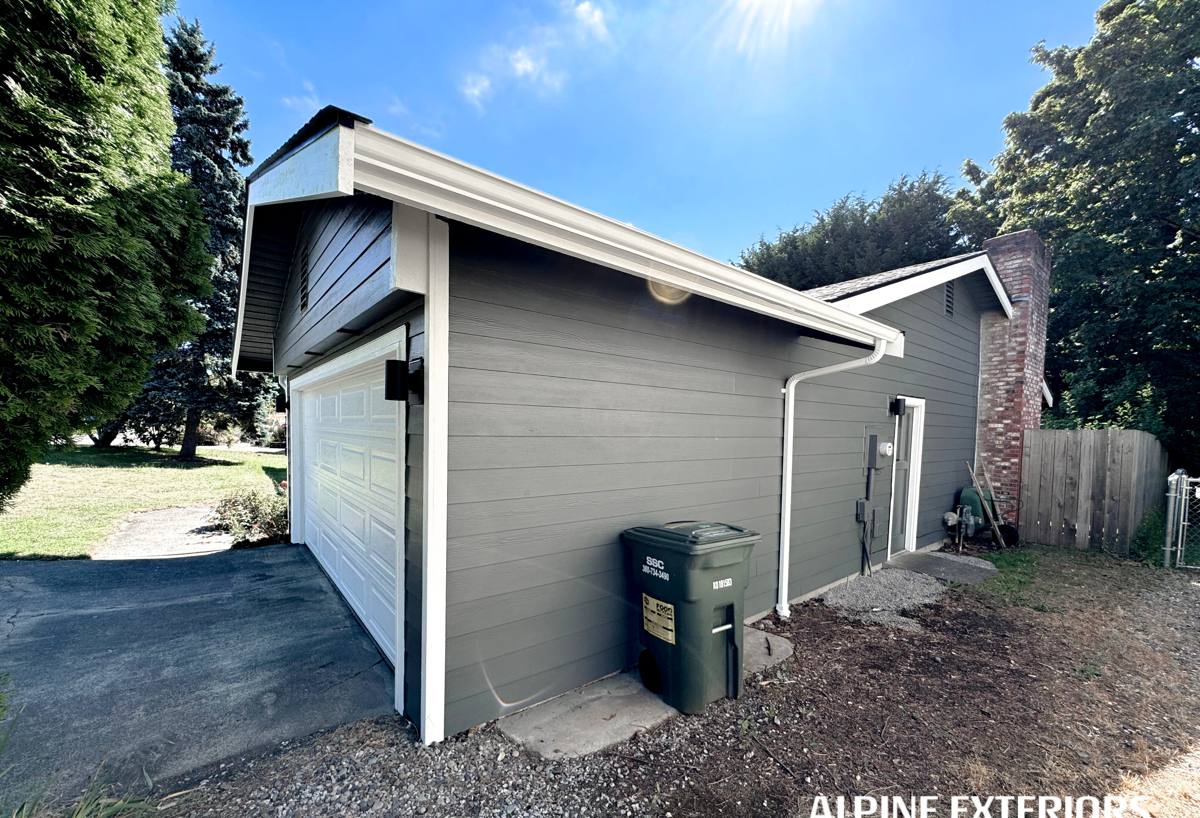
James Hardie siding is fiber cement — a cured blend of Portland cement, sand, and cellulose fiber. It's an inorganic material, so it doesn't have a wood-based core that swells, warps, or feeds rot the way organic siding can when it stays wet for long stretches, which is a fair description of a Birch Bay winter. It's also non-combustible, which is a real advantage independent of climate.
The HZ5 Product Line
Hardie engineers its siding differently for different climate zones, and the HZ5 formulation is built for regions with sustained moisture exposure and freeze-thaw cycling — a good match for waterfront Whatcom County winters. A product engineered for a hot, dry climate doesn't perform the same way here, so using the correct HZ line for this specific site is part of what makes the installation work as designed, not an afterthought.
ColorPlus Factory Finish
Instead of relying on a coat of field-applied paint, Hardie's ColorPlus finish is baked on in a controlled factory environment in multiple coats before the boards ever reach the job site. That finish carries its own warranty, separate from the substrate warranty, and it's formulated to resist the fading and chalking that salt air and UV exposure cause faster on a site-painted surface.
Dimensional Stability
Fiber cement doesn't expand and contract with humidity and temperature the way vinyl and wood-based products do. On a property that goes from damp, cool mornings to wind and sun through the day, that stability matters — it's part of why caulked joints and trim details hold up longer over repeated wet-dry cycles.
Why We Don't Install Other Siding Products in Birch Bay
We used to install a wider range of siding. We stopped after years of service calls and tear-offs in this exact kind of coastal, high-moisture climate showed a consistent pattern — not because of a supplier relationship or a sales pitch.
- Vinyl siding is affordable and low-maintenance in milder inland climates, but its lapped, non-sealed seams aren't built to shed wind-driven rain the way a waterfront property regularly delivers it, and it offers no real fire resistance.
- LP SmartSide and other engineered wood products use a treated wood-fiber core that depends on the factory coating and every field-cut edge staying fully sealed indefinitely. In a climate where wet weather is the default, that's a lot of long-term maintenance riding on a wood-based core.
- Cedar and primed spruce are genuine, traditional materials, but they're organic, combustible, and dependent on a paint or stain schedule that has to be kept up consistently — and moss finds an organic surface especially hospitable in a climate that stays damp most of the year.
- Cemplank and Allura are other fiber cement manufacturers, and fiber cement as a category is the right direction. We standardized on James Hardie specifically for its ColorPlus finish, its climate-engineered HZ lines, and the depth of its warranty and installer support in this region.
Each of those products has a legitimate place in the market and homeowners who are happy with them in other settings. On a shoreline exposure like Birch Bay, we made a professional call that we'd rather fully stand behind one system than offer a cheaper option that quietly shifts more long-term maintenance risk onto the homeowner.
What Correct Installation Looks Like on a Birch Bay Home
Fiber cement's reputation depends heavily on installation quality, and that's especially true on a waterfront lot where the margin for error is smaller. A Hardie product installed loosely will still develop moisture problems in this climate — the material is only as good as the details behind it.
| Installation Detail | Why It Matters in Birch Bay |
|---|---|
| Manufacturer-specified clearances from grade, roofline, and deck | Keeps splash-back and standing moisture off the board edge during heavy, wind-driven rain |
| Corrosion-resistant fasteners, correctly placed and set to depth | Salt air accelerates corrosion on the wrong fastener grade; correct fasteners hold the board and the finish over decades |
| Proper flashing at windows, doors, and penetrations | Directs sideways-driven rain away from seams instead of letting it collect there |
| Factory-cut edges used wherever possible; field cuts sealed to spec | Preserves the ColorPlus finish's protection at every exposed edge |
| Rain screen or drainage plane behind the siding | Lets any moisture that gets past the surface drain and dry instead of sitting against the wall sheathing |
| Correct joint and caulk detailing at laps and trim | Reduces the moss and mildew growth points that come from trapped moisture at seams |
Our Process for a Birch Bay Siding Project
- On-site assessment. We walk the exterior and look specifically at how the current siding has handled salt exposure and moisture over time, including the sides of the house that get the least sun.
- Written scope and product plan. We confirm the correct HZ product line, color, and trim details for the specific site before anything is ordered.
- Sheathing and moisture check. Once old siding comes off, we check the sheathing and framing underneath for hidden moisture damage before new siding goes up — this is common enough on waterfront homes that we build the time into the schedule rather than treating it as a surprise.
- Installation to spec. Correct fasteners, flashing, clearances, and drainage detailing are standard practice on every job, not an upgrade option.
- Final walkthrough. We go over the finished work with the homeowner and explain what, if any, ongoing maintenance the product needs.
Cost Factors for a Birch Bay Siding Project
- Home size and complexity: More corners, dormers, and trim details mean more labor and material, independent of square footage alone.
- Condition of the existing wall assembly: Hidden rot or moisture damage found once old siding is removed can add scope, which is why a written change-order process matters.
- Product line and finish: HZ5 boards and ColorPlus color options vary somewhat in cost, and we'll walk through those differences during the estimate.
- Access and site conditions: Waterfront lots can have tighter access, drainage considerations, or seasonal weather windows that affect scheduling and cost.
- Removal and disposal of old siding: Tear-off and haul-away of the existing material is part of a full re-side and should be spelled out clearly in any quote.
Why Hiring a Crew That Already Works Birch Bay Matters
A contractor who works this stretch of coastline regularly already knows how salt air, wind exposure, and prolonged moisture behave differently here than they do even a few miles inland. That familiarity shows up in specific choices — which fastener grade to use, how much extra drainage detailing to add on a shaded north wall, where moss is likely to come back first — and those choices are what actually determine whether a siding job lasts one wet season or several decades.
A Simple Checklist Before Hiring for Siding in Birch Bay
- Ask what siding material they install and why, and whether they stand behind it with a written, transferable warranty
- Confirm they carry current Washington contractor licensing and active liability insurance
- Ask how they detail flashing and drainage specifically for coastal, wind-driven rain, not a generic answer
- Ask about fastener grade and corrosion resistance for salt-air exposure
- Get a clear, written scope of work, including how hidden sheathing damage would be handled, before signing anything
Comparing Siding Materials for a Birch Bay Property
| Material | Moisture Behavior | Performance in Salt Air | Typical Longevity Here |
|---|---|---|---|
| James Hardie fiber cement (HZ5) | Dimensionally stable, resists swelling and warping | Low maintenance; factory finish resists fading and chalking | 30+ years with correct installation |
| Vinyl siding | Can warp or distort with heat; seams are moisture entry points | Low upfront cost, but fasteners and joints are exposure points | Variable, often shorter in direct wind-driven rain |
| LP SmartSide / engineered wood | Wood-fiber core is moisture-sensitive at cut edges and joints | Moderate; depends on consistent edge sealing and caulk upkeep | Depends heavily on installation quality and maintenance |
| Cedar / primed wood | Absorbs and releases moisture readily | High maintenance; needs a consistent refinishing schedule | Shorter without regular upkeep in salt air |
If you're weighing siding options for a home in Birch Bay, we're glad to walk the exterior with you and give a straight read on what it actually needs. Reach out below for a free, no-pressure estimate.