 Ferndale
 Windows Take a Beating in This Climate
Everson sits inland from Ferndale in the Nooksack River valley, but "inland" doesn't mean dry. Whatcom County's marine climate still delivers long stretches of driving rain, heavy fog off the river bottoms, and a moss and mildew season that can run eight or nine months out of the year. Homes here don't get the salt spray you'd see right on Bellingham Bay, but they get plenty of standing moisture, wind-driven rain against west and south walls, and the kind of slow, constant dampness that finds every gap in a window installation and works it wider every year.
Windows are one of the biggest weak points in any home's exterior envelope. A wall assembly can be built correctly and still fail at the window opening if the flashing, sealant, and fit aren't done right. That's the part homeowners can't see once the trim is back on — and it's the part that decides whether a window lasts twenty-five years or starts leaking into the wall cavity after five.
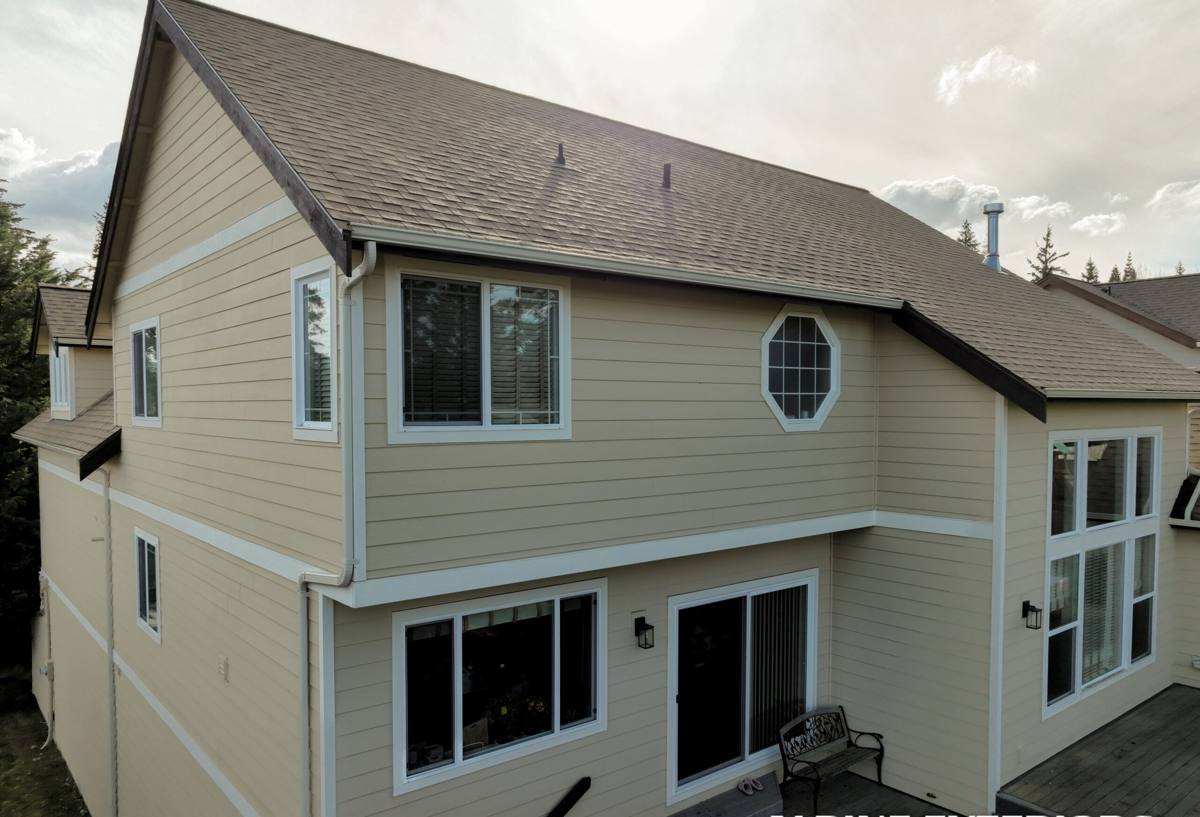
Signs an Everson Home Needs New Windows
Most homeowners don't replace windows because they woke up wanting new windows — they replace them because something started going wrong. In this area, the usual signs are:
- Fogging or a permanent haze between the panes (the seal on the insulated glass unit has failed)
- Visible moss, algae, or dark staining on the sill or trim below the window
- Soft or spongy wood when you press on the sill, jamb, or the siding directly under the window
- Drafts you can feel with a hand near the frame on a windy day
- Windows that are hard to open, close, or lock because the frame has swollen or warped
- Condensation building up on the inside of the glass every morning, especially in bedrooms and bathrooms
Any one of these is worth a look. Several at once usually means the original installation is letting water into places it shouldn't be, and the window itself may be the least of it — the framing around it could already be compromised.
What a Correct Window Installation Actually Involves
Setting a new window into an opening looks simple from the outside. Getting the water management right is where the job is actually won or lost. There are three parts to this that matter more than anything else.
Flashing and Water Management
Every window opening needs a sloped sill pan so any water that gets past the glass or trim drains back out, not down into the wall. The weather-resistive barrier (the house wrap) has to be integrated with the window flanges in the right shingle-lap order — top piece over the one below it, always — so water sheds outward the way it would off a roof. Skip this step or do it out of order, and you've built a funnel instead of a barrier.
Insulation and Air Sealing
The gap between the window frame and the rough opening needs to be filled with a low-expansion foam or backer rod and sealant — not stuffed with fiberglass batting, which does nothing to stop air movement and can actually hold moisture against the frame. Over-filling with high-expansion foam can bow the frame and cause the sashes to bind, which is a common callback on rushed jobs.
Fit, Level, and Reveal
A window has to be plumb, level, and square in the opening, with an even reveal (gap) around the sash so it operates smoothly for the life of the unit. Shimming in the wrong spots or racking the frame during installation is a leading cause of windows that stick, won't latch, or wear out their weatherstripping early.
Choosing the Right Window for This Climate
Material choice matters less than installation quality, but it's still worth getting right for a house that's going to sit through Whatcom County winters and wet springs for decades. Here's how the common options compare for a Everson-area home:
| Material | Moisture Performance | Maintenance | Typical Lifespan |
|---|---|---|---|
| Vinyl | Won't rot; seams and welds are the main thing to inspect over time | Low — occasional cleaning | 20–30 years |
| Fiberglass | Very stable in wet/dry cycles; expands and contracts close to glass | Low | 30–40 years |
| Wood, unclad | Good insulator but vulnerable to rot without diligent upkeep | High — regular painting/sealing | Varies widely with maintenance |
| Wood, clad (vinyl or aluminum exterior) | Good — exterior shell protects the wood core | Moderate | 25–35 years |
For most homes in this area we lean toward vinyl or fiberglass for anywhere exposed to weather, simply because they don't need paint upkeep to keep water out. Unclad wood can still be the right call for a specific look, but it comes with a real maintenance commitment in a climate this wet — that's an honest trade-off, not a knock on wood as a material.
What Affects the Cost of a Window Installation
Every home is different, but the price of a window job is driven by a handful of factors that are worth understanding before you get quotes:
| Factor | Why It Matters |
|---|---|
| Replacement vs. new construction | New-construction (full-frame) installs cost more but let us fully address flashing and rot; replacement inserts are faster but only as good as what's already behind the trim |
| Window size and glass type | Larger units and upgrades like triple-pane or low-E coatings add cost but improve comfort and energy performance |
| Number of openings | Per-window cost typically drops when doing a full house at once versus one-off replacements |
| Condition of the existing opening | Rot or water damage found once the old window is out adds repair work — this is the most common source of surprises |
| Trim and siding tie-in | Matching existing trim profiles or re-flashing into siding adds labor but is what actually keeps water out long-term |
As a broad range, homeowners in this region typically see somewhere around $500 to $1,300 per window installed, all-in, depending on those factors. Anyone quoting well outside that without an obvious reason — very large openings, full-frame replacement, custom shapes — is worth asking follow-up questions.
Our Installation Process, Start to Finish
- On-site assessment. We look at each opening, check for existing rot or water damage, and measure for the correct window size and type.
- Ordering and scheduling. Windows are ordered to the exact opening dimensions; we schedule the install around weather, since flashing work needs a dry window to do right.
- Careful removal. The old window comes out without tearing up more siding or trim than necessary, and we inspect the sheathing and framing underneath before anything goes back in.
- Repair as needed. Any soft wood, compromised house wrap, or old flashing that's failed gets replaced before the new window goes in — this is where a rushed job cuts corners and a correct one doesn't.
- Set, flash, and seal. The window is set level and plumb, sill pan and flashing tape go in following proper shingle-lap order, and the unit is sealed and insulated correctly.
- Trim and finish. Interior and exterior trim is reinstalled or replaced to match, and the siding tie-in is finished so there's no visible gap or mismatch.
- Final check. We test operation, check the seal, and walk the job with the homeowner before calling it done.
Mistakes We See From Rushed or DIY Installations
We get called out to fix a fair number of window jobs that were done fast rather than done right. The patterns repeat:
- House wrap taped in the wrong order, so water gets directed behind the barrier instead of over it
- No sill pan, so any water that gets past the window sits directly on bare wood
- Caulk used as the primary water seal instead of proper flashing — caulk fails; flashing sheds water by design
- High-expansion spray foam bowing the frame, causing the window to stick or fail to latch
- Trim reinstalled over rot instead of the rot being addressed first
- Mismatched reveal or an out-of-square frame that wears out weatherstripping years early
None of these show up on day one. They show up two, five, or ten winters later as a soft spot in the wall or a window that won't close right — which is usually more expensive to fix than it would have been to do correctly the first time.
Why a Crew That Already Works in Everson Matters
We're a siding company first, which matters more for windows than it might seem. Window flashing and siding water management are the same system — the house wrap, the flashing, and the siding all have to shed water in the same direction, in the right order. When one crew handles both, there's no gap between "that's the window guy's job" and "that's the siding guy's job," and no finger-pointing if something leaks at the seam between them.
We also know what Whatcom County framing and siding from different eras tends to look like once it's opened up — older wood siding, various vintages of house wrap, and the kind of moisture patterns that show up on farmhouses and older homes in this part of the county after decades of wet winters. That's not something a crew coming in from outside the area gets right the first time on every house.
If you're weighing a window replacement in Everson — whether it's one leaking unit or a full-house job — we're happy to come take a look and give you a straight assessment of what's actually going on. Use the form below to request a free, no-pressure estimate.