 Ferndale
 Custer's Climate Puts Real Demands on Siding
Custer sits in the part of Whatcom County where Pacific storms roll in off the Strait of Georgia and Birch Bay with little to slow them down. Homes here deal with a combination that's tougher on exterior materials than most homeowners realize: salt-laden air moving inland off the water, long stretches of driving, wind-pushed rain in the fall and winter, and a wet, shaded moss season that can run half the year. Any siding product installed in Custer has to survive all three at once, year after year, not just look good on installation day.
Salt air accelerates corrosion on fasteners, trim, and any metal flashing that isn't properly rated or protected. Driving rain finds its way into laps, seams, and butt joints that aren't detailed correctly, and once moisture gets behind siding it doesn't dry out quickly in a climate this damp. Moss and algae take hold on north-facing walls, under eaves, and anywhere airflow is restricted — and they hold moisture against the wall surface even longer. This is the environment we design every Custer installation around.
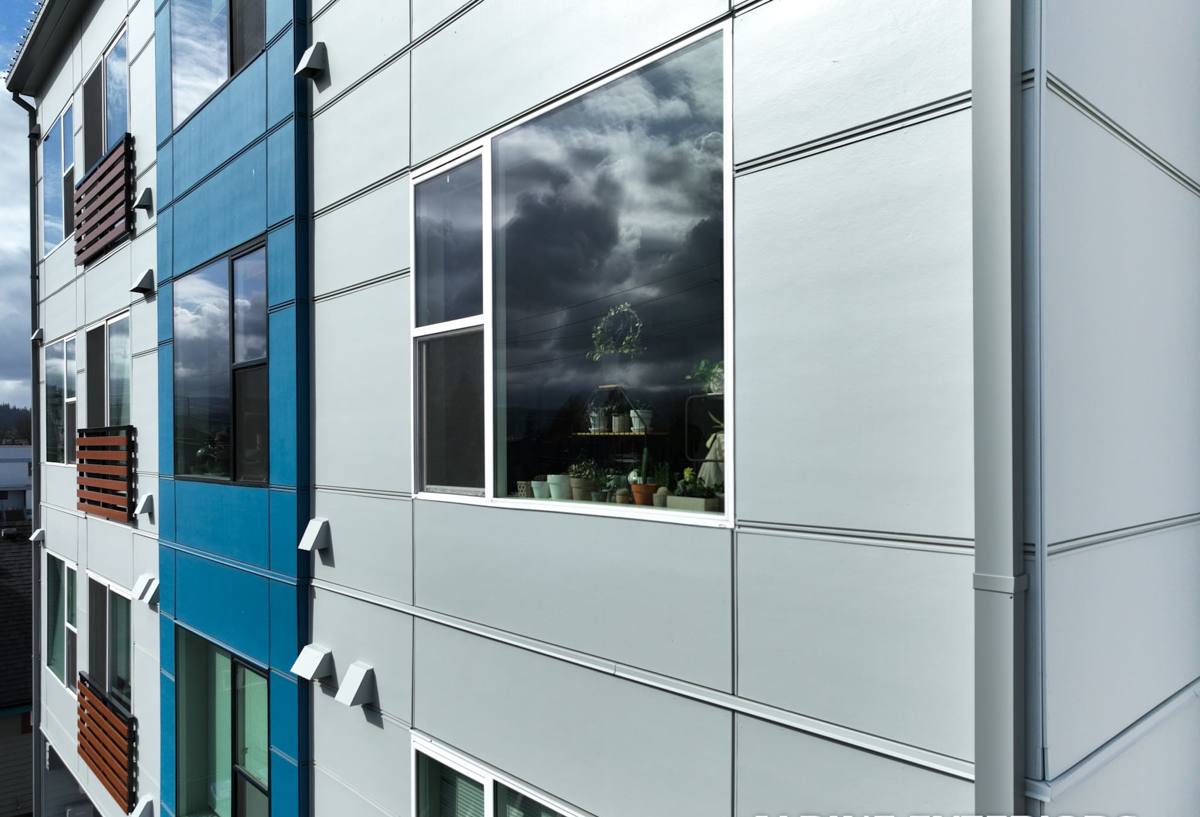
Why We Install Only James Hardie Fiber Cement
Ferndale Siding installs one siding system: James Hardie fiber cement. We don't install vinyl, LP SmartSide, Cemplank, Allura, or unfinished wood siding like primed spruce or cedar, and that's a deliberate standard, not a limitation on what we're capable of doing.
Vinyl softens, warps, and can crack in freeze-thaw cycles, and it doesn't hold up well against the physical impact and UV exposure Whatcom County weather delivers over decades. Wood products like cedar and primed spruce look good going up but require an ongoing maintenance commitment — re-staining or re-painting, checking for rot, and managing moisture absorption — that most homeowners underestimate until the wood is already compromised. Engineered wood siding like LP SmartSide uses treated strand board that performs well in many climates, but it's still a wood-based product, and wood-based products are inherently more sensitive to sustained moisture exposure than fiber cement.
James Hardie fiber cement is a cement, sand, and cellulose fiber composite. It doesn't rot, it's not attractive to pests, and it's non-combustible. It holds paint and factory finish far longer than wood substrates, and it's engineered specifically for the moisture and temperature swings of different U.S. climate zones — which matters directly for a coastal-influenced area like Custer.
The Right Hardie Product for Custer's Exposure
James Hardie makes climate-specific product lines, and homes on the wetter, salt-influenced side of Whatcom County call for the HZ5 formulation, engineered for the Pacific Northwest's combination of moisture and temperature range. This isn't a marketing distinction — the fiber cement formulation itself is adjusted for how much moisture cycling the material will see over its life.
We pair that substrate with Hardie's ColorPlus Technology, a factory-applied finish that's baked on under controlled conditions rather than sprayed or brushed on site. That matters in a place like Custer for a simple reason: field-applied paint is only as good as the weather conditions on the day it's applied, and a factory finish removes that variable entirely. ColorPlus finishes carry their own dedicated warranty coverage against fading and peeling, separate from the substrate warranty.
What This Combination Delivers
- A substrate formulated for high-moisture, coastal-influenced climates rather than a generic national blend
- A factory finish cured under consistent conditions, not dependent on the day's weather
- Color and finish warranty coverage separate from — and in addition to — the product warranty
- A finish that resists the chalking and fading that salt air and UV exposure accelerate on lesser coatings
What a Correct Installation Involves
Fiber cement siding is only as good as the installation behind it. Most of the siding failures we get called out to inspect in this region weren't caused by the material — they were caused by shortcuts in the install: missing rainscreen gaps, wrong fasteners, poor flashing details, or caulk used to cover a joint that should have been built correctly in the first place.
For Custer homes, given the rain and salt exposure, we treat these details as non-negotiable:
Drainage and Moisture Management
We install a rainscreen drainage gap behind the siding wherever the wall assembly allows for it, so that any moisture that does get past the cladding has somewhere to drain and dry rather than sitting against the wall sheathing. This is especially important on wind-driven-rain exposures, which describes most west- and southwest-facing walls in this part of the county.
Fasteners and Metal Components
Salt air corrodes the wrong fastener over time, so we use corrosion-resistant fasteners rated for the exposure, and we flash penetrations, windows, and butt joints with materials that won't degrade faster than the siding around them. A siding job is only as durable as its weakest metal component.
Joints, Laps, and Butt Seams
Hardie specifies precise nailing patterns, lap exposure, and joint treatment for a reason — get these wrong and you create entry points for water that no amount of caulk will permanently solve. We follow manufacturer installation specs exactly, because doing so is also what keeps the product warranty valid.
Comparing Approaches: What Separates a Correct Install
| Detail | Common Shortcut | Correct Approach for Custer's Climate |
|---|---|---|
| Wall drainage | Siding fastened directly to weather barrier | Rainscreen gap for drainage and drying behind the cladding |
| Fasteners | Standard or mismatched fasteners | Corrosion-resistant fasteners rated for salt-air exposure |
| Joint sealing | Heavy caulking to mask gaps | Correct lap and joint spacing per manufacturer spec, minimal reliance on sealant |
| Finish | Field-applied paint after install | Factory-applied ColorPlus finish, warrantied separately |
| Flashing | Reused or undersized flashing | Properly sized, corrosion-resistant flashing at every penetration |
Moss, Algae, and Ongoing Maintenance
Even a correctly installed fiber cement wall will see moss and algae growth in Whatcom County's shaded, damp conditions — no siding material is immune to that. What changes with a correct Hardie install is how much that growth actually threatens the wall behind it. A properly drained, properly finished wall sheds moisture instead of absorbing it, so surface growth stays a cosmetic issue rather than becoming a path for rot or trapped moisture.
We recommend homeowners in Custer do a simple visual check once or twice a year, particularly on north-facing and heavily shaded walls: look for moss buildup at butt joints and under trim, and keep gutters and downspouts clear so runoff isn't sheeting directly down the siding face. A gentle rinse is usually enough — fiber cement doesn't require the aggressive cleaning or re-sealing that wood siding demands to stay protected.
Why a Crew That Already Works Custer Matters
Custer isn't a dense urban area — it's a mix of rural properties, homes near the water, and lots with real exposure to wind and weather off the Strait of Georgia. A crew that already works this specific stretch of Whatcom County understands which walls on a given lot take the worst of the driving rain, where salt air exposure is worse due to proximity to the water, and how local permitting and building department expectations run in the county versus inside Ferndale's city limits.
That familiarity shows up in small decisions that add up: which wall gets the extra flashing detail, where a rainscreen gap matters most, and how to sequence a job around the wetter months so the wall assembly isn't left exposed longer than necessary. It's the difference between a generic installation and one built specifically for how weather actually behaves on that property.
Our Process, Start to Finish
Every Custer project starts with an on-site look at the existing siding, sheathing, and any problem areas — not a phone estimate. From there:
- We assess the wall assembly, exposure direction, and any existing moisture damage before quoting anything
- We recommend the correct James Hardie product line and ColorPlus color for the home's exposure
- We provide a written scope that spells out drainage, flashing, and fastening details — not just a square-footage price
- We install to manufacturer specification, which keeps both the product and finish warranties valid
- We walk the finished job with the homeowner before calling it complete
Questions Worth Asking Any Siding Contractor Before You Sign
- Will you include a rainscreen drainage gap, and where on the wall does it matter most for this property?
- What fasteners and flashing materials are you using, and are they rated for salt-air exposure?
- Is the finish factory-applied or field-painted, and what does that finish's warranty actually cover?
- Are you licensed and insured to work in Whatcom County, and can you provide proof?
- Will the installation follow the manufacturer's published spec closely enough to keep the product warranty intact?
If your Custer home's siding is aging, showing moisture damage, or you're simply planning ahead, we're happy to take a look and talk through what correct fiber cement siding would involve for your specific property. Reach out for a free, no-pressure estimate using the form below.