 Ferndale
 Composite Decking in Sumas: What Local Conditions Demand
Sumas sits inland from the coast, tucked into the valley near the Canadian border, and it deals with a different mix of weather than the neighborhoods closer to Bellingham Bay. Winter nights run colder here, moisture tends to sit longer in low-lying yards, and shaded corners of a lot can stay damp for weeks at a stretch. Add in the driving rain and the long moss season that the whole region deals with, and you have conditions that are hard on any outdoor structure — decks included. Composite decking has become the practical choice for a lot of Sumas homeowners because it doesn't rot, doesn't need yearly staining, and shrugs off the freeze-thaw cycles that eventually work wood boards loose.
That said, "composite" isn't one product, and it isn't magic. It still has to be installed correctly for this climate, with the right framing, the right ventilation underneath, and the right hardware. A composite deck built without those details in mind will still grow moss, still trap moisture, and still fail early — just more slowly than a wood deck would.
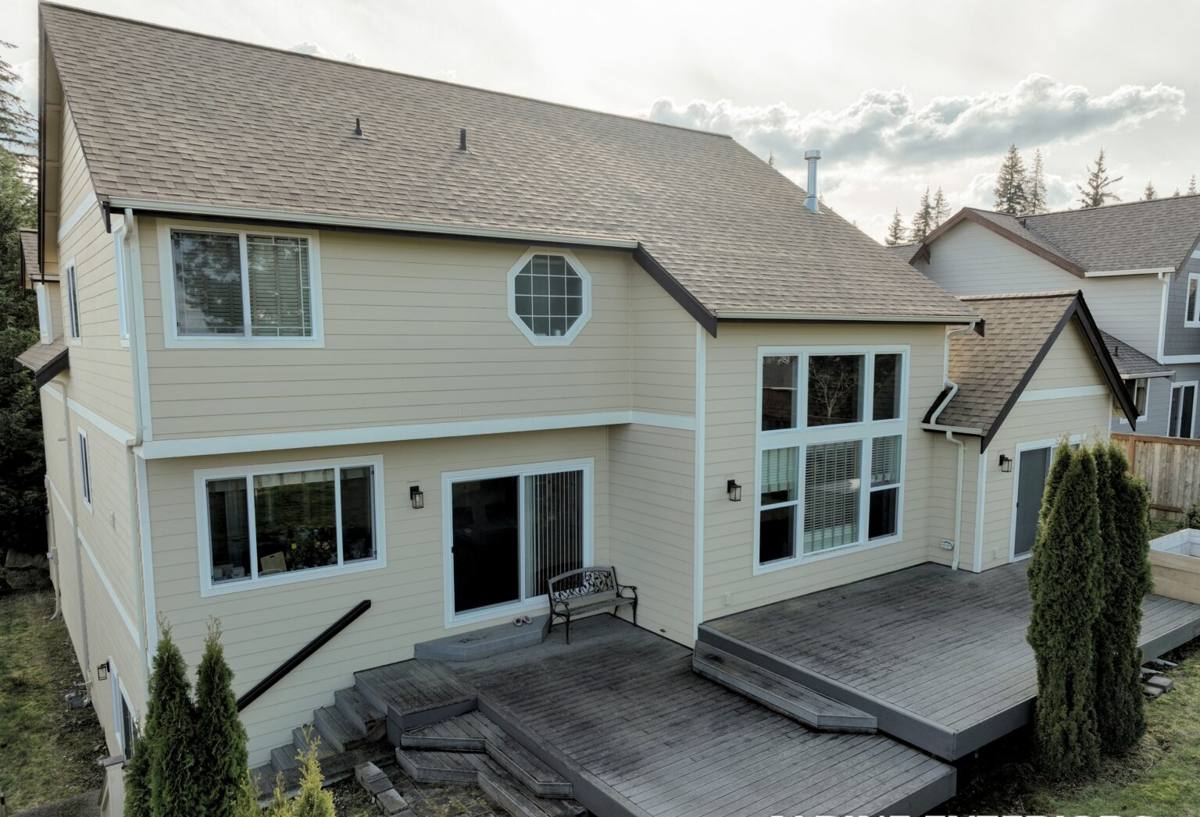
What Driving Rain and Moss Season Actually Do to a Deck
Whatcom County's wet season isn't just about total rainfall — it's about duration. Weeks of low-intensity rain, combined with limited sun exposure in the winter months, mean deck surfaces and the structure underneath can stay damp far longer than in drier climates. That has a few practical effects on decks in and around Sumas:
- Moss and algae establish on any surface that stays shaded and damp, including deck boards, especially on the north side of a house or under overhangs.
- Standing water at low spots or against the house wall works its way into seams, fasteners, and ledger connections if flashing and slope aren't done right.
- Colder valley nights mean more freeze-thaw cycles on any moisture trapped in end grain, screw holes, or gaps — this is a wood problem more than a composite one, but the framing underneath still needs to account for it.
- Poor airflow under a low deck (common on flatter Sumas lots where decks sit close to grade) slows drying and speeds up mildew growth on the underside of boards and on joists.
None of this is unique to Sumas, but the combination of colder inland winters and the region's long wet season makes attention to drainage and ventilation more important here than it would be in a drier part of the state.
What a Correct Composite Deck Installation Actually Involves
The Substructure Comes First
Composite boards are only as good as what's underneath them. Joists need to be spaced correctly for the specific board product (composite typically wants tighter joist spacing than wood, especially at angles or on stairs), and any exposed framing should be protected with joist tape or flashing so it isn't absorbing water directly. Ledger boards — where the deck attaches to the house — need proper flashing to keep water from tracking behind the siding, which is one of the most common failure points we see on older decks in this area.
Ventilation Underneath
On decks built low to the ground, which is common on the flatter lots around Sumas, airflow underneath matters as much as anything on top. Skirting, if used, should never seal the space completely — vents or gaps are needed so the area under the deck can dry out between rain events instead of staying damp all winter.
Fastening and Board Gaps
Most composite systems use hidden fastener clips rather than face screws, which keeps the surface cleaner and avoids the small pockets where water and debris can collect around screw heads. Board-to-board gaps also need to be set correctly for drainage and for the material's expansion and contraction — composite moves with temperature more than people expect, and gaps that are too tight in summer installs can buckle boards once the cold sets in.
Flashing and Transitions
Anywhere the deck meets the house, a post, or a set of stairs is a place water wants to collect. Correct flashing and drip edges at these transitions are what actually keep a deck dry over the long term — not the decking material itself.
Composite vs. Wood vs. PVC: An Honest Comparison
| Material | Maintenance | Moisture Behavior | Typical Lifespan | Upfront Cost |
|---|---|---|---|---|
| Pressure-treated wood | Annual cleaning, periodic staining/sealing | Absorbs water, prone to splintering and rot over time | 10–15 years before major repairs | Lowest |
| Capped composite | Occasional wash, no staining or sealing | Resists moisture absorption; surface sheds water | 25+ years | Mid to upper-mid |
| Cellular PVC | Low, similar to composite | Fully moisture-resistant, but more sensitive to installation temperature | 25–30+ years | Highest |
We install composite most often in this area because it strikes a reasonable balance for Whatcom County's climate — it handles the wet season without the upkeep wood demands, and it's more forgiving to install correctly than PVC, which expands and contracts more aggressively and punishes small installation mistakes. Wood still has a place for homeowners who want that specific look and are committed to the maintenance, but we're upfront that it's a different level of ongoing work in a climate like this one.
Our Process for a Sumas Composite Deck Project
- On-site assessment. We look at existing structure (if replacing a deck), grade and drainage around the house, sun/shade exposure, and how the deck connects to the house.
- Framing plan. We size and space the substructure for the specific composite product, not a generic wood spec, and plan flashing at every transition point.
- Ledger and flashing work. This is done before a single deck board goes down — it's the part that determines whether water gets behind your siding five years from now.
- Installation. Hidden-fastener boards, correct gapping for drainage and thermal movement, and attention to how stairs and railing posts tie into the frame.
- Final walkthrough. We check drainage flow off the deck surface, ventilation underneath, and that all transitions are sealed correctly before we call it done.
Living With a Composite Deck Through Whatcom County Winters
Composite decking cuts maintenance dramatically compared to wood, but "low maintenance" isn't "no maintenance," especially with a moss season as long as this region's. A yearly wash with a soft-bristle brush and a composite-safe cleaner keeps moss and algae from getting a foothold, particularly on shaded sections of the deck. Keeping gutters and downspouts clear so water isn't sheeting onto the deck surface, and keeping the area underneath a low deck clear of leaves and debris, does more for long-term performance than any product feature. None of this is heavy work — it's the difference between a deck that looks new for two decades and one that develops slick, mossy patches by year three.
What Affects Cost on a Composite Deck Project
| Factor | Why It Matters |
|---|---|
| Deck size and shape | More linear footage of framing, boards, and fascia; angles and curves add labor |
| Condition of existing structure | Replacing boards on sound framing costs less than rebuilding a failing substructure |
| Board tier | Composite lines range from entry-level to premium capped boards with better fade and stain resistance |
| Railing and stairs | Composite or metal railing systems and multi-level stairs add material and labor |
| Site access and grade | Sloped or low-clearance lots, common around Sumas, can add framing complexity |
We'd rather walk your specific site and give you real numbers than quote a range that doesn't reflect your yard, your existing structure, or the board tier you want.
Why Hiring a Crew That Already Works in Sumas Matters
Decking rules of thumb that work in a drier climate don't always hold up here. A crew that regularly works Whatcom County properties already knows to over-build ventilation on low decks, flash ledgers like the wet season is going to test them (because it will), and space fasteners with our freeze-thaw cycles in mind. That local pattern-recognition — knowing which corners of a Sumas lot stay shaded and damp longest, or how a particular grade tends to shed or hold water — comes from doing this work in this specific area, not from a general decking spec sheet.
Here's a short checklist worth going through with any contractor before you sign anything for a composite deck project:
- Do they specify joist spacing and tape/flashing details specific to composite, not just generic wood-deck framing?
- Do they explain how they'll handle ledger flashing where the deck meets your house?
- Do they account for ventilation on low or ground-level deck sections?
- Can they explain board gap spacing and why, rather than just installing "to feel"?
- Are they licensed and insured, and willing to put warranty terms on the substructure as well as the decking material itself?
- Do they have experience with the specific composite product line you're considering, including its expansion behavior?
A contractor who can answer these clearly, without hedging, is one who's actually built decks that held up through a few Whatcom County winters — not just installed boards on a sunny day and moved on.
Get a Straight Answer for Your Sumas Property
Every lot in the Sumas area handles drainage, shade, and grade a little differently, and that affects how a deck should actually be built — not just what it's built out of. If you're weighing a new composite deck or replacing an aging wood one, we're glad to come take a look, walk the site with you, and give you a straightforward, no-pressure estimate based on what your property actually needs. Use the form below to get started.