 Ferndale
 Why Semiahmoo's Marine Climate Is Hard on Decks
Semiahmoo sits right up against the water, and that proximity changes how a deck ages compared to one a few miles inland. Salt-laden air carries fine particulate that settles on every exposed surface — decking boards, railings, and especially metal hardware. Combined with Whatcom County's driving rain and a moss season that can stretch from late fall well into spring, the conditions here work against a deck from multiple directions at once, not just one.
Wood expands and contracts with moisture cycles, and in a marine environment those cycles happen more often and more abruptly than inland. Salt also lowers the effective corrosion resistance of standard fasteners and connectors, which is a big part of why decks near the water often show hardware failure — rust streaks, loosened ledger bolts, corroded joist hangers — well before the decking itself looks worn out. Add in wind-driven rain that gets pushed sideways under railings and against ledger boards, and you get moisture intrusion in places a deck further from the shoreline rarely sees.
Moss and algae are the visible symptom most homeowners notice first, but they're really an indicator of a deeper issue: the surface is staying wet longer than it should. A deck that drains and dries properly will still get some moss in a Whatcom County winter, but it won't hold water long enough for the growth to take hold in the wood grain itself.
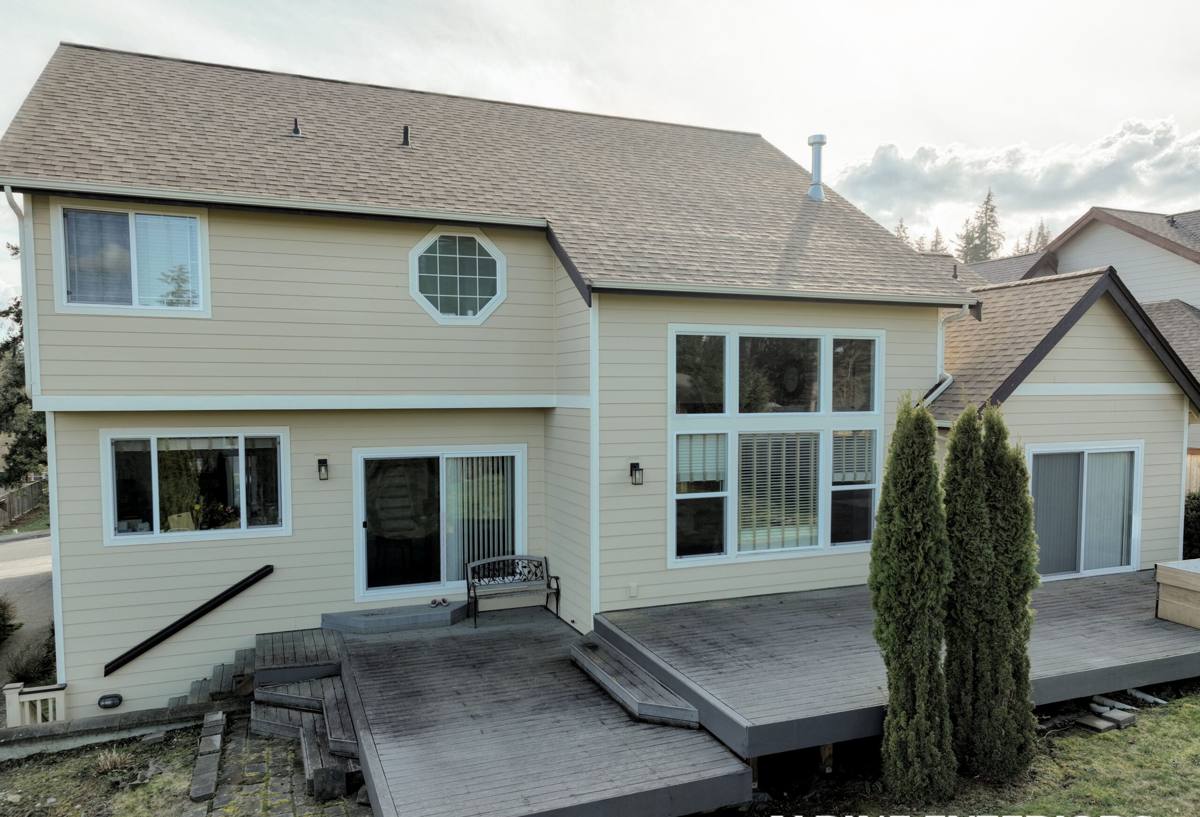
Signs Your Deck Needs Replacement, Not Just Repair
Not every problem deck needs to come out entirely. But there's a point where patching individual boards or re-bolting a loose post is just delaying a bigger job — and in some cases, masking a structural problem that's getting worse underneath. Knowing which situation you're in matters, because replacing framing after the fact costs more than doing it right the first time.
- Soft or spongy spots in the decking, especially near the house or around post bases
- Visible rot or dark staining at the ledger board where the deck meets the house
- Rust stains bleeding from screw heads, joist hangers, or post brackets
- Persistent moss or algae that returns within weeks of cleaning
- Railings or stairs that feel loose or move under normal use
- Gaps opening up between boards, or boards cupping and warping
- A deck more than 15-20 years old that has never had framing inspected
If you're only seeing one or two of these and the framing underneath tests solid, a repair or resurfacing may be the honest answer. We'll tell you that during an inspection rather than push a full tear-out you don't need. But when the ledger connection, joists, or posts show decay, replacement is almost always the more cost-effective path — repeated patch jobs on a failing structure rarely add up to savings.
What a Correct Deck Replacement Actually Involves
A deck replacement isn't just swapping old boards for new ones. Done correctly, it starts from the house outward: the ledger connection, the framing, the drainage path, and only then the decking surface and railings. Skipping steps in that order is how decks end up with the same failure a few years later, just with new boards on top of an old problem.
The ledger board — where the deck attaches to the house — is the single most important connection on the entire structure, and it's also the one most exposed to water running off the house siding and roofline. A correct install includes proper flashing behind and over the ledger, a water-resistant barrier between the ledger and the house sheathing, and structural bolts (not just deck screws) rated for the load. This is also where a lot of shortcuts happen on lower-quality jobs, because it's the least visible part of the finished deck.
From there, framing spacing, beam sizing, and post footings all need to match the actual load the deck will carry and the soil conditions on the lot. Whatcom County's wet clay-heavy soils in many areas mean footings need to be set to the right depth and bear on undisturbed soil, not just poured wherever is convenient.
Choosing Decking Material for Salt Air and Standing Moisture
There's no single "best" decking material for every home — it depends on your budget, how much upkeep you're willing to do, and how close you are to the water. What we won't do is install a product in a way that ignores how it actually behaves in this climate. Here's an honest comparison of the main options homeowners in Semiahmoo consider:
| Material | How it handles salt air & rain | Maintenance | Typical lifespan here |
|---|---|---|---|
| Pressure-treated lumber | Good if properly sealed and re-sealed on schedule; end cuts need field treatment | Annual cleaning, re-staining every 2-3 years | 15-20 years with upkeep |
| Cedar | Naturally rot-resistant but still needs sealing near salt air to prevent graying and checking | Cleaning plus periodic oil or sealant | 15-20 years with upkeep |
| Composite decking | Doesn't absorb moisture the way wood does; resists rot but can still grow surface moss if drainage is poor | Periodic washing, no staining or sealing | 25-30 years, varies by product warranty |
| PVC/capped polymer | Fully sealed surface, best resistance to moisture and salt residue buildup | Occasional washing | 25-30+ years, varies by product warranty |
Composite and capped polymer boards tend to make the most sense for homes with direct water exposure, simply because they don't rely on a maintained sealant film to keep moisture out. That said, plenty of homeowners prefer the look and feel of real wood and are happy to keep up with sealing — that's a legitimate choice too, as long as the framing underneath is built to handle the extra moisture cycling wood goes through.
Whatever surface material you choose, the hardware and framing underneath should be treated the same way regardless of decking type. A composite deck built on under-rated fasteners will still fail at the connections even if the boards themselves never rot.
Fasteners and Hardware: The Part Homeowners Never See
This is where a lot of the real difference between a deck that lasts and one that doesn't gets decided, and it's almost entirely invisible once the project is finished. In a salt-air environment, standard electro-galvanized fasteners corrode faster than their rated lifespan would suggest inland. That corrosion doesn't just look bad — it weakens the connection at joist hangers, ledger bolts, and post bases, which are exactly the points carrying the deck's structural load.
For decks in coastal and near-coastal Whatcom County locations, we use fasteners and structural connectors rated for the moisture and chemical exposure they'll actually face — typically stainless steel or heavy hot-dip galvanized hardware at connection points, matched to what's compatible with the decking material chosen (some composite manufacturers specify particular fastener coatings to avoid a chemical reaction with the board treatment). Mixing incompatible metals at a connection point can accelerate corrosion on both sides, so this isn't a place to substitute whatever is on the shelf.
None of this hardware is visible in the finished deck, which is exactly why it's worth asking a contractor directly what they're using before work starts, not after.
Our Deck Replacement Process, Step by Step
We keep the process straightforward and try to minimize surprises once demolition starts, since that's when hidden problems — a rotted ledger, undersized footings, framing that was never up to code — tend to show up.
- On-site inspection. We check the ledger connection, framing, post footings, and drainage before quoting anything, so the estimate reflects what's actually there.
- Scope and material walkthrough. We go over decking material options, hardware grade, and railing choices based on your budget and how exposed the deck's location is to wind and rain.
- Permit handling. For projects that require it, we handle the permit application with Whatcom County so you're not navigating that process yourself.
- Demolition and disposal. Old decking, framing, and hardware are removed and hauled off; we check the ledger area and house sheathing for hidden water damage at this stage.
- Framing and ledger work. New or repaired framing goes in first, with proper ledger flashing and structural fasteners, before any decking is installed.
- Decking, railing, and stairs. Boards, railings, and stairs are installed per the material manufacturer's spacing and fastening specs.
- Final walkthrough. We go over the finished deck with you, including care instructions specific to the material you chose.
Timelines vary with deck size and whether framing needs full replacement versus reinforcement, but we'll give you a realistic window before work begins rather than an optimistic one that slips.
Permits and Local Requirements in Whatcom County
Deck replacement projects in unincorporated Whatcom County — which covers much of the Semiahmoo area — generally require a building permit when the work involves structural changes, a deck built above a certain height, or attachment to the home's structure. Simple like-for-like resurfacing on an existing, code-compliant frame sometimes falls outside permit requirements, but that determination depends on the specifics of the project and current county code, not a blanket rule.
We handle the permit application and inspection scheduling as part of the job for projects that need it, so you're not the one tracking down requirements or waiting on hold with the county. If your property is part of an HOA or has waterfront setback considerations, that's worth flagging early in the conversation too, since it can affect placement or railing height requirements.
Maintenance That Extends Deck Life After Replacement
A well-built deck still needs some ongoing attention in this climate — the goal of a correct build is to make that maintenance manageable, not to eliminate it entirely. Here's what actually makes a difference:
- Rinse salt residue and debris off the surface a few times a year, especially after storms with wind off the water
- Keep gutters and downspouts near the deck clear so runoff isn't dumping directly onto or under it
- Sweep leaves and organic debris out of gaps between boards before they trap moisture and feed moss growth
- For wood decking, reseal on the schedule appropriate to the product — don't wait until graying is severe
- Check railing posts and stair connections annually for movement, even on newer decks
- Keep planters and rugs from sitting in one spot for months at a time, since they trap moisture underneath
- Have the under-deck framing and ledger connection glanced at every few years, even if the surface looks fine
None of this is complicated, but it's easy to let slide, especially through a wet Whatcom County winter when nobody's spending much time on the deck anyway. A quick seasonal check catches small issues — a loose baluster, a clogged drainage gap — before they turn into bigger ones.
Why Hire a Crew That Already Works in Semiahmoo
A contractor who mostly works inland doesn't always think to spec stainless hardware, factor in wind-driven rain at the ledger, or account for how quickly moss establishes itself on a shaded, salt-exposed deck. It's not a knowledge gap most people notice until the deck starts showing problems a few years in — by then it's a repair job instead of a build decision.
Working regularly in and around Semiahmoo means we've seen how decks in this specific environment actually hold up over time, not just how they're rated to perform on paper. That shapes the material and hardware recommendations we make from the first inspection, rather than defaulting to a generic spec sheet that assumes drier, calmer conditions than what this area actually gets.
We're also familiar with Whatcom County's permitting process for this area specifically, which keeps projects from stalling on paperwork or inspection scheduling. If you're weighing a deck replacement and want a straight answer about whether your current deck needs a full rebuild or just targeted repair, we're happy to come take a look. Reach out for a free, no-pressure estimate — we'll walk the deck with you and tell you what we'd actually recommend, not just what's easiest to sell.