 Ferndale
 Siding Replacement for Bellingham Homes
Bellingham sits right on the water, and that location shapes everything about how siding ages here. Salt-tinged marine air moves through the city on an almost daily basis, storms off the Salish Sea push rain sideways into wall assemblies instead of straight down, and shaded or tree-covered walls stay damp long enough to grow moss for most of the year. Siding that was installed thirty, twenty, or even fifteen years ago was not necessarily built to handle that combination indefinitely, and a lot of the replacement calls we get in Bellingham start with a homeowner noticing a problem that's actually been developing behind the wall for years before it became visible.
This page is specifically about full siding replacement, not patch repair or new-construction installation. Replacement is a different job with different stakes: it means removing what's there now, dealing with whatever the tear-off reveals, and putting on a system that's actually engineered for this climate rather than one that happened to be the builder's original spec decades ago.
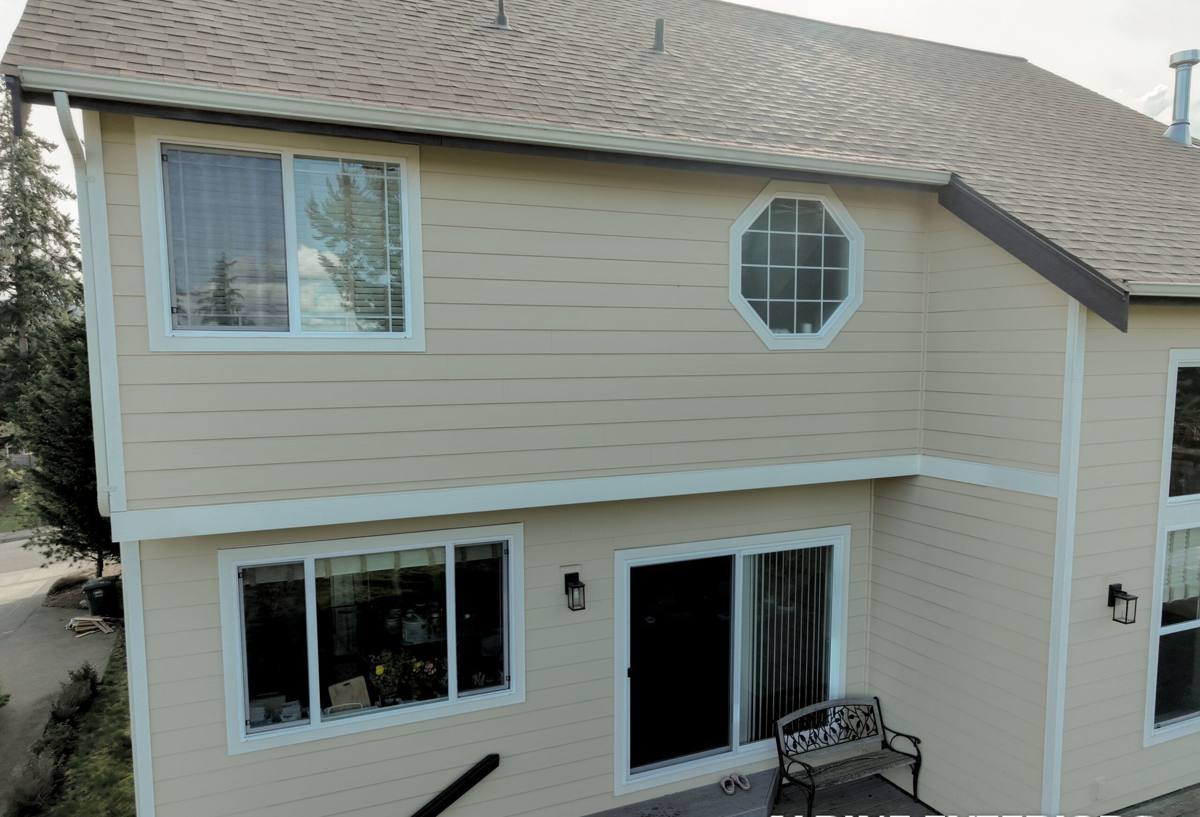
How Bellingham's Climate Wears Down Siding
Salt Air and Sustained Moisture
Bellingham Bay puts a steady flow of moist, salt-tinged air across the city, and that exposure doesn't need a storm to do damage. It's a slow, cumulative process that corrodes fasteners, degrades lower-grade finishes, and works into any gap in the exterior envelope over years. By the time it's visible from the street, it's usually been active for a while.
Wind-Driven Rain
Rain in this part of Whatcom County frequently arrives at an angle, pushed by wind off the water. A siding system, house wrap, and flashing setup that would keep water out in a calmer climate can still fail here specifically because water is being driven sideways into lap joints, trim seams, and penetrations that a straight-down rainfall model wouldn't stress the same way. This is one of the most common reasons we find rot behind old siding that looked fine on the surface.
A Long Moss and Mildew Season
Mild temperatures, cloud cover, and consistent dampness give moss and mildew a long growing window on north-facing and shaded walls. Any siding with even slight porosity, or that holds moisture against the substrate instead of shedding it, becomes a growth surface over time, and that surface moisture accelerates whatever decay process is already underway underneath.
Signs a Bellingham Home Needs Full Replacement, Not a Patch
- Soft, spongy, or crumbling siding across multiple walls, not just one isolated spot
- Moss or dark staining that returns within weeks of cleaning, especially on shaded sides
- Paint that's peeling or bubbling across large sections rather than one board
- Visible warping, cupping, or delamination on multiple boards
- A musty smell inside near exterior walls, which can point to moisture already in the wall cavity
- Siding that's simply original to a home 25-plus years old and at or past its practical service life
One damaged board or a cracked corner is usually a repair. Widespread symptoms across several walls, or moisture that's clearly been active for a while, is usually a sign that patching would just delay a bigger job while the underlying problem keeps spreading.
What a Correct Siding Replacement Actually Involves
Full siding replacement is not simply removing old boards and nailing up new ones. Done right, it's a sequence where each step protects the one before it:
- Tear-off: Removing the existing siding fully enough to see the sheathing underneath, not just working around it.
- Substrate inspection: Checking for rot, soft sheathing, and hidden moisture damage before anything new goes on. This is the step that most often changes the scope of the job once we're actually inside the wall.
- Repair of damaged framing or sheathing: Any rot found gets cut out and replaced. Siding over compromised substrate just traps the problem under a new surface.
- House wrap and flashing: A continuous weather-resistive barrier and correctly lapped flashing at every window, door, and penetration, installed as one integrated system rather than a series of disconnected steps.
- Siding installation: Correct fastening patterns, proper clearance from grade and roofline, and joints that are lapped and sealed to spec.
- Trim and finish detail: Corners, trim boards, and caulking done in a way that sheds water rather than collecting it.
Skipping or rushing any one of these steps is one of the most common reasons a good siding material still fails early. The material matters, but the installation is what actually determines whether the wall stays dry.
Why We Only Replace Siding With James Hardie
When we tear off old siding on a Bellingham home, what we find underneath tells a consistent story about which materials hold up to this specific climate and which ones don't. That's why we install James Hardie fiber cement siding, exclusively, on every replacement job.
- Non-combustible core: Fiber cement doesn't feed a fire the way wood-based siding can, which matters for both safety and, in many cases, insurance.
- Factory-applied ColorPlus finish: The color coat is cured under controlled factory conditions instead of applied on-site, so it resists fading and moisture intrusion far longer than field-applied paint.
- Climate-engineered HZ formulation: Hardie's HZ5 product line is built for regions with sustained moisture and freeze-thaw cycling, which fits coastal Whatcom County's weather pattern specifically.
- Dimensional stability: Fiber cement doesn't swell, cup, or warp the way engineered wood products can after repeated wet-season moisture cycles.
- Strong transferable warranty: Provided installation follows spec, Hardie backs its products with one of the more substantial warranty structures in the industry.
We don't install LP SmartSide, vinyl siding, Cemplank, Allura, primed spruce, or cedar. Those are legitimate products and other contractors install them competently. But on replacement jobs specifically, where we're the ones responsible for what goes back on the wall after tearing off whatever failed before, we made the professional decision to stand behind one system we trust completely rather than offer a lower-cost alternative that shifts maintenance risk onto the homeowner down the road. LP SmartSide's engineered wood core is more sensitive to moisture at cut edges and fastener points than fiber cement in a climate this wet. Vinyl is affordable but can warp in sun exposure and trap moisture behind the panel if flashing details aren't handled carefully. Cedar and primed spruce look great but need ongoing painting or sealing to keep water out, and in Bellingham's rain, that maintenance schedule tends to slip.
Our Siding Replacement Process
Every replacement job starts with an in-person walk of the property, not a phone estimate. We look at wall orientation, existing damage, trim complexity, and anything the current siding is already telling us about moisture history. From there we give you a straightforward scope and price, explain what we expect to find once tear-off starts, and set a realistic timeline before any work begins. If tear-off reveals more substrate damage than expected, which happens more often in Bellingham than in drier climates, we'll show you what we found and explain the cost impact before proceeding, not after.
Cost Factors for Bellingham Siding Replacement
| Factor | What It Affects | Why It Matters in Bellingham |
|---|---|---|
| Home size and wall complexity | Total material and labor | Older Bellingham homes on hillside lots often have more dormers, trim, and roof intersections where wind-driven rain works its way in |
| Substrate condition found at tear-off | Repair costs before new siding goes on | Years of trapped moisture behind failing siding can rot sheathing and framing invisibly from outside |
| Existing material being removed | Tear-off labor and disposal | Multiple layers or previous overlay siding adds time and cost to strip back to bare sheathing |
| Trim and color selection | Material cost and finish longevity | ColorPlus factory finish outlasts field-applied paint against salt air and UV exposure |
| Site access and terrain | Labor time and equipment needs | Sloped lots and mature tree cover common around Bellingham can add staging and setup time |
Real numbers depend on the specific house and what tear-off reveals, which is why we quote after walking the property rather than off square footage alone.
Timing a Replacement Right
Siding replacement can happen in most seasons here, but scheduling around Bellingham's wetter months matters more than it would in a drier climate. We plan tear-off and house wrap installation for windows where the wall assembly can be closed back up quickly, minimizing the time exposed sheathing sits open to weather. If your current siding is already showing widespread moisture symptoms, waiting through another wet season before replacing it usually means more substrate damage to repair when the job finally happens.
Replacement Day Checklist
- Confirm the scope covers full tear-off to bare sheathing, not overlay on top of existing siding
- Ask what happens if substrate damage is found, and how that's priced before the work starts
- Confirm house wrap and flashing are part of the written scope, not just the siding material itself
- Get the fastening and clearance specs the crew is following in writing
- Confirm cleanup and disposal of old siding and debris is included
Beyond the Siding: Roofing, Windows, and Decks
Siding failure rarely starts with the siding itself. A leaking roof valley, a window that was flashed incorrectly years ago, or a deck ledger trapping moisture against the house can all surface as siding damage even though the siding is just where the water finally shows itself. Because we also handle roofing, windows, and decks, we can look at a Bellingham property as one connected exterior system during the replacement estimate and trace a problem back to its real source instead of putting new siding over a leak that's still active underneath.
Why Hiring a Crew That Already Works Bellingham Matters
A crew that replaces siding across Bellingham regularly sees how salt air, wind-driven rain, and moss actually behave on real houses through a full year, not just how a product performs on a spec sheet. That experience shows up in the decisions that matter on tear-off day: where extra flashing attention is worth the time, which wall orientations stay wettest longest, and which corners genuinely cannot be cut without causing a callback two winters later. It also means we're not guessing at what your specific street, exposure, or lot terrain typically does to a wall assembly; we've likely already worked on a house facing the same conditions nearby.
If your Bellingham home has siding that's reached the end of its service life, or you're just not sure whether what you're seeing is a repair or a full replacement, we're glad to take a look. Reach out using the form below to schedule a free, no-pressure estimate.