 Ferndale
 Why Bellingham Decks Take More Punishment Than Most
Bellingham sits right on the water, and that proximity to Bellingham Bay and the Salish Sea shapes what a deck has to survive here. You've got salt-laden air working on fasteners and finishes, driving rain that comes in sideways off Puget Sound storms, and a moss season that can run from October clear through April in a wet year. A deck built to a generic spec sheet, without accounting for those three things together, tends to show its age fast — usually in the form of green streaking, soft spots around fasteners, or a substructure that's rotting quietly underneath boards that still look fine on top.
Composite decking earns its keep in a climate like this, but only when it's installed with those local stressors in mind. A composite deck that's spec'd, framed, and finished the same way you'd do it in a dry inland climate will still underperform here. The material choice matters, but the installation details matter just as much — sometimes more.
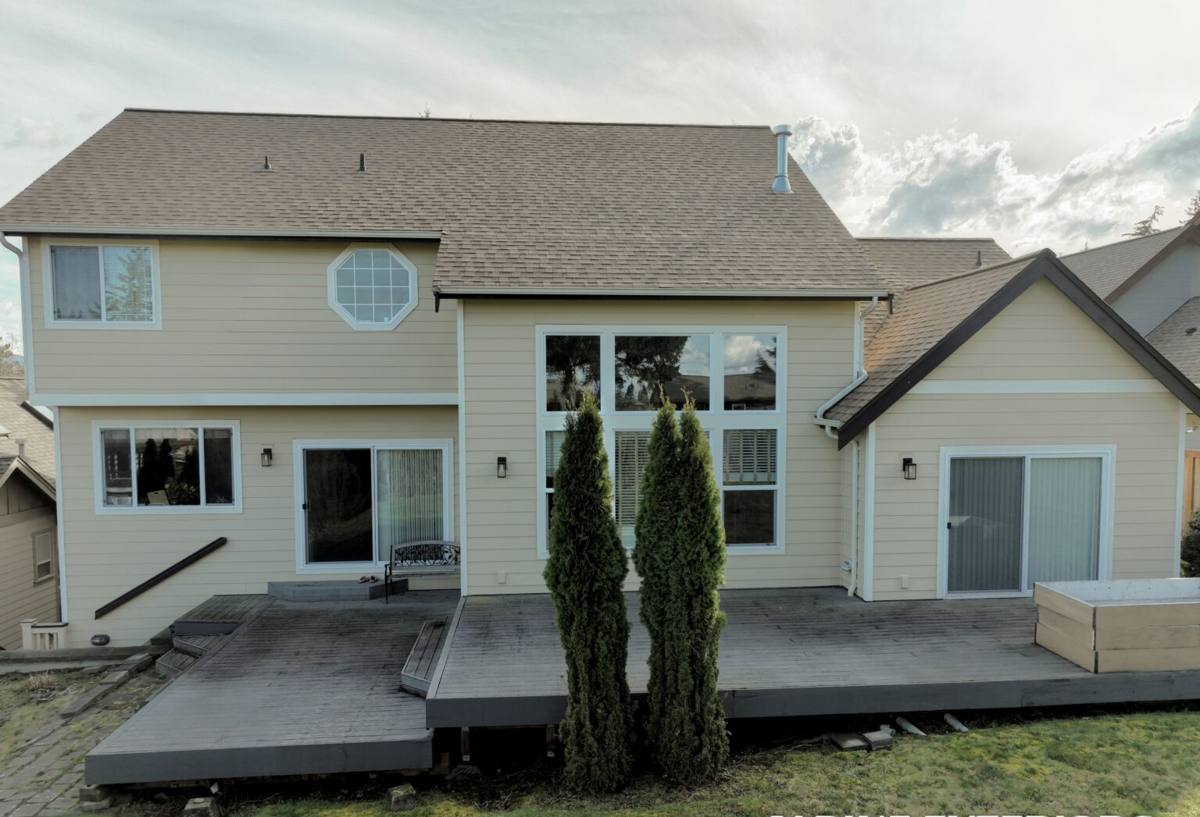
What Bellingham's Climate Actually Does to a Deck
Moisture load
Whatcom County gets a lot of rain, and Bellingham's marine exposure adds fog and heavy dew on top of that. Water doesn't just fall on a deck here — it sits on it, soaks into anything porous, and lingers in shaded or low-airflow spots for days. Any decking system that traps moisture against wood framing or fasteners is working against the climate, not with it.
Moss and organic growth
Moss needs shade, moisture, and time — Bellingham gives it all three for a good chunk of the year. Moss doesn't just look bad; it holds water against the deck surface and can make boards slick and unsafe underfoot, especially on north-facing decks or ones shaded by mature trees, which are common on older Bellingham lots.
Salt air
Homes closer to the water deal with airborne salt that accelerates corrosion on exposed metal — screws, brackets, railing hardware, and fastener heads. Over years, that corrosion can stain composite boards, weaken connections, or cause premature rust-through on lower-grade hardware.
Why We Point Most Bellingham Clients Toward Composite
Wood decking isn't wrong, but it demands a maintenance rhythm — annual or biannual staining, sanding, and moss treatment — that a lot of homeowners don't keep up with, especially once the deck is a few years old and life gets busy. Skip a season or two of upkeep in this climate and wood shows it: graying, splintering, and moss taking hold in the grain itself.
Modern composite decking, particularly capped composite, gives you a surface that doesn't absorb moisture the way wood does, doesn't need staining, and resists moss adhesion far better than bare wood grain. That doesn't mean zero maintenance — we'll get into that — but it shifts the workload from "constant upkeep" to "occasional cleaning," which is a realistic ask for most households.
We're not going to tell you composite is right for every homeowner or every budget. It costs more up front than pressure-treated wood, and if you value the specific look and feel of real wood grain and are committed to the maintenance schedule, wood is still a legitimate choice. Our job is to lay out the trade-offs honestly and build whichever system you choose correctly.
What a Correctly Installed Composite Deck Requires Here
The composite boards themselves get the attention, but the substructure underneath is what determines whether a deck lasts 10 years or 25 in this climate. This is where a lot of quality gaps show up — not in the visible decking, but in what's hidden beneath it.
- Joist protection: Joist tape or a comparable moisture barrier over every joist top, so water shedding off the composite boards doesn't sit directly on exposed wood framing.
- Airflow underneath: Proper deck height and joist spacing so air can circulate under the deck and dry out moisture that gets past the surface, rather than letting it pool against the ground or a low ledger board.
- Corrosion-resistant hardware: Stainless or coated fasteners and brackets rated for coastal/marine exposure, not standard interior-grade hardware that will corrode faster this close to salt air.
- Ledger board flashing: Proper flashing where the deck attaches to the house, so water is directed away from the band joist and siding rather than wicking into the wall assembly.
- Hidden fastener systems: Clip-based fastening rather than face-screwing where possible, which reduces the number of exposed fastener points where water and salt can attack over time.
- Grading and drainage under the deck: Ground slope and drainage that moves water away from the structure instead of letting it collect underneath, where shade and moisture combine to grow moss and mildew even under the deck itself.
How Our Process Works
- On-site assessment. We look at sun/shade exposure, existing drainage, ledger board condition if you're rebuilding, and how close the home is to the water, since that affects our hardware and fastener recommendations.
- Material selection. We walk through composite tiers and board profiles based on your budget, foot traffic, and how much sun or shade the deck gets — shaded decks need different surface texture considerations than sun-exposed ones.
- Substructure build or repair. Framing, joist protection, and flashing get done to spec before a single composite board goes down. This is the part that's invisible once the deck is finished, and the part we won't shortcut.
- Board installation. Boards are laid with correct expansion gaps (composite expands and contracts with temperature swings), proper fastening, and attention to drainage slope across the deck surface.
- Railing and trim. Railing systems, fascia, and stair components are installed and checked for level, with the same corrosion-resistant hardware standard used throughout.
- Final walkthrough. We go over basic care with you — what to expect from the material, how to clean it, and what warranty coverage applies — before we call the job done.
Composite Board Options: What the Differences Actually Mean
"Composite decking" covers a range of products, and the differences aren't just cosmetic — they affect how the board handles moisture and moss over time.
| Board Type | Moisture Behavior | Moss/Mold Resistance | Maintenance |
|---|---|---|---|
| Uncapped composite | Can absorb some moisture at the surface over time | Lower — more susceptible to surface mold in shaded, wet spots | Periodic cleaning; more attention needed in shaded areas |
| Capped composite | Polymer shell resists moisture absorption | Higher — smoother, less porous surface | Occasional washing; low overall upkeep |
| PVC (fully synthetic) | Essentially non-porous | Highest — least hospitable surface for organic growth | Lowest; mainly rinsing off surface debris |
| Pressure-treated wood (for comparison) | Absorbs and releases moisture readily | Requires active treatment to control | Annual staining/sealing and moss treatment |
For most Bellingham homes, especially anything shaded by trees or positioned where it gets limited direct sun, we lean toward capped composite or PVC. The upfront cost difference versus uncapped composite is usually worth it once you factor in how much longer the surface stays clean and slip-resistant through a typical wet Whatcom County winter.
Living With a Composite Deck Here: Realistic Maintenance
Composite is low-maintenance, not no-maintenance. Here's what actually keeps a composite deck performing well in this climate:
- Rinse or sweep debris (leaves, needles, seed pods) off the surface regularly, especially in fall — trapped organic debris holds moisture and gives moss and mildew something to grab onto.
- Wash the deck surface with mild soap and water a couple of times a year, more often in shaded areas prone to green buildup.
- Keep gutters and downspouts near the deck clear so you're not dumping extra roof runoff onto or under the deck structure.
- Check railing hardware and fastener points periodically for early signs of corrosion, particularly if the home is close to the water.
- Trim back overhanging branches where practical to reduce shade and debris buildup, which cuts down on moss pressure significantly.
Cost Factors: What Actually Moves the Number
We won't quote a price without seeing the site, but these are the variables that typically drive the cost of a composite deck project up or down:
| Factor | Why It Matters |
|---|---|
| Deck size and shape | More square footage and complex angles or cutouts increase material and labor |
| Board tier (uncapped vs. capped vs. PVC) | Material cost per square foot varies significantly by tier |
| Substructure condition | Rebuilding rotted framing or a compromised ledger board adds cost but isn't optional if present |
| Height and access | Elevated decks or difficult site access increase labor complexity |
| Railing system | Composite, cable, or metal railing options range widely in price |
| Permitting | Whatcom County and City of Bellingham permit and inspection requirements can add time and a permit fee depending on scope |
Permits and Local Requirements
Depending on the deck's height, size, and whether it's attached to the home, a permit through the City of Bellingham or Whatcom County may be required, along with inspections at framing and final stages. We handle that process as part of the project rather than leaving it on the homeowner, and we build to code on ledger attachment, railing height, and stair geometry regardless of whether a project happens to fall under a permit threshold — those standards exist for a reason, especially on an elevated deck.
Why It Matters That We Already Work in Bellingham
A contractor who's only worked inland or in a drier climate can still build a technically sound deck on paper, but they may not think to spec marine-grade hardware, account for moss-prone shade patterns, or flash a ledger board the way you'd want it done a few blocks from the water. Working regularly in Bellingham and across Whatcom County means we're not guessing at how salt air, rain volume, or moss season here will treat a given product — we've seen how different decking systems hold up in these exact conditions over years, not just in a manufacturer's spec sheet written for a national market.
That local experience shapes real decisions on your project: which hardware grade we default to, how we handle drainage under a shaded deck, and which board tier we'll actually recommend versus just sell. It's the difference between a deck that's built to a generic standard and one that's built for the place it's actually going to sit.
If you're planning a new composite deck or replacing an aging one, we're happy to come take a look and walk you through your options honestly — no pressure, no obligation. Fill out the form below for a free estimate.