 Ferndale
 Why Window Replacement Is Different on Lummi Island
Lummi Island sits out in the marine air off the Whatcom County mainland, and that changes what a window has to survive. Homes here take on salt-laden air, wind-driven rain coming straight off the water, and a long stretch of the year where moisture just doesn't fully dry out between storms. A window system that would be fine twenty miles inland can fail early out here — not because it was a bad product, but because it was never built for this exposure.
We work on homes across Ferndale and the surrounding county, and island properties consistently show a different failure pattern than mainland homes: corroded hardware before the glass ever fogs, sills that stay damp and grow moss, and frames that swell or crack at the corners years ahead of what the manufacturer's warranty would suggest. None of that means island homes need something exotic. It means the replacement has to be specified and installed with the actual conditions in mind, not the average.
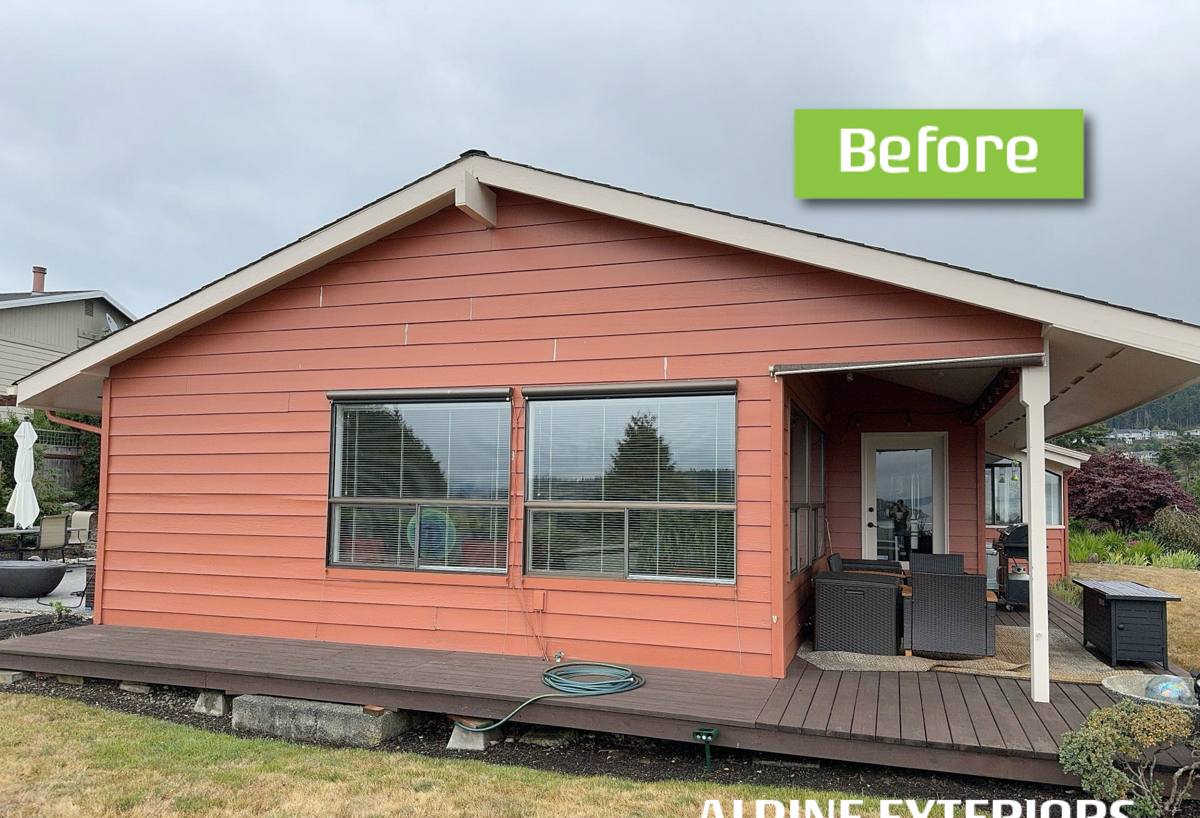
What Salt Air, Rain, and Moss Actually Do to a Window
Salt Air and Hardware
Airborne salt is corrosive to metal, and it doesn't need direct ocean spray to do damage — it travels on the wind and settles on any exposed surface. Cheaper window hardware (latches, hinges, balance mechanisms, screws) is often a basic steel or a thin plating that wasn't chosen with a marine environment in mind. Once that hardware starts to corrode, a window that used to open and lock cleanly starts to stick, bind, or fail to latch — which is also a security and water-sealing problem, not just an annoyance.
Driving Rain and Water Intrusion
Wind off the water doesn't just fall as rain — it drives sideways and pushes water up under trim and into gaps that would stay dry in a calmer setting. A window that's flashed and sealed correctly sheds that water outward. One that isn't will let moisture track behind the trim and into the wall cavity, where it can sit for months before anyone notices a soft spot or a stain.
Moss and the Long Wet Season
Whatcom County's wet season runs long, and on the island the humidity tends to linger a bit longer than it does further inland. That's ideal growing conditions for moss and algae on horizontal surfaces — window sills, exterior stops, and anywhere water sits instead of draining. Moss holds moisture against wood and paint far longer than open air would, which accelerates rot in exactly the spots where a window's seal depends on solid material underneath.
Signs an Island Home Actually Needs Replacement
- Hardware that's stiff, corroded, or won't latch fully closed
- Visible fogging or moisture between the panes of a double-glazed unit (a failed seal)
- Soft or spongy wood at the sill or lower corners of the frame
- Moss or dark staining building up on the sill even after cleaning
- Noticeable draft or a cold band of air near the frame in windy weather
- Paint or finish that's bubbling, peeling, or chalking faster than the rest of the house
- Windows that are difficult to open, close, or lock without extra force
Any one of these on its own might just need a repair. Several showing up together, especially on the side of the house that faces the water, usually means the window system itself has reached the end of its useful life.
Choosing a Frame Material for This Exposure
There's no single "best" window material — the right call depends on how much maintenance a homeowner wants to take on and how directly the home faces the water. Here's how the common options actually hold up in a salt-air, high-rain setting:
| Frame Material | Salt Air / Corrosion | Moisture Behavior | Maintenance |
|---|---|---|---|
| Vinyl | Doesn't corrode; hardware quality still matters | Won't rot; good if fully sealed | Low — occasional cleaning |
| Fiberglass | Very stable, resists pitting and corrosion well | Dimensionally stable in wet/dry cycling | Low |
| Aluminum | Can pit and corrode without a marine-grade finish | Conducts cold, prone to condensation | Moderate — finish needs monitoring |
| Wood / Wood-clad | Cladding protects the exterior face; hardware is the weak point | Exposed wood swells and rots if the seal fails | Higher — repainting and sealant checks |
On a straightforward island property, we usually steer homeowners toward vinyl or fiberglass for the exterior-facing units simply because they hold up with the least ongoing attention. Wood-clad windows still have a place where the interior look matters more than low maintenance, but we're upfront that they need more attention out here than they would on a sheltered inland lot.
Glazing and Coatings
Glass matters as much as the frame. For this climate we generally recommend:
- Double-pane at minimum, with argon fill for better insulating performance in a house that stays damp and cool much of the year
- A quality low-E coating to cut heat loss without darkening the view — useful given how many gray, overcast days the region gets
- Warm-edge spacer systems rather than older aluminum spacers, which conduct cold and are more prone to condensation and seal failure at the edge of the glass
- Corrosion-resistant hardware and fasteners specified for coastal or marine use, not just the manufacturer's standard-grade parts
What a Correct Installation Actually Involves
The window unit itself is maybe half the job. The other half is how it's flashed, sealed, and tied into the wall — and that's where most premature failures out here actually start, not with the product itself.
- Remove the old unit carefully and inspect the rough opening, sill, and surrounding framing for hidden moisture damage before anything new goes in.
- Repair or replace any compromised framing or sheathing rather than installing a new window over a soft or rotted opening.
- Install flashing that sheds water outward and downward, lapped correctly so wind-driven rain can't work its way behind the trim.
- Set the window plumb, level, and square, shimmed correctly so the frame isn't under stress that can crack seals over time.
- Seal and insulate the gap around the frame with the right materials — not just caulk over a gap, but proper backer rod and sealant designed to move with the building.
- Finish the exterior trim and sills so water is directed away from the wall, not pooled where moss can take hold again.
Skip any one of these steps and the window can look fine for a year or two while a moisture problem quietly builds behind the wall. That's the real reason we don't treat window replacement as a "swap the unit" job.
Working Around Island Logistics
Lummi Island isn't accessed the same way as a mainland Ferndale property — materials, crew, and equipment all move on the ferry schedule, and that has to be planned for rather than worked around at the last minute. We build the ferry timing into the project schedule up front: staging materials so a full day's work isn't lost waiting on a sailing, coordinating crew arrival and departure around the schedule, and being realistic with homeowners about what a weather delay does to an island job versus a mainland one. A crew that hasn't done this before will often underestimate how much the ferry schedule shapes the timeline, which leads to surprises partway through the job. We plan for it instead of discovering it mid-project.
Our Process, Start to Finish
For a Lummi Island window replacement, our process generally looks like this:
- On-site assessment — we look at each window's condition, the surrounding wall and sill, and the home's overall exposure to wind and water
- Product recommendation — matched to the home's exposure, not a one-size answer, with honest trade-offs explained
- Written estimate — clear on materials, scope, and timeline, including how ferry scheduling factors into the project dates
- Removal and structural check — old windows come out carefully so we can catch any hidden rot or moisture before it's covered back up
- Correct installation — flashing, sealing, and finish work done in the sequence that actually keeps water out
- Walkthrough and cleanup — every window opens, closes, and locks the way it should before we call the job done
Keeping New Windows Performing Long-Term
A good install buys years of trouble-free performance, but a little upkeep goes a long way in this climate:
- Rinse sills and tracks periodically to clear salt residue before it can work into hardware
- Keep moss and algae from building up on sills and nearby trim — a soft brush and mild cleaner is usually enough
- Check that exterior caulking and sealant lines stay intact, especially after a hard windstorm off the water
- Operate locks and latches through their full range a few times a year so corrosion doesn't get a foothold unnoticed
Why It Matters That We Already Work This Island
A contractor who's only ever worked mainland Ferndale homes can still do competent general window work, but they haven't necessarily had to solve for salt-laden air, sideways rain, and a moss season that outlasts the calendar's idea of "wet season." We've priced, scheduled, and installed around the ferry, we know which frame and glazing choices actually hold up out here versus which ones just look fine on a spec sheet, and we build the extra flashing and sealing steps into every quote rather than treating them as an upcharge. That experience shows up less in what a homeowner sees on install day and more in how the windows are still performing five or ten winters later.
If your windows on Lummi Island are showing stiff hardware, drafts, fogged glass, or sills that just won't stay clean, we're happy to take a look. Reach out for a free, no-pressure estimate using the form below — we'll walk the property, give you a straight read on what's actually going on, and lay out your options without any pressure to decide on the spot.