 Ferndale
 Roofing in Sumas Has to Answer to the Weather, Not the Catalog
Sumas sits up against the Canadian border in Whatcom County, and the roofs out here take a beating that a lot of manufacturer warranties were never really written for. You've got long stretches of steady, driving rain from fall through spring, humid air that never fully dries out a roof deck, and a moss season that can run most of the year on north-facing slopes and shaded pitches. Add in the salt-laden air that pushes inland off the Sound on windy days, and you have a combination that ages an ordinary roof faster than the same product would age two hours south in a drier climate.
A "new roof" in Sumas isn't just about picking a shingle color. It's about building an assembly — deck, underlayment, flashing, ventilation, and field material — that's matched to what this specific stretch of Whatcom County throws at it year-round. That's the lens we use on every new roof installation we quote out here, and it's what separates a roof that looks fine at year one from one that's still performing at year twenty.
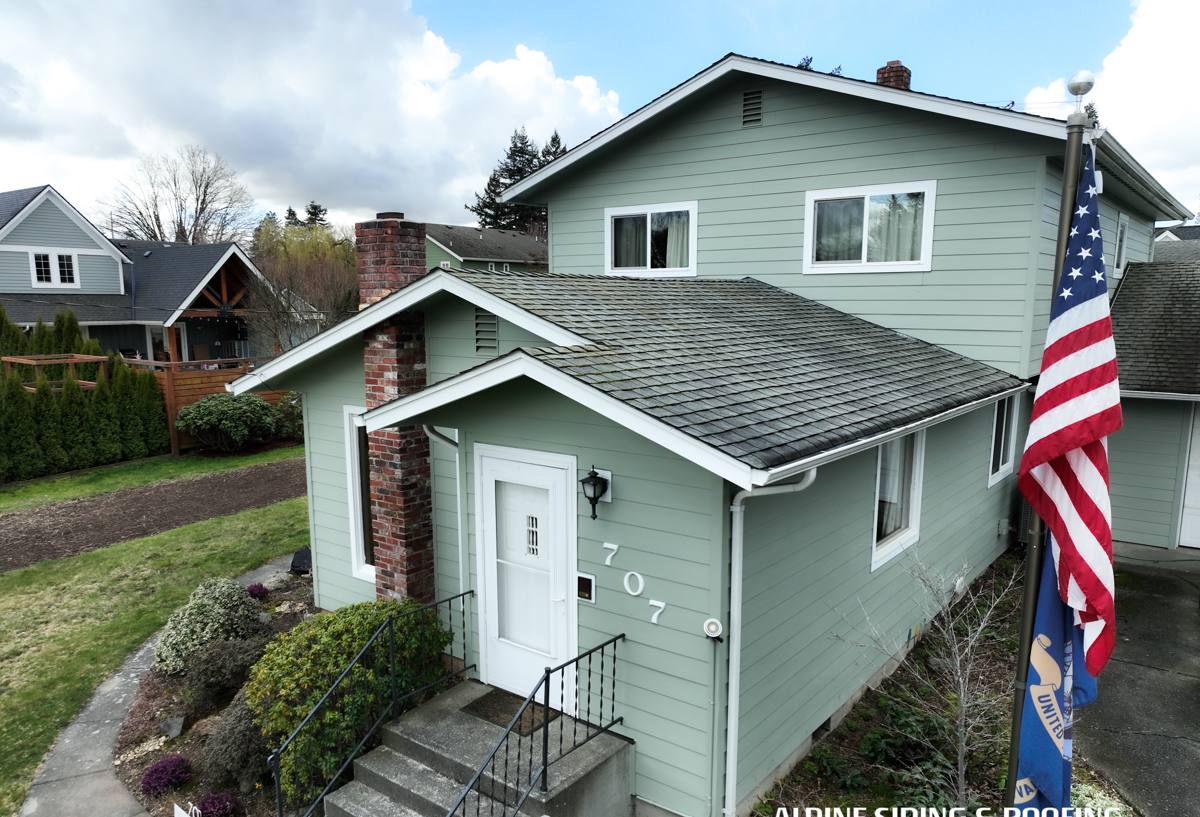
Signs a Sumas Home Needs a New Roof, Not Another Patch
Roof repairs have their place, but a lot of Sumas homeowners call us after paying for two or three repairs in a row on a roof that was already past the point of patching. Here's what usually tells us a full replacement is the honest answer:
- Granule loss heavy enough that you're finding shingle grit in the gutters every time it rains
- Shingles that are cupping, curling at the edges, or cracking when you look closely from the ground
- Moss or algae staining that keeps coming back within a season or two of cleaning
- Soft spots, sagging, or visible deflection in the roof plane
- Daylight or water staining visible in the attic around vents, chimneys, or valleys
- A roof that's at or past the age range for its material (roughly 20-25 years for standard asphalt composition shingle in this climate)
- Multiple layers already on the roof, which limits what repair options even exist
If you're only seeing one or two of these, a repair might genuinely be the right call — we'll tell you that if it's true. But once moisture has been working its way into the deck for a season or more, patching the surface doesn't fix what's happening underneath.
What a Correct Roof Installation Actually Involves
A new roof is really a stack of separate systems working together, and skipping or shortcutting any one of them is where most premature failures start.
The Deck
Before anything new goes on, the plywood or OSB deck underneath gets inspected. In a climate this wet, it's common to find soft or delaminated sheathing around old leak points, valleys, or plumbing vents — especially on a roof that's been patched over the years instead of replaced. Any compromised decking gets cut out and replaced before the new roof goes down. Installing new shingles over a soft deck just hides the problem for another year or two.
Underlayment and Water Barriers
This is the layer that actually keeps water out if wind-driven rain ever gets under the field material — and in Sumas, it will, eventually. We use synthetic underlayment as the standard water-resistant layer across the field, and self-adhered ice-and-water shield membrane in the vulnerable spots: eaves, valleys, around chimneys and skylights, and anywhere roof planes meet a wall. That membrane matters more here than in drier parts of the state because of how much sustained, low-intensity rain this area gets rather than short, hard downpours.
Flashing
Flashing around chimneys, skylights, sidewalls, and roof-to-wall transitions is where most leaks actually originate, not in the open field of shingles. New flashing gets installed with every roof replacement — reusing old, dented, or rusted flashing to save a step is a shortcut that shows up as a ceiling stain within a year or two.
Ventilation
An underventilated attic traps warm, moist air against the underside of the deck, which accelerates rot from the inside and feeds condensation that has nothing to do with the roof surface at all. We check intake (soffit vents) and exhaust (ridge or box vents) together, since one without the other doesn't move air the way it's supposed to.
Field Material
The visible shingle, shake, or metal panel is the last piece, not the first — and it's only as good as everything installed underneath it.
Choosing a Roofing Material for This Climate
There's no single "best" roofing material — there's the material that fits your budget, your roof's pitch and exposure, and how much long-term maintenance you're willing to do. Here's how the common options actually compare for a Sumas home:
| Material | Typical Lifespan Here | Moss/Algae Resistance | Maintenance | Relative Cost |
|---|---|---|---|---|
| Standard asphalt composition shingle | 20-25 years | Moderate; benefits from algae-resistant granules | Periodic moss removal, gutter care | Lowest |
| Architectural/dimensional shingle | 25-30 years | Better than 3-tab; thicker profile sheds moss growth more slowly | Same as standard, less frequent | Moderate |
| Standing seam metal | 40-50+ years | High; smooth surface discourages moss anchoring | Low; occasional debris clearing | Highest upfront |
| Cedar shake | 20-30 years with upkeep | Low without regular treatment; retains moisture | High — needs regular treatment/cleaning in this rainfall | High |
We're upfront that cedar shake, while it has a classic look plenty of homeowners want, is a tougher fit for Sumas' rainfall and moss pressure than it might be in a drier region — it needs a real maintenance commitment to hold up, and the wood's natural tendency to hold moisture works against it in a climate that rarely gives a roof a chance to fully dry between rain events. That's not a knock on the product; it's just a maintenance trade-off worth knowing before you commit to it.
Our New Roof Installation Process
- On-site inspection and estimate. We walk the roof (or use a lift/drone where pitch or access requires it), check the attic from the inside, and give you a written estimate that spells out material, scope, and price — no vague allowances.
- Material selection. We go over the options that make sense for your roof's pitch, sun/shade exposure, and budget, including realistic maintenance expectations for each.
- Tear-off and deck inspection. Old roofing comes off down to the deck so we can actually see what condition it's in, rather than guessing from underneath.
- Deck repair. Any soft, rotted, or delaminated sheathing is replaced before anything new goes down.
- Underlayment and ice-and-water membrane installation. Applied per manufacturer spec, with extra attention at eaves, valleys, and penetrations.
- New flashing. Installed at every chimney, skylight, vent, and sidewall transition.
- Ventilation check and correction. Intake and exhaust venting are balanced, adding or adjusting vents where the existing setup falls short.
- Field material installation. Shingles, shakes, or metal panels installed to manufacturer nailing and exposure specs — not "close enough."
- Cleanup and magnetic sweep. Full site cleanup including a nail/debris sweep of the yard and driveway.
- Final walkthrough. We go over the finished roof with you before calling the job done.
Moss, Algae, and Salt Air: The Three Things That Age Roofs Fastest Out Here
Moss is the most visible problem, but it's really a symptom of shaded, slow-drying roof sections holding moisture longer than they should. Left alone, moss lifts shingle edges, traps water against the surface, and works its way toward the deck. Algae staining is a different issue — it's a surface organism, not a structural threat by itself, but it signals a roof surface that stays damp longer than it should, which usually points back to shading, pitch, or ventilation.
Salt air is the quieter factor. It's less of an issue for asphalt shingles directly but matters a lot for any exposed metal — flashing, fasteners, vent caps, and gutter hardware. We spec corrosion-resistant flashing and fasteners on Sumas jobs for that reason; using standard-grade hardware here shortens its service life compared to the same components installed further from salt-influenced air.
What Drives the Cost of a New Roof in Sumas
| Factor | Why It Matters |
|---|---|
| Roof size and number of planes | More square footage and more valleys/hips mean more material and labor |
| Pitch and access | Steep or hard-to-access roofs take longer and may require additional safety equipment |
| Deck condition | Rotted sheathing found at tear-off adds material and labor to replace it properly |
| Material choice | Standard shingle, architectural shingle, and metal carry different upfront costs |
| Layers to remove | Tearing off multiple existing layers costs more than a single-layer tear-off |
| Ventilation upgrades | Adding or correcting intake/exhaust venting is a smaller add-on cost with a real payoff in roof life |
We don't quote roofs sight unseen over the phone — too many of these factors only show up once we're actually on the roof and in the attic. What we can promise is a written estimate that breaks out labor and material so you know what you're paying for.
What to Ask Before You Hire a Roofer
- Are you licensed and bonded to do roofing work in Washington State?
- Do you carry liability insurance, and can you provide proof of it?
- Will tear-off include a full deck inspection, or just a re-cover over the old roof?
- What underlayment and ice-and-water shield will you use, and where will it be applied?
- Will you check and correct attic ventilation as part of the job, or only replace the surface?
- What's covered under the material warranty versus your own workmanship warranty?
- Do you have experience with roofs specifically in this part of Whatcom County?
Why It Matters That We Already Work in Sumas
A crew that's worked roofs in Sumas and the surrounding Whatcom County area already knows which valleys tend to hold moss, which pitches face the prevailing rain, and how much ventilation a given attic style actually needs in this climate — instead of applying a one-size-fits-all spec written for a different region. That local familiarity shows up in small decisions throughout the job: where we add extra ice-and-water membrane even when it's not strictly required by code, which flashing details we double up on, and how we handle scheduling around this area's wetter months. It's the difference between a roof installed to a generic checklist and one installed for the specific conditions it has to survive.
If you're weighing a new roof for your Sumas home, we're happy to come take a look and give you a straight, no-pressure estimate — free of charge, with no obligation to move forward. Fill out the form below and we'll get in touch to schedule a time.