 Ferndale
 Decks in Bellingham Face a Different Set of Problems
Bellingham sits close enough to the water and far enough into the Pacific Northwest's wet season that a deck here has to earn its keep in ways a deck in a drier climate never has to. Salt-tinged air off Bellingham Bay, long stretches of driving rain, and a moss season that can run from fall through spring all work against wood, fasteners, and even some composite products if they weren't chosen and installed with this climate in mind. A deck that looks fine the day it's finished can start showing problems within a year or two if the framing, drainage, and material choices weren't matched to what Whatcom County actually throws at it.
We build and repair decks for homes throughout the Bellingham area, and the patterns repeat: undersized or poorly flashed ledger boards, joists that trap water instead of shedding it, decking installed tight enough that moss and algae get a foothold in the gaps, and fasteners that were never rated for a marine-influenced environment. None of that is unusual — it's just what happens when a deck is built to a generic standard instead of a Pacific Northwest one.
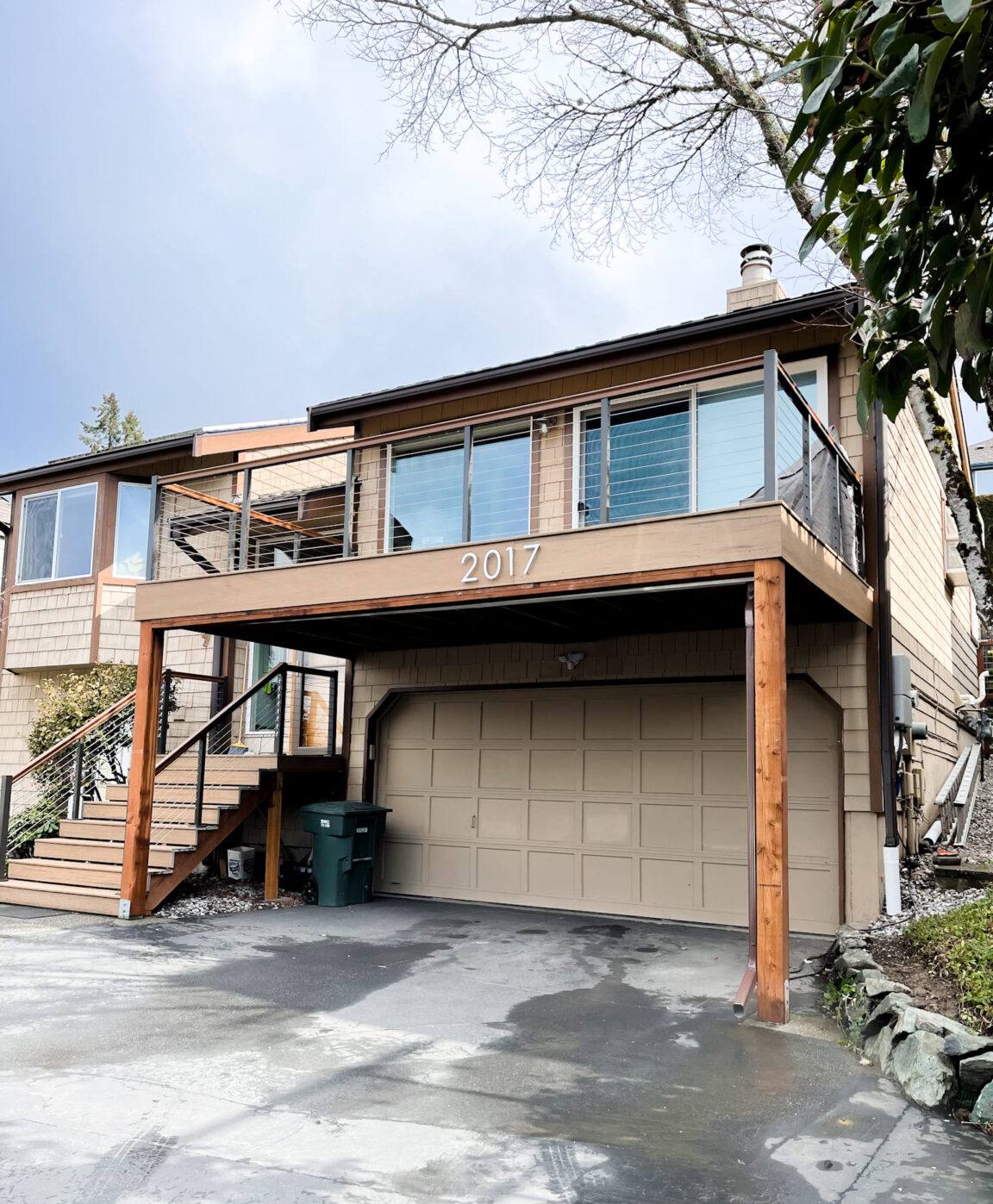
What a Bellingham Deck Needs to Hold Up
Before we talk about boards and railings, it helps to be clear about what the climate actually demands structurally. A deck built to last in this area needs:
- Fasteners and hardware rated for coastal or high-moisture exposure, not standard interior-grade hardware
- A ledger connection that's properly flashed so water can't work its way behind the house's siding or sheathing
- Joist spacing and blocking that keeps the frame stiff even as lumber moves through repeated wet-dry cycles
- Airflow underneath the deck so the structure can actually dry out between rain events
- Decking spaced and oriented to shed water instead of holding it against the frame
Skipping any one of these doesn't usually cause an immediate failure — it causes a slow one, which is worse, because by the time you notice soft boards or rust streaks, the damage is often already in the framing.
Choosing Decking Material for This Climate
Pressure-Treated Lumber
Still the most common choice because it's affordable and widely available. It performs fine here as long as it's properly sealed and re-sealed on a regular schedule — in a climate with this much rain, an unmaintained pressure-treated deck will grey, split, and grow moss faster than the same wood would in a drier region.
Cedar
A traditional Pacific Northwest choice for good reason — it has natural resistance to rot and insects and takes on a nice weathered look if left untreated. It's a softer wood, though, so it dents and scratches more easily, and it still benefits from periodic cleaning to keep moss from getting established in a shaded or damp yard.
Composite and PVC Decking
Composite decking has become a common upgrade for homeowners who are tired of the annual sealing routine. Quality capped composite resists moisture absorption and won't rot, and it's much less hospitable to moss than bare wood. It costs more upfront and needs a properly ventilated substructure underneath — composite doesn't dry out the way wood does, so a frame that traps moisture can still cause problems even with composite boards on top.
| Material | Upfront Cost | Maintenance | Moss/Moisture Resistance | Typical Lifespan |
|---|---|---|---|---|
| Pressure-Treated Lumber | Low | High — annual cleaning and periodic sealing | Fair if maintained | 10-15 years |
| Cedar | Medium | Medium — periodic cleaning and optional oiling | Good if kept clean | 15-20 years |
| Capped Composite/PVC | High | Low — occasional washing | Very good | 25+ years |
Framing and Structure: Where Most Deck Failures Actually Start
Homeowners tend to focus on the decking surface because it's what they see and walk on, but the framing underneath is what determines whether a deck is actually safe. Ledger boards that aren't flashed correctly let water track behind the house's exterior wall, which can rot both the deck framing and the wall structure it's attached to — a problem that's especially common with older decks retrofitted onto a home after the fact. Footings need to be sized and set below frost depth and on stable, well-drained soil, since this region's saturated ground in the wet months can shift a footing that wasn't set deep or wide enough. Every connection — joist hangers, post bases, ledger bolts — should use hardware rated for exterior, high-moisture use, not standard zinc-coated fasteners that will corrode over a few wet seasons.
Moss, Algae, and Drainage: Designing a Deck That Actually Sheds Water
Moss and algae aren't cosmetic problems here — they're a sign a deck isn't drying out between rain events, and a damp deck surface is also a slip hazard for a good chunk of the year. Board spacing matters more in this climate than in most: gaps that are too tight trap debris and moisture, while proper spacing lets water and organic matter pass through instead of collecting. Orientation and slope matter too — a deck built dead level, or worse, sloped slightly toward the house, will pond water and grow moss faster than one with a gentle pitch away from the structure. Shade from trees and the house itself extends how long a deck stays wet after a storm, which is worth factoring into material choice and cleaning frequency for a given yard.
Permits and Building Standards
Most deck projects that involve a new structure attached to the house, or that sit above a certain height, require a permit and inspection under Washington's residential building code as adopted locally in Whatcom County. Requirements vary by project size, height, and attachment method, so we handle the permitting conversation as part of the process rather than leaving homeowners to figure out what applies to their specific project. Building to code isn't just a formality — the same rules around footing depth, railing height, and structural connections exist because they address real failure points in wet climates like ours.
How We Build a Deck
Our process for a Bellingham deck project generally follows the same sequence, though the details shift with the site and the homeowner's goals:
- On-site assessment — we look at the house's structure, the yard's drainage and sun exposure, and talk through how the deck will actually be used
- Material and design discussion — honest trade-offs between wood and composite, sizing, railings, and layout based on the site, not a one-size-fits-all package
- Permit handling — we prepare and submit what the project requires so the homeowner isn't navigating that process alone
- Framing — footings, ledger flashing, joists, and hardware built to hold up under repeated wet-dry cycling, not just to pass a quick inspection
- Decking and railing installation — proper spacing, fastening, and finishing for the material chosen
- Final walkthrough — we go over care and maintenance specific to the material installed, so the deck's lifespan doesn't get cut short by simple neglect
Maintaining a Deck in a Wet, Mossy Climate
Even a well-built deck needs some seasonal attention in this region. A simple annual routine goes a long way:
- Sweep debris and standing leaves off the surface regularly, especially in fall
- Wash the deck surface at least once a year to remove algae and moss buildup before it gets established
- Check and clear the gaps between boards so water and debris keep draining through
- Inspect fasteners and hardware annually for rust or corrosion
- Reseal or refinish wood decking on the schedule appropriate to the product — don't wait until it's visibly grey and dry
- Confirm the area underneath the deck has airflow and isn't collecting standing water
Why Work With a Crew That Already Knows Bellingham
A deck built by a crew that mostly works in drier climates can look fine on day one and still be the wrong build for Whatcom County conditions — wrong fastener grade, wrong board spacing, wrong assumptions about how much moisture the frame needs to shed. We're based nearby in Ferndale and build and repair decks throughout the Bellingham area regularly, so the material choices and construction details on this page aren't theoretical — they're what we've seen actually hold up, and actually fail, on decks around here. That local pattern recognition is worth more than a lower bid from a crew that's building to a different climate's standards.
If you're planning a new deck or want an honest look at whether an existing one is holding up the way it should, we're happy to come take a look and give you a straightforward, no-pressure estimate — use the form below to get started.