 Ferndale
 Board & Batten in Marietta: A Style Choice That Also Has to Work
Board and batten has been showing up more and more on homes around Marietta, and it's easy to see why. The vertical lines read as clean and a little more modern than traditional lap siding, and it pairs well with the mix of older cottages and newer builds you find along this stretch of Ferndale. But board and batten isn't just a look — it's a specific system of wide panels and narrow strips, and how that system is built determines whether it holds up to the weather this part of Whatcom County actually gets. On a property this close to the water, that distinction matters more than it does further inland.
What Marietta's Climate Actually Does to Siding
Marietta sits close enough to the Bellingham Bay and Lummi Bay shoreline that salt-laden air is a real, daily factor on this siding — not an occasional event. Salt air accelerates corrosion on fasteners and metal trim, and it slowly breaks down paint films and caulk faster than the same products would degrade twenty miles inland. Combine that with driving rain off the water — wind-driven rain that gets pushed sideways into seams and laps rather than just falling straight down — and you've got two separate stresses working on the same wall at the same time.
Then there's moss. Whatcom County's long, wet, mild winters give moss and algae a season that can stretch eight months or more, especially on the shaded, north-facing walls that are common on tree-lined Marietta lots. Moss holds moisture against a wall long after a storm has passed, and it's not just cosmetic — sustained damp contact is what causes rot in wood-based products and paint failure on anything not built to shed water quickly.
None of this means board and batten is a bad choice for Marietta. It means the material and the installation details have to be chosen with this specific combination of salt, wind-driven rain, and moss exposure in mind, rather than treated as generic siding work.
What Correct Board & Batten Installation Actually Involves
The panel and batten system
Board and batten siding is built from wide vertical panels with narrower battens installed over the seams, creating the characteristic rhythm of shadow lines. The panels do the real work of keeping weather out; the battens cover the joints and add the visual texture. If the panels themselves aren't dimensionally stable and properly sealed at every seam, the battens are just decoration over a weak point.
Rainscreen gap
On a site with Marietta's rain and moss exposure, we install with a drainage gap behind the siding rather than fastening panels directly to the weather-resistive barrier. That gap lets any moisture that does get past the cladding drain and dry out instead of sitting against the wall sheathing. It's a small detail with an outsized effect on how a wall performs over 20-plus years in a wet climate.
Fastening and flashing
Every seam, corner, window, and penetration needs flashing detailed so water is shed down and out, not channeled behind the siding. Fasteners have to be corrosion-resistant and driven to the manufacturer's spec — over-driving or under-driving a nail is a common shortcut that shows up as cracking or loosening years later, and it's exactly the kind of failure that shows up faster in salt air.
Caulk, color, and finish
Factory-finished panels need far less field caulking than site-painted products, but the joints that do get sealed have to use a sealant rated for the exposure, not whatever's cheapest at the yard. James Hardie's board and batten panels are available factory-finished through the ColorPlus system, in colors that are baked on and backed by a finish warranty separate from the product warranty. For a Marietta home, that factory finish is worth more than it would be somewhere drier, because it removes the weakest link in a coastal paint job: a field-applied topcoat fighting salt air and UV from day one. Panels are also available primed for field painting if you want a custom color match, though we walk every homeowner through that maintenance trade-off before recommending it this close to the water.
Board & Batten vs. Traditional Lap Siding: Cost and Maintenance Factors
| Factor | Board & Batten | Traditional Lap |
|---|---|---|
| Visual style | Vertical lines; modern or farmhouse look | Horizontal lines; traditional look |
| Material cost | Moderately higher — more trim pieces (battens) per square foot | Generally lower material cost |
| Labor/install time | More labor-intensive — precise batten layout and fastening | Faster on a straightforward wall |
| Moss/algae exposure | Same base resistance as lap in the same fiber cement; grooves at battens need attention when cleaning | Fewer vertical grooves to catch debris |
| Best fit | Accent walls, gables, entries, farmhouse or modern facades | Whole-house siding, classic PNW look |
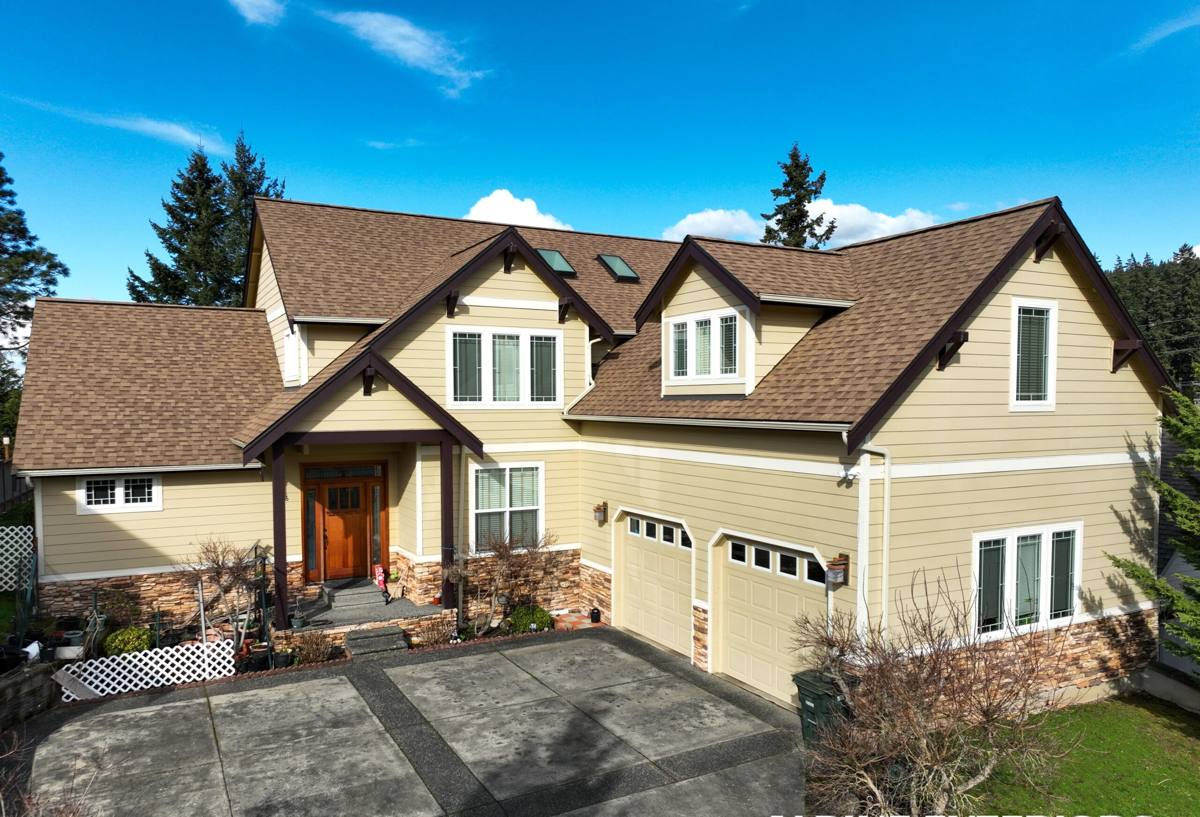
A lot of Marietta homeowners end up mixing the two — board and batten on a gable, entry feature, or accent wall, with lap siding on the main body of the house. That's a perfectly legitimate approach and one we build estimates around regularly; it doesn't have to be all one or the other.
Our Process for a Marietta Board & Batten Project
- On-site assessment — we look at exposure (how much salt air and driving rain that particular wall actually takes), existing moisture damage, and where board and batten will and won't work well on the house.
- Tear-off and sheathing check — old siding comes off and we inspect the sheathing underneath for rot or soft spots before anything new goes up. This is where problems that have been hidden for years get found.
- Weather-resistive barrier and rainscreen — a properly lapped moisture barrier goes on first, then furring or a manufactured rainscreen product to create the drainage gap.
- Panel and batten installation — panels are installed plumb and true, seams and corners flashed, battens fastened to the manufacturer's spacing and nailing pattern.
- Trim, caulk, and touch-up — window and door trim, corner details, and any factory-finish touch-up paint applied to fastener heads and cut edges.
- Final walkthrough — we go over the finished work with the homeowner before calling the job done.
Living With Board & Batten: Maintenance in a Marietta Climate
Fiber cement doesn't need the repainting cycle that wood-based board and batten does, but it isn't zero-maintenance in a climate like this one. The vertical grooves at each batten can catch windblown debris and give moss a foothold faster than a flat wall would, especially on shaded elevations. A periodic soft wash with the right cleaner, rather than a high-pressure rinse that can force water behind trim and seams, is the safest way to keep moss and algae from establishing in those grooves. We can walk you through a simple maintenance schedule when the job wraps up, based on which side of the house gets the most shade and moisture.
Why We Install Only James Hardie
We install James Hardie fiber cement exclusively. We don't install LP SmartSide, vinyl, or other fiber cement brands, and that's a deliberate standard, not a limitation on what we're capable of installing.
Fiber cement is non-combustible, which matters to insurers and to homeowners regardless of wildfire exposure. James Hardie's ColorPlus factory finish is baked on under controlled conditions, which gives more consistent, longer-lasting color than field-applied paint — a real advantage in a climate where sun, salt, and rain all work against paint film over time. Hardie also builds climate-engineered product lines matched to different regions; the products suited to the Pacific Northwest are engineered around the moisture load this region actually sees, rather than a one-size-fits-all formulation. The warranty structure is transferable and backed by a large, established manufacturer, which matters if you sell the house before the siding's functional life is up.
None of that means every other product on the market is bad. It means that after weighing moisture behavior, maintenance burden, and long-term performance against installation complexity, James Hardie is what we're willing to put our name on and stand behind.
What to Check Before Hiring a Board & Batten Contractor Here
- Do they install a drainage gap/rainscreen, or fasten panels directly to the wall?
- Can they explain how they'll flash windows, corners, and penetrations before work starts, not just after you ask?
- Do they use fasteners rated for coastal, salt-air exposure?
- Have they worked in Marietta or similarly exposed parts of Ferndale before, or is this their first job this close to the water?
- What's covered under the manufacturer's warranty versus the contractor's own workmanship warranty, and for how long?
- Will they give you a written scope that specifies the exact Hardie product and battens, not just "board and batten siding"?
Why Local Experience in Marietta Matters
Siding work in Marietta isn't the same job as siding work in a drier, inland part of the county. A crew that already works this area knows which walls take the worst of the wind-driven rain, which lots hold moss longest because of shade and tree cover, and how much margin to build into flashing and fastener choices because of the salt air. That knowledge doesn't come from a spec sheet — it comes from having done the work here and seen how different approaches actually perform a few years down the road. It's also why we don't treat board and batten as an off-the-shelf product; the details get adjusted to the specific wall and exposure in front of us.
If you're weighing board and batten siding for a home in Marietta, we're happy to take a look and walk you through what it would actually involve for your house — no pressure, no obligation. Fill out the form below and we'll set up a free estimate.