 Ferndale
 Why Windows Fail Faster in Custer Than People Expect
Custer sits in the stretch of Whatcom County between Ferndale and the Canadian border, close enough to the water that homes here deal with a different set of pressures than a house forty miles inland. Salt-laden air off the Strait of Georgia and Puget Sound corrodes metal hardware and hinges faster than it would in a dry climate. Driving rain off winter storms doesn't just fall straight down — it gets pushed sideways into window frames, sills, and trim by wind coming off open farmland and the water. And the long, low-sun moss season that runs from fall through spring keeps north- and shade-facing walls damp for months at a stretch, which is exactly the environment that lets rot take hold around an old or poorly sealed window.
None of this means Custer homes need exotic solutions. It means window installation here has to be done with those three conditions specifically in mind — flashing that actually sheds water instead of trapping it, hardware and frame materials that hold up to salt exposure, and sealant details that don't fail after one or two wet seasons. A window that's technically "installed" but not installed for this climate will show problems within a few years: fogged glass, soft trim, drafts, and stains creeping out from the corners.
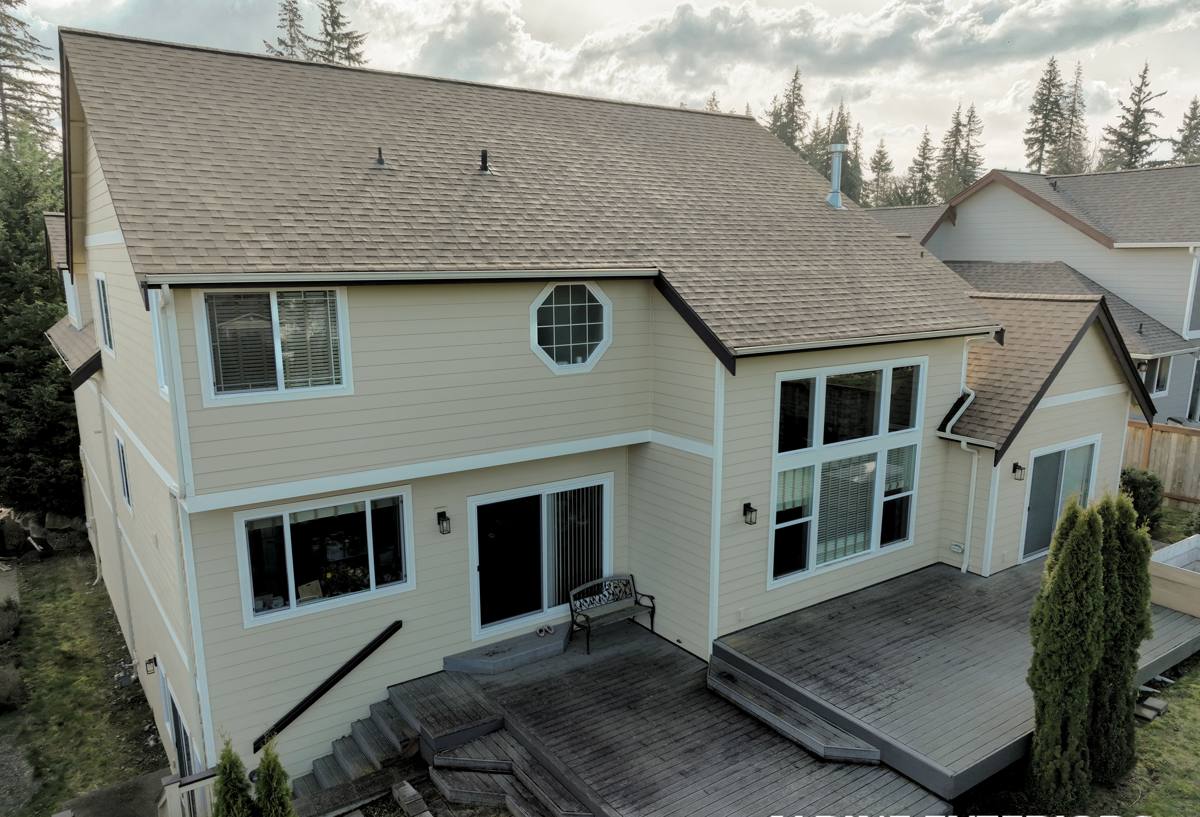
Signs Your Current Windows Are Losing the Battle
Most homeowners don't think about window condition until something is obviously wrong, but the early signs are usually visible if you know where to look. Around Custer, we see the same handful of failure patterns over and over:
- Soft or discolored wood trim at the bottom corners of the frame, where driving rain collects and old caulk has given up
- Fogging or a visible haze between panes on double-pane windows — a sign the seal has failed and the insulating gas has escaped
- Green or black staining and moss growth on the sill or lower sash, especially on north-facing or shaded walls
- Windows that are noticeably harder to open and close than they used to be, often from swollen wood or corroded hardware
- A draft you can feel with your hand along the frame edge on a windy day, even with the window latched
- Paint that keeps peeling or bubbling around the frame no matter how often it's repainted
Any one of these on its own might just mean routine maintenance. Two or three together, especially rot combined with fogging, usually means the window and possibly the framing behind it needs to come out rather than be patched again.
What a Correct Window Installation Actually Involves
The window unit itself is only part of the job. In a coastal, high-rainfall area, how it's installed matters as much as what's installed. A correct installation is a system, not just a box set into a hole in the wall:
Flashing and Water Management
Water needs a planned path around and out of the window opening, not just a caulk bead hoping to stop it. That means proper head flashing above the window to divert water outward, side flashing that laps correctly with the house wrap or weather-resistant barrier, and a sloped sill pan underneath so any water that does get past the glass drains back out instead of pooling against the framing.
Sealant and Backer Rod
Cheap or improperly applied sealant is one of the most common causes of early window failure we see. The right approach uses backer rod to control joint depth and a quality exterior sealant rated for the gap size, applied so it can flex with temperature and moisture changes instead of cracking after one season.
Fastening and Shimming
A window that isn't shimmed level and square will bind, won't seal evenly, and puts uneven stress on the frame that shortens its life. Fasteners need to hit solid framing at the manufacturer's specified spacing — skipping this to save time is a common shortcut that shows up as a leak two or three years later.
Interior and Exterior Trim
Trim isn't just cosmetic. It's part of the air and moisture seal, and in this climate, the material choice matters — trim that can't handle repeated wetting and drying will fail well before the window itself does.
Choosing a Frame Material That Holds Up Here
There's no single "best" window material for every house, but some perform noticeably better than others under Custer's combination of salt air, wind-driven rain, and prolonged damp shade. Here's how the common options compare for this specific environment:
| Frame Material | Salt Air Resistance | Moisture Behavior | Maintenance |
|---|---|---|---|
| Vinyl | Very good — won't corrode or oxidize | Doesn't absorb water; seams need quality welding | Low — occasional cleaning |
| Fiberglass | Excellent — dimensionally stable, won't pit or corrode | Very stable through wet/dry cycles | Low |
| Wood (unclad) | Poor — finish must be maintained constantly | Absorbs moisture, prone to rot without upkeep | High — regular refinishing needed |
| Wood-clad (vinyl or aluminum exterior) | Good on the clad side; interior wood still needs care | Exterior is protected; cladding seams are the weak point | Moderate |
| Aluminum | Fair — prone to pitting and corrosion near salt air over time | Conducts cold and can condensate more in damp climates | Moderate to high near the coast |
For most Custer homes, we steer people toward vinyl or fiberglass for the exterior-facing performance, sometimes with a wood or wood-look interior if that matches the house. Solid wood frames with no cladding can look great, but they ask for a level of upkeep that a lot of homeowners don't want to sign up for once they understand what this climate does to unprotected wood.
Full-Frame Replacement vs. Insert Windows
There are two basic approaches to replacing an existing window, and which one makes sense depends on the condition of what's already there.
Insert (pocket) replacement fits a new window into the existing frame, leaving the old frame and exterior trim in place. It's faster and less invasive, and it works fine when the existing frame is still solid and properly flashed.
Full-frame replacement removes the window down to the rough opening, including the old frame and trim, so we can inspect and repair the framing underneath, install new flashing and a sill pan, and start clean. This is the right call whenever there's any sign of rot, water staining on the interior wall below a window, or a frame that was never properly flashed to begin with — which is common on older homes in this area.
We won't recommend an insert replacement over a window we can see or suspect has hidden water damage behind it, because that just seals the problem back inside the wall. Part of the estimate process is figuring out honestly which situation you're actually in.
Our Installation Process
- On-site assessment. We look at each window individually — frame condition, signs of past water intrusion, sun and wind exposure — rather than quoting a blanket price for the whole house.
- Product selection. We walk through frame material, glass package, and trim options based on that window's exposure, not a one-size-fits-all recommendation.
- Removal and inspection. Old windows come out carefully so we can check the rough opening and sheathing for rot or moisture damage before anything new goes in.
- Flashing and sill pan installation. This is the step that gets skipped by crews in a hurry, and it's the step that determines whether the window is still performing in ten years.
- Window setting, shimming, and fastening. Set level, plumb, and square, fastened to solid framing.
- Sealing and insulation. Backer rod and sealant on the exterior, low-expansion foam or insulation in the gap on the interior — never just foam alone doing both jobs.
- Trim and cleanup. Interior and exterior trim finished to match the house, site cleaned up, old windows hauled away.
Why Working With a Crew That Already Knows Custer Matters
A lot of window problems in this area trace back to installation work that was done correctly for a different climate. Flashing details that are adequate in a drier region aren't enough here, and a crew that mostly works inland doesn't always think to plan for wind-driven rain coming sideways off the water or the effect of months of shaded dampness on trim and sealant. Knowing which walls on a typical Custer property take the worst weather, and building the installation around that from the start, comes from doing this work locally and repeatedly — not from a general contracting background applied to a coastal job.
There's also a practical side to it. A local crew can get to a callback fast if something needs a second look after the first hard rain of the season, and we're not guessing at permitting or inspection expectations for Whatcom County because we deal with them regularly.
Living With Moss Season: What You Can Do Between Installations
Even a correctly installed window benefits from a little seasonal attention in this climate. A few habits go a long way toward protecting your investment:
- Clear moss and debris off sills and tracks before it holds moisture against the frame through winter
- Check exterior caulk lines each fall for cracking or gaps and have them touched up before the rainy season sets in
- Keep gutters and downspouts clear so roof runoff isn't sheeting down across upper-story windows
- Trim back vegetation that keeps a wall in constant shade, since that's where moss and prolonged dampness take hold fastest
- Operate windows periodically through winter — hardware that sits unused tends to seize or corrode faster near salt air
These are small things, but they're the difference between a window installation that's still performing well in fifteen years and one that starts showing the same problems the old windows had after just a few.
What to Ask Before You Hire Anyone for This Job
Window installation is one of those jobs where the visible result can look fine for a year or two even if it was done wrong. Before you hire a crew for a Custer-area job, it's worth asking a few direct questions:
- Will you install a sill pan and proper flashing on every window, or only where it's obviously needed?
- What happens if you find rot or water damage in the framing once the old window is out?
- Are you licensed and insured to do this work in Washington, and can you show proof?
- What's the warranty on the installation labor, separate from the manufacturer's product warranty?
- Have you worked on homes in this specific area before, and do you understand the exposure a given wall faces?
A contractor who answers these clearly and without hedging is worth trusting. One who brushes past them, especially the question about hidden water damage, is a warning sign.
If your windows around Custer are drafty, fogged, showing soft trim, or you're just planning ahead for a home you want to keep dry and comfortable through another Whatcom County winter, we're happy to take a look and walk the property with you. The estimate is free, there's no pressure to sign anything on the spot, and you'll get a straight answer about what your windows actually need — not a generic quote. Fill out the form below to get started.