 Ferndale
 Siding Repair for Everson Homes
Everson sits inland from Ferndale, out in the Nooksack River valley farmland east of Bellingham, closer to Nooksack and Sumas than to the water. It's a quieter, more agricultural setting than the coastal parts of Whatcom County, but the underlying weather pattern that wears down siding is the same one that shapes exterior work across this whole region: rain that arrives sideways as often as it falls straight down, a valley floor that holds dampness longer than higher, better-drained ground, and a moss season that runs long even by Pacific Northwest standards. We work in Everson and the surrounding river-valley communities regularly, and this page covers what siding repair actually looks like for a home out here — not a generic repair page, but one built around what this specific stretch of the county does to a wall over time.
We install and repair James Hardie fiber cement siding exclusively. For a valley property that sees this much sustained moisture, it's the material we trust, and it's also the material we're best equipped to repair correctly when a section fails or gets damaged.
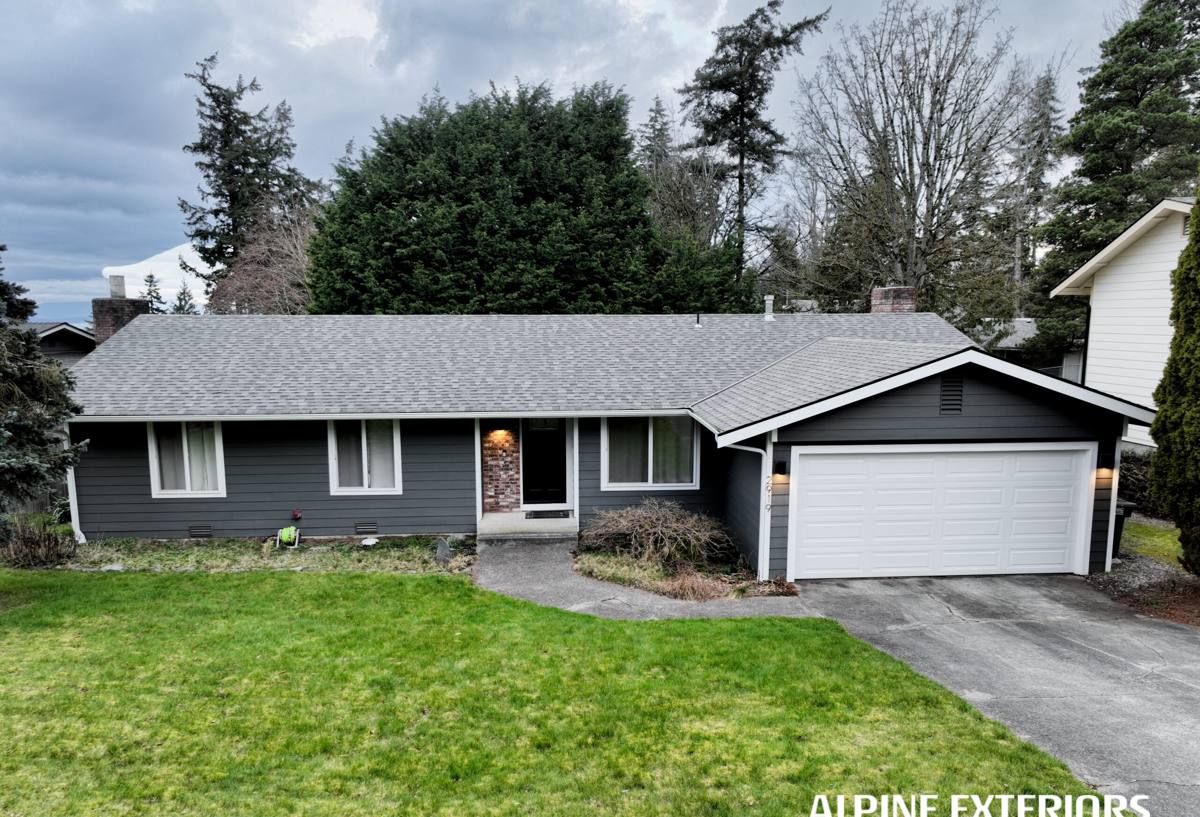
What the Everson Climate Does to Siding
Driving Rain and Valley Dampness
Storm systems moving through Whatcom County don't stay offshore — they push inland and bring wind-driven rain with them, and a flat river-valley property doesn't shed that moisture as quickly as a hillside lot does. Rain pushed sideways into a wall finds seams, corners, and window trim before it finds a flat, open stretch of siding, which is why repair issues on an Everson home tend to cluster at joints, laps, and flashing details rather than showing up as damage across an entire wall.
A Long Moss and Mildew Season
Consistent regional dampness, mild temperatures, and plenty of shaded, north-facing wall area on most homes add up to a moss and mildew season that stretches across much of the year here. It shows up first as green staining or streaking on shaded siding, and while it looks cosmetic, sustained organic growth holds moisture directly against the wall, which is one of the more common paths to hidden rot behind an otherwise intact-looking wall.
Freeze-Thaw Cycling
Being further inland, Everson tends to see more frequent hard frosts than the milder coastal towns closer to Bellingham Bay. That matters for repair work because water that's already worked its way into a porous or poorly sealed material expands when it freezes, turning a small crack or a soft spot into a larger failure faster than a purely wet-but-mild climate would.
Irrigation and Ground Moisture
Many Everson properties sit on or near working farmland, and irrigation, drainage ditches, and generally saturated ground in the wetter months can keep humidity higher right at grade than a typical in-town lot experiences. Siding installed without enough clearance from grade, or trim that's absorbing splash-back moisture, tends to show damage low on the wall first.
Common Siding Repair Issues We See in Everson
- Cracked, split, or impact-damaged siding panels, often from storm debris or routine yard and farm equipment work
- Soft or spongy boards near the bottom of a wall, usually tied to grade clearance or splash-back moisture
- Failed caulking or sealant at joints and trim, letting wind-driven rain track behind the siding
- Moss and mildew staining on shaded or north-facing walls that keeps coming back after cleaning
- Trim separation or cracking around windows and doors from repeated wet-dry and freeze-thaw cycling
- Warped, cupped, or delaminating panels on older, non-Hardie siding products nearing the end of their service life
- Rusting fasteners or staining around nail heads on older installations
Repair vs. Replacement: How We Make the Call
| What We Find | Usually a Repair | Usually Points to Replacement |
|---|---|---|
| One or two cracked or impact-damaged panels | Yes, if the rest of the wall is sound | Only if surrounding panels also show hidden damage |
| Isolated soft spot near grade | Yes, once the moisture source is corrected | If soft spots show up in multiple locations |
| Failed caulk or trim seal at a few spots | Yes — reseal and re-flash correctly | Not usually a replacement trigger on its own |
| Widespread moss staining with soft siding underneath | Rarely — usually a deeper problem | Yes, if rot has spread behind the surface |
| Older non-Hardie siding (vinyl, engineered wood, cedar) failing broadly | Patch repairs only buy limited time | Yes, especially if it's past its practical service life |
| Water tracking behind the wall for an extended period | No — patching won't fix the source | Yes, once framing or sheathing is involved |
The honest answer depends on how far the damage has actually traveled behind the visible siding, which is why we inspect before we quote instead of pricing off a description over the phone.
How We Diagnose a Repair Before Recommending It
A repair estimate that's worth anything starts with finding out what's actually happening behind the siding, not just patching what's visible. On an Everson property, that typically includes:
Checking Beyond the Visible Damage
A cracked panel or a soft spot is a symptom, not the whole story. We probe the surrounding area, not just the obvious damage, because moisture that's tracked in from a failed seam or flashing detail often travels further than the visible symptom suggests, especially on a wall that stays damp as long as valley walls do here.
Tracing the Water Back to Its Source
Damaged siding is frequently a downstream symptom of a problem somewhere else — a window that isn't flashed correctly, a roofline that's shedding water onto a wall it wasn't designed to hit, or trim that's lost its seal. Repairing the siding without correcting the actual source just delays the same failure.
Assessing What's Underneath
Where we suspect moisture has been present for a while, we check the sheathing and framing behind the siding before closing anything back up. A repair that looks complete from the outside but leaves compromised sheathing underneath isn't really finished.
What a Correct Siding Repair Involves
Matching Materials, Honestly
When the existing siding is James Hardie, we can typically match panel profile and, where the ColorPlus finish hasn't faded significantly, get a close color match using current product lines. On older installations, exact matches aren't always possible, and we'll tell you that upfront rather than promising an invisible repair we can't deliver.
Correcting Flashing and Moisture Barriers, Not Just Covering Them
A repair that replaces a damaged board but leaves the same faulty flashing or gapped house wrap underneath will fail again, often in the same spot. Correct repair work means fixing the water management detail that let moisture in, not just the cosmetic layer on top of it.
Fastening and Finishing to Spec
Replacement panels get fastened, lapped, and sealed to the same standard as new construction — proper nailing patterns, correct overlap, and sealed joints rather than caulk doing the job flashing should be doing. On a valley property that holds moisture longer than a well-drained lot, shortcuts here tend to show up again within a single wet season.
Grade Clearance and Drainage Corrections
If a repair is being driven by splash-back or grade moisture, we address the clearance and drainage issue as part of the job. Replacing the board without correcting the clearance just resets the clock on the same failure.
Our Siding Repair Process
1. On-Site Inspection
We walk the property, look at the damaged area and the surrounding wall, and check for related issues at rooflines, windows, and trim before recommending a scope of work.
2. Honest Scope and Estimate
We explain what we found, whether it's a straightforward repair or something that points toward replacement, and give a written estimate before any work starts — no pressure to sign on the spot.
3. The Repair Itself
Damaged material comes out, the cause gets corrected (flashing, clearance, sealant, whatever it is), and new material goes in fastened and finished to the same standard as new construction.
4. Cleanup and Walkthrough
We clean up the work area and walk the repair with you so you know exactly what was done and why, including any maintenance worth keeping an eye on afterward.
Why We Only Work in James Hardie Materials
We used to install a wider range of siding products before narrowing to one system, after seeing which materials actually held up under sustained Whatcom County moisture and which ones quietly became repeat repair calls. For a valley property like an Everson home, the case for fiber cement is strong:
- Non-combustible core: Fiber cement doesn't feed a fire the way wood-based siding can, which matters for household safety and insurance underwriting alike.
- Factory-applied ColorPlus finish: Baked on under controlled conditions rather than brushed on in the field, so it resists fading and moisture intrusion far longer than site-applied paint — and holds up better under repeated repair touch-ups over the years.
- Climate-engineered HZ product lines: Hardie builds formulations for regions with sustained moisture exposure and freeze-thaw cycling, a real match for a river-valley property like this one.
- Dimensional stability: Fiber cement doesn't swell, cup, or warp the way engineered wood siding can after repeated wet-season cycles, which means fewer repeat repair calls over time.
- Strong transferable warranty: Backed by a solid warranty structure when installed to spec, which matters when a repair is being done years after the original install.
We don't install or repair-in-kind LP SmartSide, vinyl siding, Cemplank, Allura, primed spruce, or cedar. Each has its place in the broader market, and if your home currently has one of those products, we'll still repair it honestly where that's the sensible option — but if it's failing broadly, our recommendation is going to be replacement with Hardie rather than chasing another material's ongoing maintenance with more patches.
Cost Factors for Siding Repair in Everson
| Factor | What It Affects | Why It Matters Here |
|---|---|---|
| Extent of hidden moisture damage | Whether sheathing or framing repair is also needed | Valley dampness gives trapped moisture more time to spread before it's found |
| Material match availability | Whether a repair blends in or needs a broader panel replacement | Older or discontinued colors and profiles can require wider replacement to match |
| Number and location of damaged sections | Labor time and access | Scattered damage across multiple walls takes longer than one concentrated area |
| Root cause correction | Whether flashing, grading, or drainage work is bundled into the repair | Skipping the cause means paying for the same repair again after another wet season |
| Site access | Labor time and staging | Rural and farm-adjacent properties can have longer approaches or different staging needs than in-town lots |
Exact pricing depends on what we find during inspection, which is why we walk the property in person before quoting a number instead of estimating from a description alone.
Signs Your Everson Home May Need a Siding Repair
- Cracked, split, or visibly damaged siding panels anywhere on the home
- Soft or spongy areas when pressed gently, especially low on the wall or below windows
- Moss or dark staining on shaded walls that returns quickly after cleaning
- Gaps, cracking, or separation at trim around windows, doors, or corners
- Caulking that's cracked, shrunk, or pulled away from a joint
- Peeling paint or a chalky finish on older, non-Hardie siding
- Rising energy bills that may point to a wall assembly no longer sealing properly
Why a Local Crew Matters for Repair Work in Everson
Repair work rewards local familiarity more than new construction does, because diagnosing a problem correctly depends on knowing how this specific area's weather behaves on a real wall over a full year — not just how a product performs on a spec sheet. A crew that already works the Everson and Nooksack River valley area knows which wall orientations stay damp longest, how far moisture from a failed flashing detail tends to travel on a wall like this, and which repairs are worth doing right versus which ones are a stopgap on a wall that's genuinely done. That translates into a more accurate diagnosis on the first visit and a repair that's actually built to hold, rather than a patch that gets revisited after the next wet season.
Ready for an Honest Look at Your Siding
Whether you're dealing with one damaged panel, a recurring moisture spot, or you're just not sure if what you're seeing is cosmetic or something more, we're glad to walk your Everson property and tell you plainly what we find — including when the honest answer is that a repair is all you need. Reach out using the form below to schedule a free, no-pressure estimate.