 Ferndale
 Siding Repair in Sumas: Built for This Corner of Whatcom County
Sumas sits at the far edge of Whatcom County, tucked against the foothills near the Canadian border, and it gets the same wet, gray, moss-friendly weather pattern that defines siding wear across this whole region. The marine air that pushes in off the Salish Sea brings driving rain and salt-laden moisture even to inland communities, and by the time that weather reaches Sumas it's usually settled into the kind of long, low-intensity soak that siding either sheds or slowly absorbs. Add a moss season that can run eight or nine months out of the year, and you have a climate that is unusually hard on exterior walls compared to drier parts of the state.
Siding repair here isn't a cosmetic afterthought. A cracked board, an open seam, or a section of trim that's pulled away from the wall is a direct path for water into the framing behind it. In a climate that rarely gets a real dry stretch to let things reset, small damage doesn't sit still — it spreads. We repair siding in Sumas because we know what this weather does to a wall over a full year, not just what it looks like on the one dry afternoon we happen to be standing in front of it.
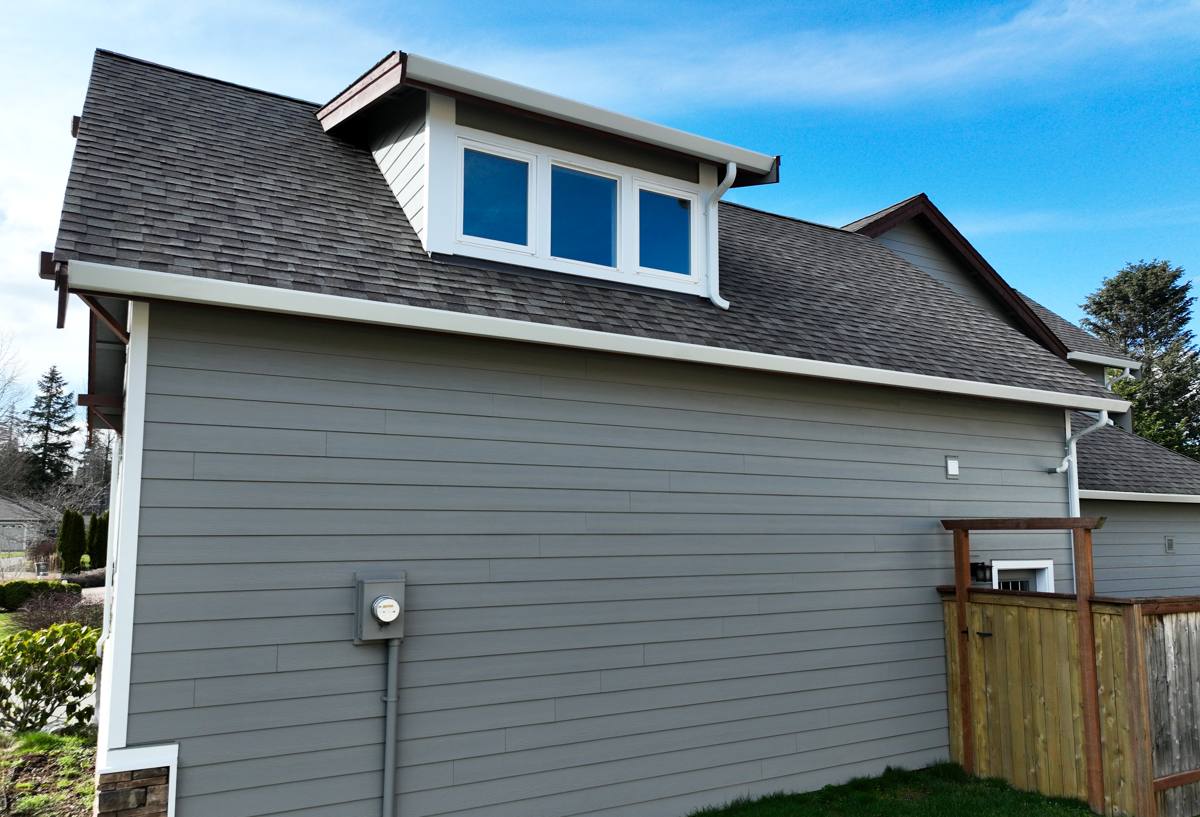
What Sumas Homes Are Actually Up Against
Persistent Moisture
Long stretches of low, steady rain do more damage to siding than the occasional hard storm. Water finds the smallest gap — a nail hole that's worked loose, a caulk line that's shrunk, a seam that was never properly flashed — and it keeps finding it, week after week, for most of the year. That's how a minor imperfection turns into rot, delamination, or a stained wall cavity.
Moss and Organic Growth
Moss doesn't just look bad. It holds moisture directly against the siding surface, keeps that section of wall from ever fully drying, and can work its way into seams and fastener points. On horizontal lap siding, moss tends to build up along the bottom edge of each board first — exactly where water already collects.
Wind-Driven Rain and Salt-Influenced Air
The same weather system that carries salt air across the region also drives rain sideways into exposed walls, gable ends, and anywhere caulking or flashing has started to fail. Salt-influenced moisture is more aggressive on fasteners and metal trim than plain rainwater, which is one reason we pay close attention to nail and flashing condition during a repair inspection, not just the visible face of the siding.
Freeze-Thaw Cycling
Whatcom County doesn't get deep winters, but it does get repeated freeze-thaw swings — cold snaps followed by wet, above-freezing days. Water that's already worked its way into a crack or seam expands when it freezes, which widens the damage a little more each cycle.
Signs a Sumas Home Needs Siding Repair
Most siding failures give warning signs well before they become structural problems. We look for these on every inspection, and homeowners can spot most of them from the ground:
- Cracked, split, or visibly warped boards, especially near corners and window trim
- Soft or spongy spots when you press on the siding (a strong sign of trapped moisture or rot underneath)
- Paint or finish that's bubbling, peeling, or chalking unevenly in patches
- Gaps opening up at seams, butt joints, or where siding meets trim, windows, or doors
- Persistent moss or dark streaking that comes back quickly after cleaning
- Nail heads popping, backing out, or leaving rust streaks below them
- Visible daylight or drafts through the wall from inside during storms
- A musty smell near exterior walls, which often points to moisture already inside the cavity
Any one of these on its own might be minor. Several together, or damage that's concentrated on one side of the house, usually means water has been getting behind the siding for a while — and that changes the repair from a patch to a more involved fix.
What a Correct Siding Repair Actually Involves
A repair that only replaces the damaged board and stops there is a repair that's likely to fail again. Doing it right means treating the cause, not just the symptom.
1. Find the Real Source of the Damage
Before we touch a board, we figure out why it failed. Was it a flashing gap above a window, a caulk joint that dried out, a fastener installed wrong, or just age and sun exposure on that side of the house? Replacing a board without fixing the entry point means the same spot fails again in a season or two.
2. Check What's Behind the Siding
Once a section is opened up, we look at the water-resistive barrier (house wrap), the sheathing, and the framing underneath. If moisture has been getting in for a while, there may be soft sheathing or early rot that needs to be addressed before new siding goes back on — patching over a compromised substrate just hides the problem.
3. Repair the Water Management, Not Just the Surface
Proper flashing at windows, doors, and horizontal seams; correctly lapped house wrap; and sealant only where it belongs (not as a substitute for proper flashing) — these are what actually keep water out. A siding repair that skips this step is cosmetic.
4. Match the Replacement Material Correctly
Board profile, exposure, and finish all need to match the existing wall, or the repair sticks out and can create its own water-shedding problems at the transition. This is where the material the home is already sided in matters a lot — see below.
Repairing James Hardie Siding vs. Other Materials
We install James Hardie fiber cement exclusively, and that shapes how we approach repairs. On homes already sided in James Hardie, repairs are usually the most straightforward call we make: the boards, trim profiles, and ColorPlus factory finishes are still in active production, so a damaged section can be replaced with true matching material rather than a close guess. Hardie's engineered fiber cement also doesn't absorb water the way wood-based products do, so a well-executed repair tends to hold for the long term rather than becoming a recurring line item.
We also get called out to repair homes sided in other materials — vinyl, LP SmartSide, cedar, or older fiber cement brands. We'll always give an honest assessment of what a repair can and can't fix on those products:
| Siding Material | Repair Reality |
|---|---|
| James Hardie fiber cement | Matching boards and finishes are available; repairs integrate cleanly and hold up long-term |
| Vinyl | Panels crack in cold snaps and fade unevenly over time; exact color/profile matches get harder to find as products age off the market |
| LP SmartSide (engineered wood) | Repairable while the panel is sound, but any panel with edge swelling or moisture intrusion usually indicates the issue is spreading, not isolated |
| Cedar | Individual boards can be replaced, but matching weathered cedar's color and grain exactly is difficult, and the underlying moisture sensitivity remains |
When a home has enough scattered damage on non-Hardie siding that we'd be doing repairs every year or two, we'll say so plainly, and we'll walk through what a full or partial replacement with James Hardie would look like — not as a sales pitch, but because it's often the more honest long-term answer for a house in this climate.
Our Repair Process
- Inspection: We walk the full exterior, not just the spot you called about — damage on one wall often has a sibling on another that hasn't shown itself yet.
- Diagnosis: We identify the cause of the failure, not just the visible symptom, including a look behind the siding where damage suggests moisture intrusion.
- Written scope and options: You get a clear explanation of what needs to be done, why, and what the realistic alternatives are — including when a repair isn't the right long-term move.
- The repair: Matching materials, correct flashing and water management, and fastening to spec — not just a board swap.
- Walkthrough: We show you what was found and what was fixed before we consider the job done.
Repair or Replace? A Straight-Talk Comparison
| Situation | Usually Repair | Usually Replace |
|---|---|---|
| Damage location | Isolated to one or two boards/areas | Spread across multiple walls or elevations |
| Cause | Impact damage, a single failed seam, isolated flashing gap | Systemic moisture intrusion, widespread rot, or aging material at end of life |
| Material availability | Matching product/finish still available | Discontinued profile or color, or material inherently mismatched to this climate |
| Age of siding | Mid-life, otherwise sound | Near or past expected service life |
| Underlying structure | Sheathing and framing intact | Sheathing soft, stained, or compromised in multiple spots |
Cost Factors Worth Knowing
- Extent of damage — one board is a very different job from a whole elevation
- Whether sheathing or framing repair is needed behind the siding
- How easy it is to source a matching material and finish
- Access — second stories, tight setbacks, and landscaping around the repair area
- Whether trim, flashing, or paint/finish work is bundled with the siding repair itself
We give a written estimate before any work starts, so there's no guessing about scope or cost once we're on the wall.
Why a Crew That Already Works Sumas Matters
Siding repair done by someone unfamiliar with this specific climate pattern tends to treat every job the same way, regardless of region. A crew that regularly works Whatcom County knows which elevations take the worst weather, how fast moss reestablishes here, how the freeze-thaw pattern behaves through a typical winter, and what water damage actually looks like once it's had a season or two to develop under siding in this kind of environment. That local pattern recognition is what separates a repair that catches the real problem from one that just replaces what's visibly broken and moves on.
It also means faster, more accurate estimates. When we've seen how a particular material and installation style holds up under Sumas conditions dozens of times before, we're not guessing at cause and effect — we're confirming what we already know to check for.
Get a Straight Answer on Your Siding
If you're seeing cracked boards, open seams, moss that keeps coming back, or a soft spot on an exterior wall, it's worth having it looked at before the next wet season adds to the damage. We'll give you a clear, honest assessment of what's going on, what it will take to fix it right, and whether a repair or a longer-term replacement makes more sense for your home. Reach out for a free, no-pressure estimate using the form below.