 Ferndale
 Cordata's Climate Is Harder on Siding Than Most Homeowners Realize
Homes in and around Cordata sit in a stretch of Whatcom County where three things work against exterior walls year-round: salt-laden air moving in off the Puget Sound region, long stretches of driving, wind-blown rain, and a moss and algae season that can run eight or nine months out of the year. None of these are dramatic events. They're slow, constant, and cumulative — which is exactly why so many siding failures in this area aren't sudden. They're the result of five, ten, fifteen years of moisture finding small gaps, wood fiber slowly wicking water, and paint film breaking down faster than it would in a drier climate.
Salt air accelerates the breakdown of paint and caulk, and it's harder on any fastener or trim detail that isn't corrosion-resistant. Driving rain doesn't just wet a wall — it drives water sideways into laps, seams, and butt joints that a calmer climate would never test. And moss doesn't just look bad; it holds moisture against the siding surface for months at a stretch, which is a problem for any material that isn't genuinely water-resistant at its core.
None of this means siding is a lost cause here. It means the material and the installation both have to be chosen with this climate in mind, not a generic one.
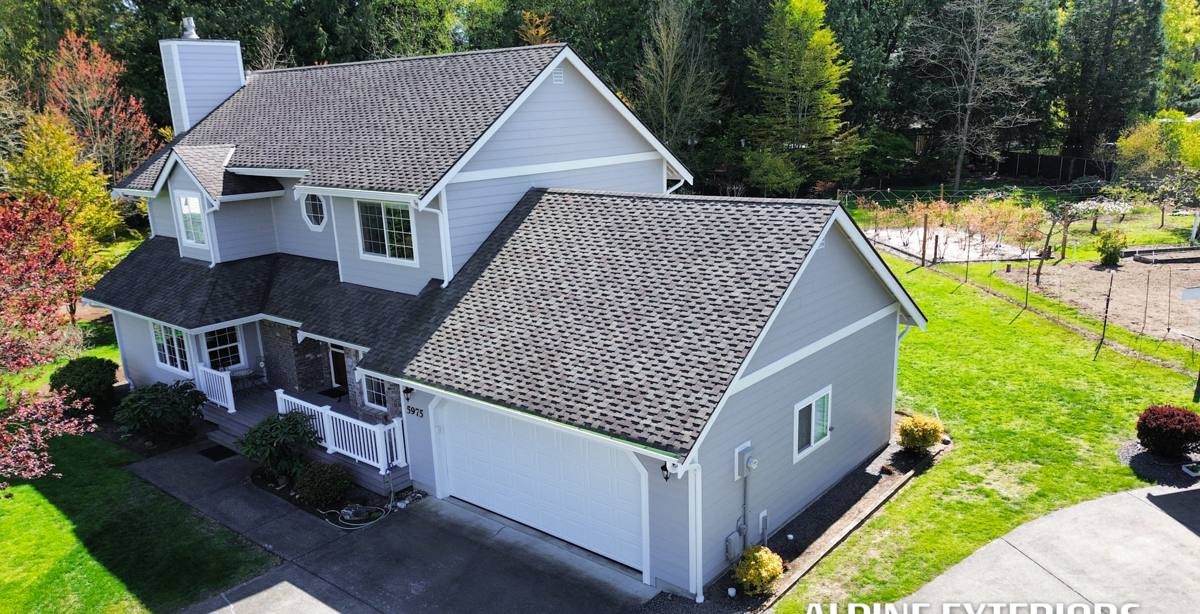
What "Correct" Fiber Cement Installation Actually Means in This Area
Fiber cement itself is a strong material for the Pacific Northwest — it doesn't rot, it doesn't feed insects, and it holds paint far longer than wood. But fiber cement is also unforgiving of installation shortcuts, and in a climate like Cordata's, those shortcuts show up faster than they would somewhere dry.
The details that matter most here
- Proper weather-resistive barrier and rain screen gap behind the siding, so any moisture that does get past the surface can drain and dry instead of sitting against sheathing
- Correct fastener placement and type — the wrong nail pattern or a fastener that isn't corrosion-resistant becomes a weak point exposed to salt air
- Factory-primed and factory-painted panels (ColorPlus, in Hardie's case) instead of field-painting cut edges only and hoping caulk holds
- Proper flashing at every window, door, and roofline intersection — this is where the vast majority of moisture intrusion actually starts, not in the field of the siding itself
- Correct clearance from grade, decks, and roof lines so splash-back and standing water aren't sitting against the bottom course
- Sealed and back-primed cut edges on every panel, every time — not just the ones that are easy to reach
Skip any one of these and the siding itself can be excellent while the wall behind it still fails. That's the gap between a siding job that looks right on install day and one that's still performing correctly a decade later.
Why We Only Install James Hardie
We made a decision as a company to install James Hardie fiber cement exclusively — not vinyl, not LP SmartSide, not the lower-cost fiber cement alternatives on the market. That's a narrower lineup than some contractors offer, and we think that's the right trade-off for homes in a climate like this one.
Hardie's HZ product lines are engineered for regional exposure categories, including the wetter, more moisture-driven conditions common in the Pacific Northwest. The material is non-combustible fiber cement, which matters for wildfire-adjacent exposure risk as much as it does for moisture. ColorPlus finish is baked on at the factory under controlled conditions, which holds color and resists fading and chipping far better than a field-applied paint job — a real advantage in a climate that's hard on paint film generally. And Hardie backs the product with a transferable warranty that's meaningful precisely because the material has a long track record of performing when it's installed to spec.
We're not going to tell homeowners that every other siding product is bad — vinyl and LP SmartSide both have legitimate uses and loyal installers. We just don't think they're the right call for the moisture and salt exposure this area sees, and we'd rather install one product extremely well than several products adequately. If you're weighing those alternatives, we'll walk you through the honest trade-offs rather than talk you out of asking.
Our Process for Cordata Jobs
Every project starts with a walk-around of the existing exterior, not just a measurement. We're looking at where water has historically collected, where trim and flashing are already showing wear, and where the house's specific exposure to wind and rain is worst — a north-facing wall in a shaded, mossy spot needs different attention than a wall that gets full sun and dries out quickly.
- On-site assessment of the existing siding, trim, and flashing condition, including any moisture damage found at removal
- Written scope covering exact Hardie product, profile, and color, plus every flashing and trim detail — not a vague "siding replacement" line item
- Removal of old siding and inspection of sheathing underneath, with repairs addressed before anything new goes up
- Installation of weather-resistive barrier, rain screen if specified, and correct flashing at every penetration
- Hardie panel or lap installation to manufacturer fastening and clearance specs
- Final trim, caulking, and touch-up, followed by a walk-through with the homeowner
Because we work in this part of Whatcom County regularly, we're not guessing at how the local climate behaves — we've seen what a rain screen gap does for a moss-prone shaded wall, and we've seen what happens on jobs where that step got skipped.
What This Typically Costs, and What Drives the Number
We don't publish a flat per-square-foot price because the real cost drivers vary a lot house to house. What we can do is lay out what actually moves the number so you're not guessing in the dark before an estimate.
| Cost Factor | Why It Matters |
|---|---|
| Condition of sheathing underneath old siding | Hidden moisture damage found at removal adds repair scope that can't be priced sight-unseen |
| Hardie product line (lap, panel, shingle-style) | Profiles and textures vary in material and labor cost |
| Trim complexity and roofline intersections | More corners, dormers, and flashing details mean more labor hours |
| House height and access | Multi-story sections and tight lot access affect equipment and staging |
| Rain screen / additional moisture detailing | Recommended in high-exposure areas of the property, adds material and labor |
| Color and finish | Factory ColorPlus finish vs. field-primed options affects material cost |
An honest estimate walks your specific house, not a national average. We'd rather give you a real number after seeing the exposure and existing condition than a ballpark that falls apart once we open the walls.
Signs Your Current Siding Is Losing the Fight
Because failure here is usually gradual, it's worth knowing what to look for before a small problem becomes a sheathing repair.
- Paint that's peeling, bubbling, or chalking faster than it used to, especially on shaded or north-facing walls
- Persistent moss or algae growth that comes back within weeks of cleaning
- Soft spots, or a spongy feel, when you press on siding near the bottom courses or below windows
- Visible gaps at seams, corners, or where trim meets siding
- Warping, buckling, or panels that no longer sit flat against the wall
- Interior signs — musty smell, staining, or peeling paint on walls that back up to exterior siding
Any one of these is worth a look. Several together usually means moisture has already gotten behind the surface, which is a bigger job than a straightforward re-side.
Why It Matters That We Already Work This Area
A crew that installs siding across a range of climates has to relearn local conditions on every job. A crew that works Ferndale, Cordata, and the surrounding Whatcom County communities regularly already knows which walls take the worst weather, which older homes in the area tend to have specific sheathing or flashing issues, and which details actually matter here versus which are boilerplate. That local repetition is part of what keeps an installation crew consistent — the fixes for wind-driven rain on a shaded wall aren't something you improvise correctly the first time you see it.
It also means we're not disappearing after the install. Warranty support, a callback about a caulk line, a question two years in about a moss patch — that's easier to handle well when the crew that did the work is still local and still doing this work down the street.
After Installation: Keeping Hardie Performing in This Climate
Fiber cement is low-maintenance, not no-maintenance. In a climate like Cordata's, a yearly rinse-down to clear moss and organic buildup before it gets a foothold goes a long way. Keep an eye on caulk lines at trim and window intersections — caulk is the one component that wears out well before the siding itself does, and it's a cheap, easy fix when caught early. Keep gutters clear and downspouts directed away from the foundation so splash-back isn't hitting the lower courses. None of this is heavy upkeep, but skipping it entirely is how a well-installed system starts showing problems earlier than it should.
If you're weighing a siding replacement or repair for a Cordata-area home, we're glad to walk the property, look at what's actually happening with your current siding, and give you a straight answer about what it needs. There's no pressure and no cost to have us out — just an honest look and a written estimate you can take your time with.