 Ferndale
 Building Decks for Kendall's Particular Weather
Kendall sits close enough to the water and open enough to weather that a deck built the way you'd build one further inland just won't hold up the same way here. Salt-tinged air moves through this part of Whatcom County, driving rain comes in sideways more often than straight down, and the wet season stretches long enough that moss gets a real foothold on anything that stays damp. A deck is one of the most exposed structures on a property — no roof overhang protecting it, full sun in summer, full weather in winter. Building one that lasts in Kendall means making different choices than a generic deck build, starting with the fasteners and working all the way up to how the boards are spaced.
We've worked on decks throughout Ferndale and the surrounding county long enough to know which shortcuts show up as problems in year three, not year one. This page covers what a correctly built custom deck looks like for a Kendall property, and what our process actually involves from first look to final walkthrough.
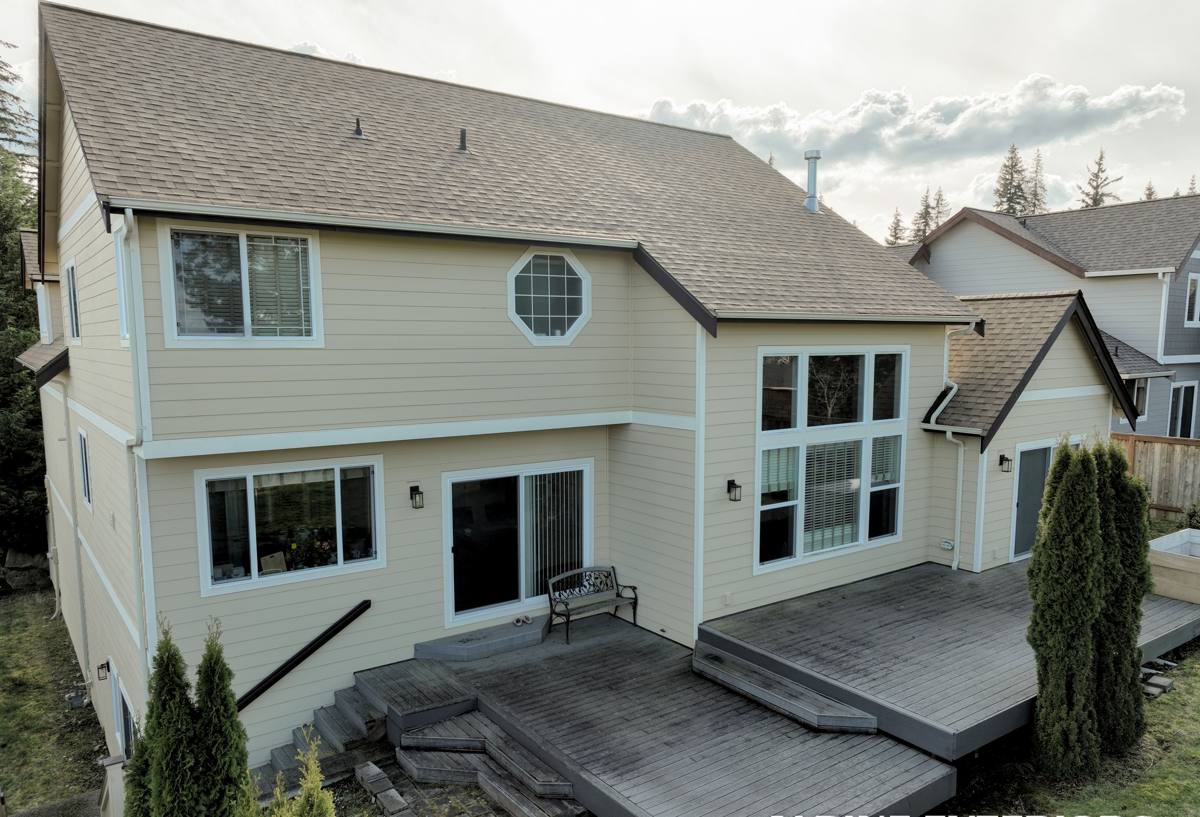
What Kendall's Climate Actually Does to a Deck
Salt Air and Metal
Even a few miles from saltwater, airborne salt finds its way onto exposed metal. Standard zinc-coated screws and joist hardware corrode faster here than the packaging suggests — you'll see rust bleed staining the decking around fastener heads within a couple of seasons if the wrong hardware gets used. This isn't a defect in the wood; it's a fastener problem, and it's entirely avoidable with the right spec.
Driving Rain
Rain that comes in at an angle gets underneath rail caps, behind fascia boards, and into end grain that isn't sealed. Flat, calm-weather rain is easy to shed. Wind-driven rain finds every gap in flashing, every unsealed cut end, and every spot where two pieces of wood meet without a drainage path. A deck built for Kendall needs those details handled at construction, not patched later.
Moss and the Long Wet Season
Moss needs shade and sustained moisture, and much of the year here provides both. It takes hold fastest on decking that stays damp between boards — tight spacing, debris buildup in the gaps, and low airflow underneath all make it worse. Moss itself isn't just cosmetic; it holds moisture against the board surface and accelerates rot and slip risk together.
Framing: The Part Nobody Sees, Until It Fails
The substructure is where a deck's lifespan actually gets decided. We build framing with attention to a few things that matter more here than in a drier climate:
- Joist hangers and structural screws rated for coastal/high-moisture exposure, not standard interior-grade hardware
- Proper joist spacing and blocking so the deck doesn't develop bounce or movement as lumber moves with seasonal moisture changes
- Ledger board flashing installed to actually shed water away from the house rim joist, not just sit against it
- Post bases that keep wood off standing water and concrete, since ground contact is where rot starts fastest
- Airflow underneath the deck so the framing can dry out between rain events instead of staying saturated
None of this is visible once the decking goes down, which is exactly why it's worth asking a contractor directly how they're handling it — a deck that looks great for the first year can still be rotting from the frame up if these steps got skipped.
Decking Material: Trade-Offs for This Climate
There isn't one universally "right" decking material — there's a right material for your budget, maintenance appetite, and how much sun/shade the deck gets. Here's how the common options actually perform in a Kendall setting:
| Material | How it handles our climate | Maintenance |
|---|---|---|
| Pressure-treated lumber | Handles moisture well if properly sealed; needs re-sealing on a regular schedule or it grays and checks | Higher — annual inspection, periodic sealing/staining |
| Cedar | Naturally moisture- and insect-resistant, ages well with the region's look; still benefits from a moisture-repellent finish | Moderate — periodic cleaning and finish maintenance |
| Composite decking | Doesn't absorb moisture into the board itself, resists rot; still needs regular cleaning where moss and algae can grow on the surface | Lower — no sealing, but surface cleaning matters |
| PVC decking | Fully moisture-resistant, no wood fiber to rot; can be slicker underfoot when wet unless the surface texture is chosen deliberately | Lowest — occasional washing |
Our standard is to walk homeowners through this honestly rather than push whatever has the best margin. If you want the warmth and repairability of real wood and are willing to keep up with a sealing schedule, that's a legitimate choice. If you want to spend your weekends doing something other than deck maintenance, composite or PVC earns its higher upfront cost over time. What we won't do is install decking without the fastener and spacing details that keep moss and rot at bay underneath it, regardless of material.
Board Spacing and Drainage
Gap spacing between deck boards matters more here than in a dry climate. Too tight, and debris packs into the gaps, holds moisture, and gives moss a place to establish. Too wide, and you lose comfort underfoot and drop more debris straight onto the framing below. We set spacing based on the specific board material's expansion behavior and the amount of shade the deck sits in — a deck under tree cover in Kendall needs different spacing consideration than one in full sun.
Rails, Fasteners, and Fixtures That Won't Rust Streak
Guardrails, stair rails, and any fascia hardware get the same coastal-air consideration as the framing. We spec stainless or coated fasteners rated for exposure, and we pay attention to where rail posts attach — that's a connection point that takes both structural load and constant weather exposure, so it needs to be both mechanically sound and properly sealed against water intrusion.
Our Process for a Kendall Deck Project
- On-site assessment — we look at sun/shade exposure, drainage slope of the yard, proximity to structures, and existing deck condition if this is a rebuild
- Design and material conversation — honest walkthrough of material trade-offs above, sized to your budget and how you'll use the space
- Permitting — decks above certain heights or attached to the home typically require permitting through the applicable jurisdiction; we handle that coordination
- Framing build — structural work with coastal-rated hardware, proper ledger flashing, and blocking done first, before anything visible goes on
- Decking and rail installation — spacing, fastening, and rail attachment done to the standard above
- Final walkthrough — we go over basic maintenance expectations for whatever material you chose, so there are no surprises in year two
Why a Crew That Already Works Kendall Matters
A contractor who builds decks all over Western Washington in general terms knows decks. A crew that's actually worked in and around Ferndale and Whatcom County knows this specific mix of salt air, rain angle, and moss pressure, and builds accordingly without having to relearn it on your project. That shows up in small decisions — which fastener grade gets specified without a second thought, how much airflow gets left under the framing, what board spacing actually works once the rainy season sets in. It's the difference between a deck that needs real maintenance calls in year three and one that just needs normal upkeep.
Maintenance: What Keeps a Kendall Deck Lasting
Whatever material you choose, a few habits matter more here than elsewhere:
- Clear debris out of board gaps a few times a year, especially going into fall, so moss doesn't get a foothold
- Rinse or lightly scrub surfaces where shade keeps them damp longer
- Check fastener heads and rail connections annually for early rust staining — catching it early is a wipe-down, not a repair
- Reseal wood decking on the schedule appropriate to the product — skipping a cycle in this climate shows up faster than it would somewhere drier
- Keep an eye on the area under the deck for standing water or blocked airflow after any landscaping changes
A deck built correctly for this climate doesn't need constant attention — it needs the right occasional attention, which is a very different thing.
Get a Straight Answer on Your Kendall Deck Project
If you're planning a new deck or looking at replacing one that's showing its age, we're happy to come take a look and give you an honest read on what it needs — no pressure, no upsell on materials you don't need. Use the form below to request a free estimate.