 Ferndale
 Why Kendall Homes Need Siding That Can Handle This Climate
Kendall sits in the part of Whatcom County where three weather patterns overlap in ways that are hard on exterior building materials. Moisture rolls in off the Salish Sea and gets pushed inland by prevailing winds, carrying enough salt content to accelerate corrosion on fasteners and trim. That same moist air sits against tree-lined lots and north-facing walls for months at a time, which is exactly the environment moss and algae need to take hold. Add driving rain that comes in sideways during fall and winter storms, and you have a combination that punishes any siding product with weak seams, absorbent substrates, or coatings that weren't engineered for sustained wet exposure.
Most siding failures we see on homes in this area aren't dramatic. They're slow: a swollen board edge behind a gutter downspout, a moss colony creeping up a shaded wall, paint that's chalking and peeling three years ahead of schedule. None of that is really about workmanship on the day the siding went up — it's about whether the product itself was designed to shed water, resist organic growth, and hold a finish through a Pacific Northwest wet season without babysitting.
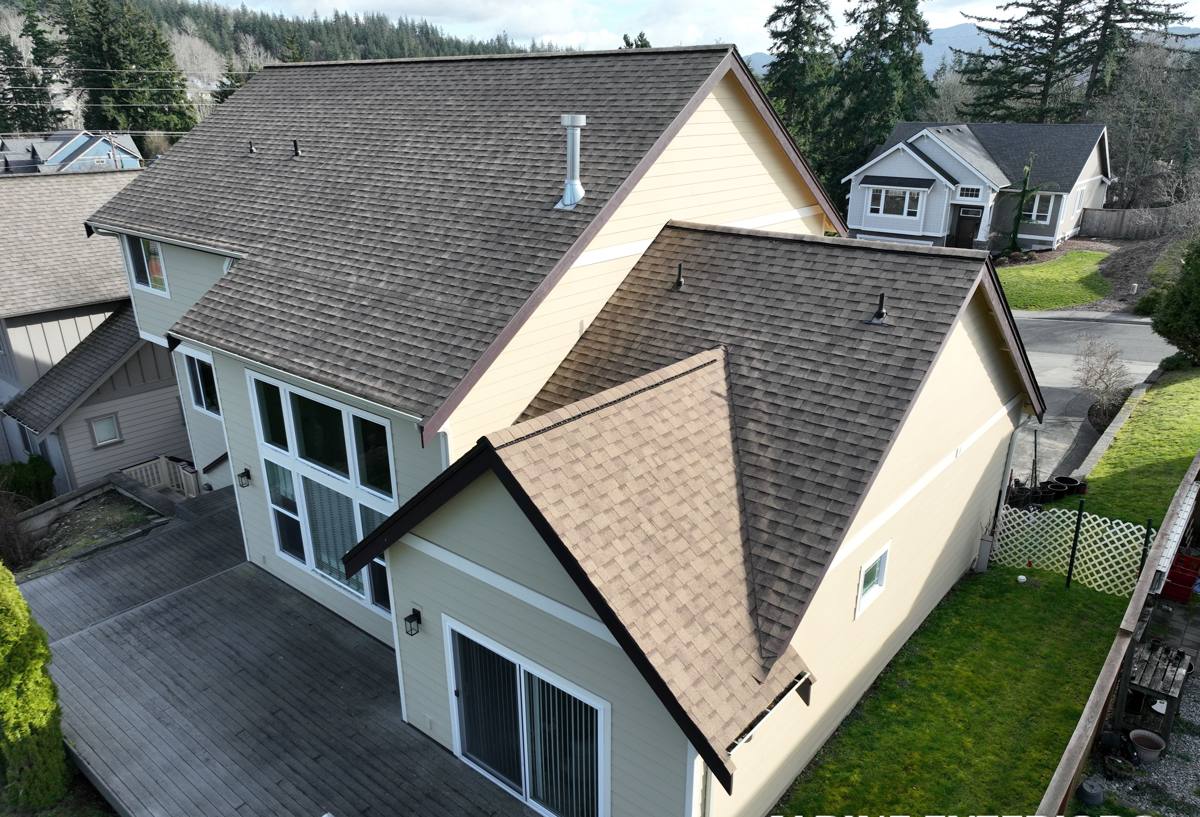
What "Correct" Fiber Cement Installation Actually Involves
Fiber cement siding is not a forgiving product to install badly. It performs exactly as well as the details behind it, and in a climate like Kendall's, those details are the difference between siding that lasts decades and siding that fails at the seams within a few years.
Moisture Management Comes First
Before a single plank goes up, the wall needs a properly lapped weather-resistive barrier, correctly integrated flashing at every window, door, and penetration, and a drainage plane that lets any water that gets behind the cladding find its way back out. Fiber cement is dimensionally stable and doesn't rot, but the wall assembly behind it can still trap moisture if flashing details are skipped. In an area that gets sustained driving rain, this step is not optional.
Clearances and Fastening
James Hardie specifies minimum clearances from grade, roof lines, decks, and horizontal surfaces for a reason: standing water and prolonged contact with soil or mulch degrade almost any siding product over time. Fastener placement, spacing, and depth also matter — over-driven nails crack the board's factory finish and create a spot for water to enter, while under-driven fasteners leave boards loose enough to work themselves free in wind.
Joint and Seam Treatment
Butt joints, corners, and trim intersections are where siding jobs succeed or fail. Factory-primed or ColorPlus-finished edges need to be treated according to the manufacturer's published details, not improvised, and caulking has to be used at the right joints — and skipped at others — to avoid trapping moisture where it shouldn't be.
Why We Install Only James Hardie — Nothing Else
We don't offer a menu of siding brands. We install James Hardie fiber cement, full stop. That's a deliberate standard, not a limitation on options.
Hardie's HZ5 product line is engineered specifically for climates that see freeze-thaw cycles and sustained moisture — which describes Whatcom County's weather well. The board itself is non-combustible, doesn't provide a food source for moss and mildew the way wood-based products can, and holds its shape in humidity swings without the swelling or delamination that can affect engineered wood siding. The ColorPlus factory finish is baked on under controlled conditions, which gives it more consistent coverage and better fade resistance than field-applied paint, and it comes with a warranty structure that's transferable if the home sells.
Other products on the market — vinyl, LP SmartSide, primed wood, cedar — each have legitimate uses and reasonable people choose them for good reasons, including upfront cost. But when we weigh moisture behavior, long-term maintenance, and how each product actually performs after ten or twenty years of Kendall's wet season, Hardie is the one we're willing to put our name on.
Comparing Siding Materials for a Kendall Home
| Material | Moisture Resistance | Moss/Algae Resistance | Maintenance Burden | Typical Lifespan |
|---|---|---|---|---|
| James Hardie Fiber Cement | Excellent — non-combustible, engineered drainage details | High — dense composition resists organic growth | Low — occasional rinse, no repainting for years | 30-50 years with correct install |
| Vinyl | Good, but seams and panels can warp in heat/cold cycling | Moderate — grooves can trap grime and moss | Low, but cracks and fades over time | 20-30 years |
| LP SmartSide (engineered wood) | Fair — wood-based core is moisture-sensitive at cut edges | Moderate to low depending on finish upkeep | Moderate — edge sealing and repainting cycles | 15-30 years |
| Cedar / Primed Spruce | Fair — natural material, absorbs and releases moisture | Low — organic material feeds moss and mildew | High — repainting/staining every few years | 15-25 years with diligent upkeep |
Our Process for Kendall Siding Projects
- On-site assessment: we walk the exterior, check for existing moisture damage, note grade clearances, roof-wall intersections, and any areas where past siding has failed.
- Scope and product selection: we confirm the right Hardie plank profile, exposure, and ColorPlus color for the home, and walk through what tear-off will reveal once the old cladding is off.
- Tear-off and sheathing check: removing the existing siding lets us inspect the sheathing underneath for rot or moisture intrusion before it gets covered up again — this step catches problems that a surface-level look can't.
- Weather barrier and flashing installation: a new, correctly lapped weather-resistive barrier goes on along with flashing at every penetration, window, and door.
- Siding installation to manufacturer spec: proper clearances, fastener schedule, and joint treatment, following Hardie's published installation instructions rather than shortcuts.
- Trim, caulking, and final detailing: corners, trim boards, and transitions get finished according to spec — this is where a lot of long-term failures start if rushed.
- Walkthrough: we go over the finished work with the homeowner before calling the job done.
Cost Factors for a Kendall Siding Job
Every home is different, but the line items that move the price on a Kendall project tend to be the same ones every time:
| Factor | Why It Matters |
|---|---|
| Condition of existing sheathing | Hidden rot found during tear-off adds repair scope before new siding can go on |
| Home size and wall complexity | More corners, dormers, and trim details mean more labor and material waste |
| Siding profile and finish | Lap width, texture, and ColorPlus color selection affect material cost |
| Access and site conditions | Steep lots, mature landscaping, or tight setbacks slow staging and scaffolding |
| Trim and accessory scope | Fascia, soffit, and trim replacement alongside siding changes total project cost |
We don't quote a number until we've actually looked at the house — anything else is a guess, and guesses on siding jobs tend to be wrong in one direction or the other.
Maintaining Fiber Cement Siding in Whatcom County's Wet Season
One of the real advantages of correctly installed Hardie siding is how little it asks of a homeowner. That said, a long moss season and heavy annual rainfall mean a short annual routine pays off:
- Rinse the exterior once or twice a year with a garden hose or low-pressure washer to keep organic buildup from establishing on shaded or north-facing walls
- Trim back landscaping and tree limbs that keep siding shaded and damp longer than the rest of the house
- Check caulking at trim joints and penetrations annually, since caulk is the one component that wears out well before the siding does
- Clear debris from behind downspouts and at deck-to-wall intersections where standing moisture tends to collect
- Watch for chalking, fading, or lifting at seams, which can signal a flashing or joint detail that needs attention
Signs a Kendall Home May Need New Siding
- Soft or spongy spots when you press on the siding, especially near the bottom courses
- Persistent moss or algae growth that returns within weeks of cleaning
- Visible warping, buckling, or gaps at panel seams
- Paint that's failing faster than it should, or siding that needs repainting more than once every several years
- Rising heating or cooling bills that point to a compromised weather barrier behind the cladding
Why Local Experience in Kendall Matters
A crew that's already worked on homes in this part of Whatcom County knows what the weather actually does to a wall, not just what the spec sheet says it should do. That means knowing which orientations need extra attention to moss resistance, which lot conditions call for wider ground clearances, and how driving rain off open fields and tree lines behaves differently than it does closer to town. It also means understanding the practical realities of scheduling around the wet season, permitting through the county, and building details that hold up specifically here — not in some generic climate zone from a manual.
If you're weighing a siding replacement on a Kendall home and want a straight answer about what your house actually needs, we're happy to take a look. Reach out for a free, no-pressure estimate using the form below.