 Ferndale
 Marietta's Climate Is Harder on Siding Than Most Homeowners Realize
Marietta sits close to the water on the edge of Bellingham Bay, which means homes here take on a combination of weather stresses that inland Whatcom County properties simply don't deal with. Salt-laden air moves in off the bay and settles on exterior surfaces year-round. Add Ferndale's long, wet fall-through-spring rain season, and you've got siding that's almost never fully dry for months at a time. Then there's moss — not just on the roof, but creeping up north-facing walls, behind trim, and into any seam where water and shade meet. Any siding product installed in Marietta has to handle all three at once, continuously, for decades, not just survive a single hard storm.
This is the honest starting point for any siding conversation in this area: the product matters less than most people think, and the installation matters more. A premium material installed poorly will fail here faster than a decent material installed correctly. That's the lens we bring to every fiber cement job in Marietta.
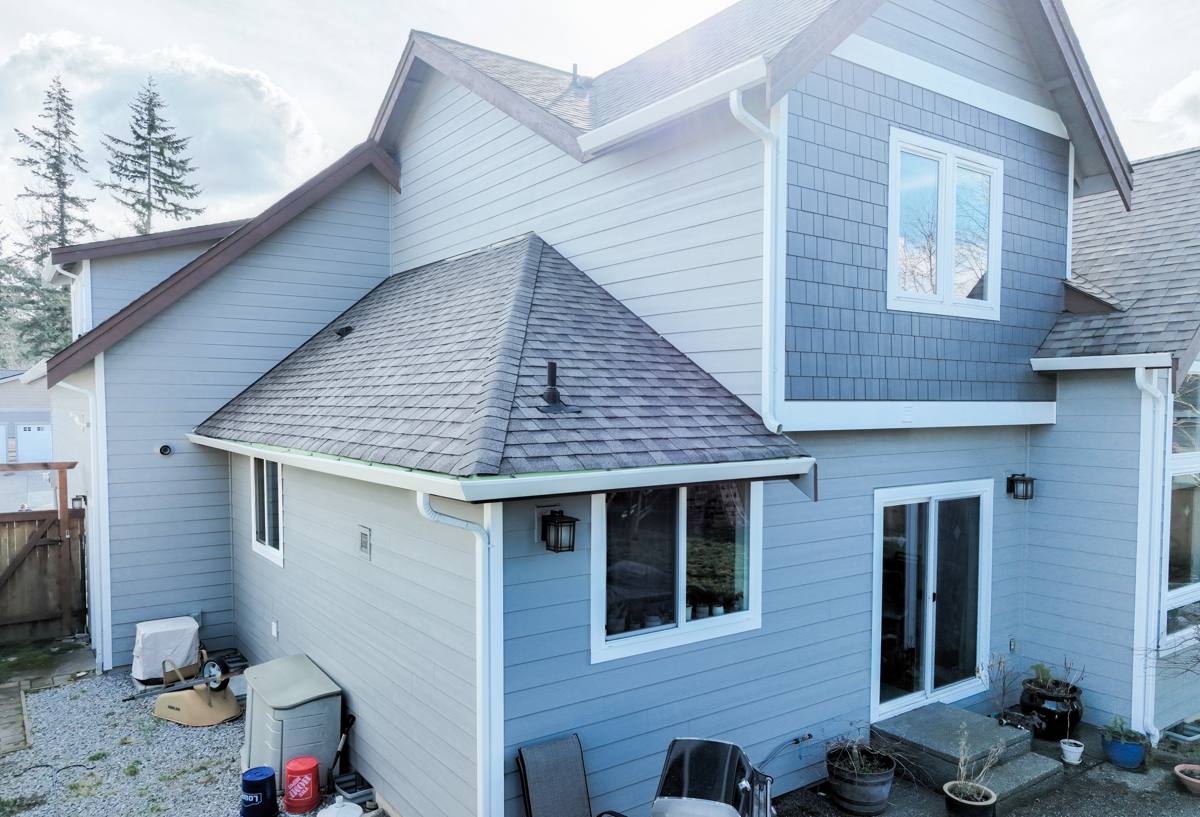
What Local Homes Actually Need From Their Siding
Moisture Management, Not Just Water Resistance
"Water resistant" siding still gets wet. What matters in Marietta is what happens after that — whether water sitting against the wall for days at a time has somewhere to go, or whether it gets trapped behind the cladding where it can rot sheathing, feed mold, and eventually push paint and caulk off from the inside out. Correct siding work here is really a drainage and ventilation project first, and a cosmetic project second.
Resistance to Salt-Driven Corrosion and Degradation
Salt air accelerates the breakdown of fasteners, caulk, and paint film faster than plain rainwater does. Products and finishes that hold up fine forty miles inland can chalk, pit, or fail early this close to the bay. That affects what fastener material we use, what caulk we spec, and how much we lean on factory-applied finish versus field-applied paint.
A Surface Moss Doesn't Love
Moss needs shade, moisture, and a rough or porous surface to grip. You can't eliminate the first two in Marietta, but the siding surface itself, plus how it's detailed at ground level, roof lines, and shaded walls, makes a real difference in how fast moss establishes and how hard it is to keep off without damaging the finish.
Why We Install Only James Hardie Fiber Cement
We don't install LP SmartSide, vinyl, Cemplank, Allura, or bare cedar or primed spruce siding, and in a climate like this one, that's not a brand preference — it's a standard we hold because of what we've seen happen to the alternatives over time in coastal Whatcom County conditions. Engineered wood products can perform well when kept dry, but Marietta's rain and salt-air moisture load leaves little margin for the edge-swelling and moisture intrusion that wood-based sidings are prone to if a seam ever fails. Vinyl expands and contracts with temperature swings, can crack in cold snaps, and doesn't hold paint if a homeowner ever wants to change the color down the road. Unfinished or primed wood species need a maintenance commitment — regular recoating — that most homeowners underestimate until the siding is already showing wear.
James Hardie fiber cement is non-combustible, dimensionally stable in wet-dry cycling, and comes from the factory with a baked-on ColorPlus finish that's formulated to outlast field-applied paint in exactly the conditions Marietta throws at it — salt exposure, UV, and near-constant moisture. It's also backed by a strong transferable warranty, which matters to homeowners who may sell within the product's lifespan. None of that guarantees a good result on its own — installation is still what determines whether the product performs — but it gives us a material we trust to hold up its end of the job.
What a Correct Fiber Cement Installation Involves
Water Management Behind the Siding
Before a single board goes up, the wall needs a proper weather-resistive barrier, correctly lapped and sealed, plus a rainscreen gap in most Marietta installations. That gap lets any moisture that does get past the cladding drain and dry out instead of sitting against the sheathing. Skipping this step is the single most common reason fiber cement siding fails early in wet coastal climates — not because the boards themselves failed, but because the wall behind them couldn't dry.
Flashing at Every Penetration
Windows, doors, hose bibs, light fixtures, vents — every penetration through the siding is a place water can get behind the wall if it's not flashed correctly. In a climate with as much sustained rain as Ferndale gets, this detail work is where most long-term problems either get prevented or get built in.
The Right HardieZone Formulation
James Hardie manufactures its siding in different formulations engineered for different climate zones — a system the company calls HardieZone. Homes in western Washington fall into the humid, high-moisture zone, and using the formulation engineered for that exposure, rather than a generic or mismatched product, is part of getting a correct installation, not an upsell.
Fastening and Clearances
Fastener spacing, type, and depth all follow manufacturer specification, and in a salt-air environment we favor corrosion-resistant fasteners throughout, not just where code requires them. Ground clearance and gaps at decks, patios, and roof lines also get held to spec — those clearances exist specifically to keep siding away from splashback and standing moisture.
Caulking and Paint Touch-Up
Factory ColorPlus finish covers the field of the siding, but cut edges and joints still need sealing with a caulk rated for the exposure, and any field-cut edges get touch-up coated. This is a small step that's easy to rush and expensive to redo once it's been missed for a few seasons.
Our Process on Marietta Projects
- Walk-through and assessment — we look at existing siding condition, moisture signs, moss growth patterns, and any trouble spots specific to the home's exposure (waterfront-facing walls, shaded north sides, low-lying grade).
- Written estimate — scope, product line, and cost broken out clearly, with no pressure to decide on the spot.
- Tear-off and sheathing check — we inspect what's underneath the old siding before covering it back up, since that's the only chance to catch and fix hidden rot or moisture damage.
- Water barrier and rainscreen install — the unglamorous part of the job that determines whether the visible work lasts.
- Hardie board installation — fastened, flashed, and sealed to manufacturer spec.
- Final detailing and walkthrough — caulk, touch-up, and a review with the homeowner before we consider the job finished.
What It Costs, and What Drives the Price
Every home is different, so we won't give you a number without seeing the job, but here's what actually moves the price on a Marietta fiber cement project:
| Cost Factor | Why It Matters |
|---|---|
| Existing siding removal | Tear-off, disposal, and any hidden repair work found underneath add labor and material |
| Wall complexity | Dormers, multiple stories, and cut-up rooflines take more time and material than a simple rectangle |
| Siding profile and accessories | Lap width, trim style, and shakes or panels cost differently than standard lap siding |
| Water barrier and rainscreen upgrade | Doing this correctly in a wet, salt-exposed setting adds cost but is not optional in our process |
| Access and site conditions | Steep grades, waterfront setbacks, or tight lot lines can affect equipment and staging |
Maintenance and Longevity in This Climate
Correctly installed Hardie siding with factory ColorPlus finish needs far less upkeep than wood or field-painted alternatives, but "low maintenance" doesn't mean "no maintenance" in Marietta. A yearly rinse to knock off salt film and organic buildup, a visual check of caulked joints, and prompt attention to any moss establishing on shaded walls will keep the finish performing for the long run. We're happy to walk homeowners through what to watch for after the install is done.
Why a Crew That Already Works Marietta Matters
Siding contractors who mostly work drier, inland jobs sometimes treat rainscreen detailing, flashing sequencing, and fastener corrosion resistance as optional upgrades. In Marietta's exposure, they're not optional — they're the difference between siding that looks good for two years and siding that performs for decades. A crew that regularly works this stretch of Whatcom County near the water already knows where water tends to collect on these lots, how moss behaves on shaded coastal walls, and which details can't be shortcut. That local pattern recognition doesn't show up on a spec sheet, but it shows up in how the job holds up ten years later.
Questions Worth Asking Any Contractor Before You Hire
- Do you install a rainscreen gap and weather-resistive barrier on every job, or only when asked?
- What fastener material do you use, and is it rated for coastal/salt-air exposure?
- Will you show me what's underneath the existing siding before it's covered back up?
- What's your plan for flashing windows, doors, and other penetrations?
- Is the warranty from the manufacturer, the installer, or both, and what does it actually cover?
- Can you walk me through why you use the product line you use, not just that you use it?
If you're weighing a siding project on a Marietta home, we're glad to come take a look and give you a straightforward, no-pressure estimate — what we'd recommend, why, and what it would cost, with no obligation to move forward.