 Ferndale
 Building a Deck That Can Handle Sandy Point's Waterfront Exposure
Sandy Point sits closer to open water than most of Ferndale, and that changes what a deck has to put up with. Wind off the Strait carries salt spray onto railings and fascia, rain comes in sideways more often than it falls straight down, and the shaded, damp corners of a yard grow moss and algae for a good chunk of the year. A deck built to a generic spec sheet will survive inland Ferndale for years and still show problems here in half the time — fastener corrosion, black streaking on the boards, soft spots where water sits against the house. Composite decking, installed correctly for this environment, is one of the better answers to that problem. Installed carelessly, it just fails in different ways than wood does.
This page covers what we actually pay attention to when we build a composite deck for a Sandy Point property: what the salt air and rain do to a deck over time, what a correct installation looks like here, how to pick a composite product that fits the site, and what upkeep actually looks like once it's built.
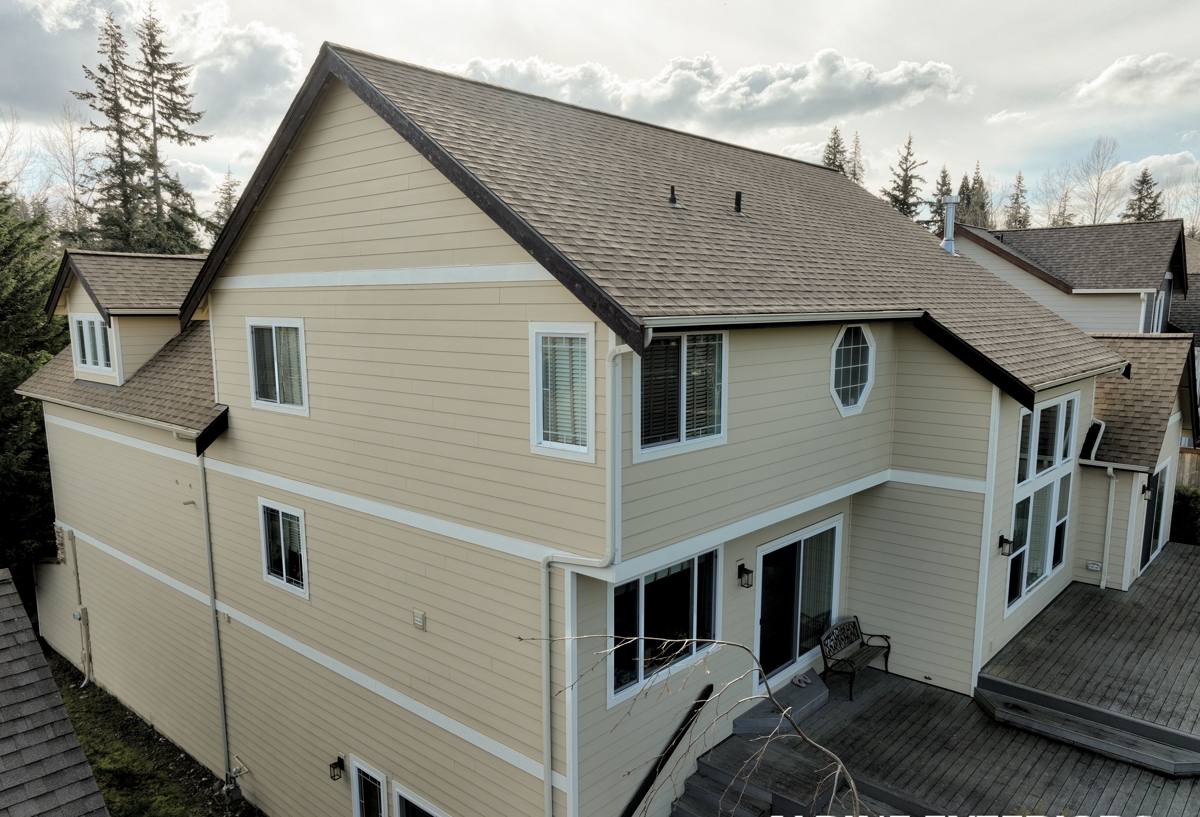
What Salt Air, Rain, and Moss Do to a Deck Near the Water
Salt Air and Corrosion
Salt-laden air accelerates corrosion on anything metal — fasteners, joist hangers, railing brackets, post bases. On a standard wood deck built with mixed-grade hardware, that shows up as rust streaks bleeding through the decking, screws that seize or shear off during repairs, and hangers that weaken years before the framing lumber does. Composite boards themselves don't corrode, but every composite deck still has a wood or metal frame underneath it, and that frame is only as durable as the fasteners holding it together.
Driving Rain and Trapped Moisture
Wind-driven rain doesn't just fall on a deck surface — it gets pushed sideways into gaps, under railings, and against the house where the deck ties in. If a ledger board isn't properly flashed, or if boards are laid tight against the siding without a drainage gap, water gets trapped and sits there. That's where rot in the framing and staining on the underside of composite boards actually starts, even though the boards on top look fine.
Moss and Algae Season
Whatcom County's wet season is long, and shaded, low-airflow spots under trees or on the north side of a house stay damp for months. Moss and algae need moisture and organic debris to take hold, and they don't care whether the surface underneath is wood or composite. The difference is that composite doesn't feed the growth the way wood fiber does, and a properly capped board sheds it far more easily during cleaning.
Why Composite Fits This Site Better Than Wood — With Honest Limits
We install composite decking in Sandy Point because it holds up to this specific mix of conditions better than an untreated or even pressure-treated wood deck, not because it's a maintenance-free product. Here's the honest tradeoff:
| Concern | Wood Decking | Capped Composite Decking |
|---|---|---|
| Salt spray staining | Absorbs into grain, greys and stains unevenly | Sheds surface moisture, washes clean more easily |
| Moss/algae growth | Wood fiber feeds growth in shaded, damp spots | Non-porous cap resists growth, still needs periodic washing |
| Rot risk | High if sealing/staining lapses | Board itself won't rot; framing underneath still can |
| Ongoing upkeep | Re-stain/seal every 1–2 years in this climate | Seasonal wash-down, no staining or sealing |
| Upfront cost | Lower material cost | Higher material cost, less long-term labor |
Composite still needs cleaning — salt film, pollen, and tree debris build up on any deck surface near the water. What it removes from the equation is the yearly sanding, staining, and sealing cycle that wood demands to keep moisture out, which is exactly the maintenance homeowners here tend to fall behind on once the wet season sets in.
What a Correct Composite Deck Build Involves Here
The Substructure Comes First
The composite boards are the visible part, but the framing underneath is what actually determines how long the deck lasts in a salt-air environment. For Sandy Point builds, that means:
- Corrosion-resistant fasteners and hardware throughout — coated or stainless-rated screws, joist hangers, and structural connectors, not standard interior-grade hardware
- Joist tape over the top of every joist to keep water from soaking into cut and drilled framing lumber
- Proper ledger flashing where the deck ties into the house, so wind-driven rain can't work its way behind the band board
- Correct board spacing and end-gapping so composite boards can expand and contract with temperature swings without buckling or pulling fasteners loose
- Adequate airflow underneath the deck — blocked or low-clearance substructures trap moisture and slow drying after every rain
Hidden Fastener Systems
Most composite decks today use a hidden fastener clip system rather than face-screwing, which gives a cleaner look and eliminates hundreds of exposed screw heads that would otherwise be the first thing salt air attacks. We use clips and screws rated for exterior, corrosive-exposure use — not the general-purpose hardware that comes bundled with some low-end board packages.
Drainage Detailing
On a site this close to the water, we pay particular attention to slope and drainage — away from the house, away from any low spots where standing water would sit against fascia or framing. A deck that drains well dries out faster after the sideways rain this area gets, which matters more here than it does a few miles inland.
Choosing the Right Composite Product for a Coastal Yard
Not all composite boards are built the same, and the differences matter more in an environment like Sandy Point's:
| Feature | What to Look For | Why It Matters Here |
|---|---|---|
| Cap type | Fully capped (all four sides) vs. capped top/sides only | Full capping protects cut ends and undersides from moisture wicking |
| Surface texture | Grooved with hidden fasteners vs. smooth face-screw | Grooved profiles drain surface water faster and hide fastener corrosion |
| Color/streaking | Multi-tonal or streaked colors | Hides salt film, pollen, and minor staining between cleanings |
| Warranty structure | Fade, stain, and structural coverage terms | Coastal exposure is the kind of use case warranties are tested against |
We steer homeowners toward fully capped boards for anything within direct line of the water or wind, and we're upfront when a lower grade board is a poor fit for the site rather than push a cheaper option that won't hold up.
Our Process for a Sandy Point Composite Deck
- On-site assessment — we look at sun exposure, wind direction, existing drainage, and how close the deck sits to the water or open yard
- Substructure plan — framing layout, fastener spec, and flashing details sized to the site, not a one-size-fits-all package
- Demo and prep — removal of the old deck or repair of existing framing, with any rot or corrosion addressed before new material goes down
- Framing and flashing — joist tape, ledger flashing, and corrosion-rated hardware installed throughout
- Board installation — correct spacing, hidden fasteners, and attention to drainage slope
- Railings and finish details — matched to the composite system and rated for the same exposure conditions
- Walkthrough — we go over what maintenance actually looks like for your specific site before we leave
Maintenance That Actually Matters in This Climate
Composite decking cuts out sanding, staining, and sealing, but it isn't a walk-away product on a site like this. What we tell Sandy Point homeowners to actually do:
- Wash the deck surface a couple of times a year to clear salt film, pollen, and organic debris before it builds up
- Check shaded or low-airflow corners for moss or algae starting in fall, when the wet season begins in earnest
- Keep gaps between boards clear of leaves and debris so water keeps draining as designed
- Inspect railing posts and fastener points near the water side of the deck periodically for any early corrosion at hardware, even though the boards themselves won't rust
- Confirm gutters and downspouts near the deck aren't dumping extra water onto or under it during heavy rain
What Drives Cost on a Sandy Point Deck
| Factor | Why It Changes the Price |
|---|---|
| Substructure condition | Rebuilding rotted or corroded framing costs more than decking over sound framing |
| Board grade chosen | Fully capped, multi-tonal boards cost more upfront than base-grade composite |
| Deck size and shape | Multiple levels, curves, or picture-frame borders add labor and material |
| Railing system | Composite or metal railing systems vary widely in price and corrosion resistance |
| Site access | Waterfront lots with limited equipment access can add labor time |
We give straight, itemized numbers rather than a single lump figure, so you can see exactly what you're paying for the framing versus the decking versus the railing.
Why It Matters That Your Crew Already Works This Area
A contractor who mostly builds decks inland doesn't always think about corrosion-rated hardware or ledger flashing the same way a crew working Sandy Point and the rest of the Ferndale waterfront does, because inland Whatcom County jobs don't punish those shortcuts as fast. We build decks up and down this part of the county, and the substructure and fastener choices on this page aren't upsells — they're what keeps a deck from needing hardware repairs or board replacement years before it should, given what the wind, salt air, and rain here actually do to a structure over time.
If you're thinking about a new composite deck or replacing an aging wood one in Sandy Point, we're happy to take a look and put together a straightforward, no-pressure estimate — just fill out the form below.