 Ferndale
 Sandy Point's Siding Problem Isn't Like Everyone Else's
Sandy Point sits close enough to the water that it deals with a different combination of stresses than a house a few miles inland in Ferndale proper. Salt-laden air, near-constant onshore moisture, and long stretches of gray, wet weather each fall and winter put a different kind of wear on exterior materials. It's not one big storm that causes trouble out here — it's the slow, steady exposure that never really lets up between April and October, plus the moss and algae season that follows.
Siding that would hold up fine in a drier, more sheltered part of Whatcom County can fail early at Sandy Point. Paint that would last eight or nine years inland might start chalking and fading in five. Wood-based products that would shrug off an occasional rain can stay damp for days at a time when the air itself carries moisture. If you're planning a siding project out here, the material and the installation both need to account for that.
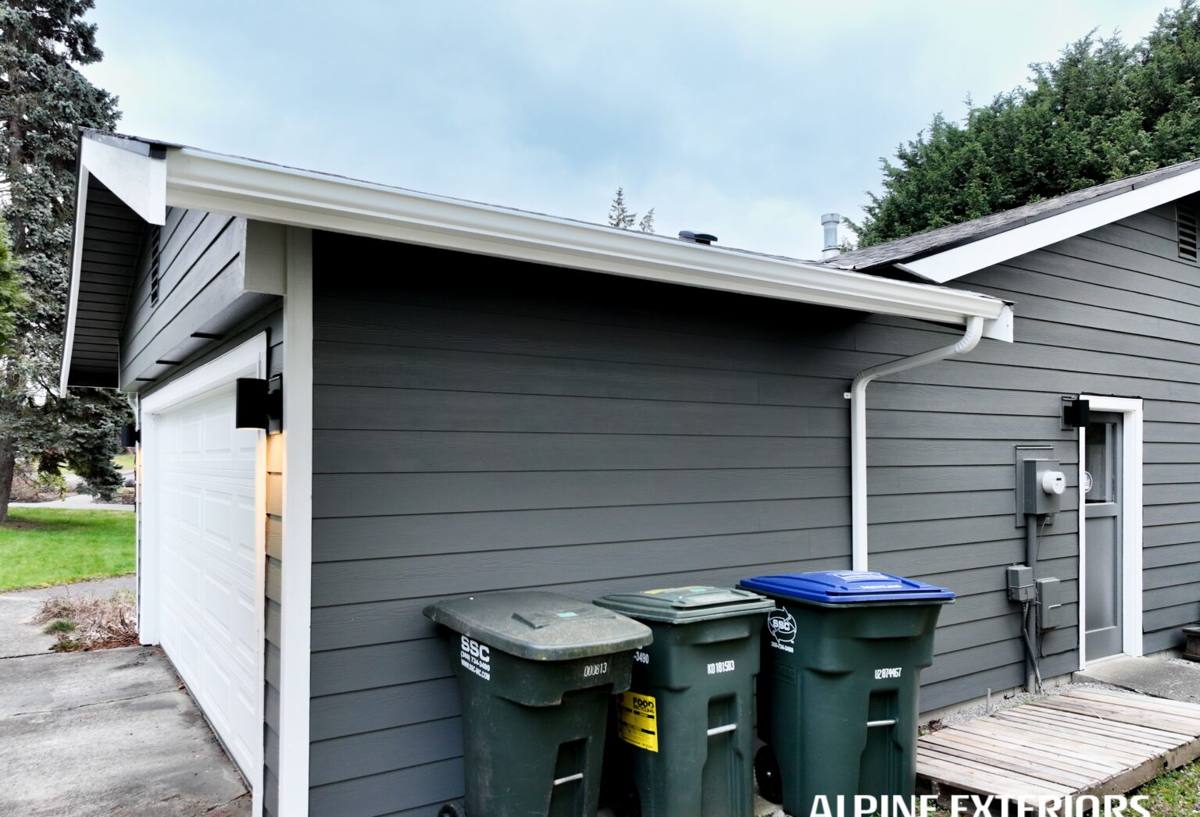
What This Climate Actually Does to Siding
Salt Air
Airborne salt is corrosive and it's persistent. It settles on exterior surfaces, works into fasteners and trim seams, and accelerates the breakdown of coatings that aren't engineered to resist it. Over years, a house near the water will show wear on its south- and west-facing elevations faster than the same house set back from the shoreline — faded color, chalky paint film, and corrosion around unprotected metal fasteners or flashing.
Driving Rain
Wind off the water doesn't just drop rain straight down — it pushes it sideways into wall assemblies, seams, and butt joints. Any siding product with a weak point at its joints, or any installation that skips proper flashing and caulking details, gives that wind-driven moisture a path behind the cladding. Once water gets behind siding at Sandy Point, the humid, rarely-fully-dry climate here means it doesn't evaporate out quickly. That's when rot, mold, and sheathing damage start.
Moss and Algae Season
Whatcom County's wet season runs long, and Sandy Point's exposure to marine moisture stretches it further. Moss and algae need sustained dampness and shade to establish, and north-facing walls, areas under tree cover, and low-sun sections of a house are the first to show green or black streaking. Left alone, that growth holds moisture against the siding surface and can accelerate coating breakdown underneath it.
Why We Only Install James Hardie Fiber Cement
We made a decision as a company to install one siding system: James Hardie fiber cement. We don't install vinyl, LP SmartSide, Cemplank, Allura, primed spruce, or cedar, and that's a deliberate standard, not a lack of options. Each of those products has legitimate strengths — vinyl is inexpensive, wood has a traditional look, engineered wood products install quickly — but each also comes with a trade-off that we think matters more in a climate like this one than it does in a drier region.
Fiber cement is non-combustible, dimensionally stable when it gets wet, and doesn't feed moss or fungal growth the way wood-based products can. James Hardie's ColorPlus factory finish is baked on under controlled conditions rather than field-applied, which matters directly for a coastal-adjacent property: factory finishes hold color and resist chalking longer than field-applied paint exposed to salt air and UV. Hardie also engineers regional product lines (HZ5 for the Pacific Northwest) specifically for climates with sustained moisture exposure, which is exactly the profile Sandy Point has.
None of that means fiber cement is maintenance-free or that installation quality stops mattering. It means the base material and finish are working with you instead of against you in a place like this.
What a Correct Installation Looks Like Out Here
Fiber cement siding is only as good as the installation behind it, and in a driving-rain, high-moisture location that matters more than in most places. A correct job includes:
- Proper weather-resistive barrier and rainscreen or drainage plane behind the siding, giving any moisture that does get past the cladding a path to drain and dry
- Correct flashing at every window, door, and roof-to-wall intersection — the majority of moisture intrusion problems start at these transitions, not in the field of the siding
- Manufacturer-specified fastener spacing, type, and embedment, with corrosion-resistant fasteners appropriate for coastal-adjacent exposure
- Proper clearance between siding and grade, decks, and roof lines so water isn't wicking up from below
- Correctly caulked and sealed joints using products rated for the exposure, not just whatever's on the truck
- Factory-cut and factory-primed edges kept intact wherever possible, since field-cut edges need to be sealed per manufacturer spec to maintain warranty coverage
Skipping any one of these doesn't usually cause an immediate, visible problem. It shows up two, five, or ten years later as a soft spot, a stain, or a section that's failing while the rest of the house looks fine. That's the nature of moisture damage — it's invisible until it isn't.
Why a Crew That Already Works Sandy Point Matters
There's a real difference between a crew installing fiber cement siding for the first time in a marine-influenced setting and one that's already done it repeatedly in this specific area. A crew that regularly works Sandy Point and similar Whatcom County shoreline-adjacent neighborhoods already knows:
- Which elevations of a typical house here take the worst of the wind-driven rain and need the most attention at seams and penetrations
- Where moss and algae tend to establish first, and how that should inform detailing at rooflines, gutters, and shaded walls
- How fastener corrosion shows up locally, and which fastener specs actually hold up rather than just meeting minimum code
- What existing sheathing and wall assemblies in this area tend to look like once old siding comes off, since a lot of Whatcom County homes weren't built with today's drainage-plane standards
That local pattern recognition doesn't replace following the manufacturer's installation manual — it just means fewer surprises and fewer corners that get missed because a crew hasn't seen this particular combination of exposure and construction before.
Comparing Siding Materials for a Sandy Point Property
| Material | Moisture Behavior in This Climate | Finish Durability Near Salt Air | Why We Don't Install It / Do |
|---|---|---|---|
| Vinyl | Doesn't absorb water but can warp, buckle, or crack in temperature swings; seams can allow water intrusion behind panels | Color can fade and become brittle with sustained UV and salt exposure over time | Lower upfront cost, but we don't install it — thin material, limited impact resistance, and a look that doesn't hold up as an investment-grade choice |
| LP SmartSide / Engineered Wood | Wood-based core; needs consistently intact caulking and finish to keep moisture out, which is harder to guarantee long-term in this exposure | Field or factory finish can wear faster where humidity stays elevated most of the year | We don't install it — the wood-based substrate carries more risk here than fiber cement if moisture gets behind the finish |
| Cedar / Primed Spruce | Natural wood, highly susceptible to moisture absorption, swelling, and rot without diligent, ongoing maintenance | Requires regular refinishing to hold up against salt air and constant dampness | We don't install it — beautiful material, but the maintenance burden in this climate is significant |
| Cemplank / Allura Fiber Cement | Similar base material behavior to Hardie; performance depends heavily on the specific product line and finish system | Varies by product line and finish warranty terms | We standardized on James Hardie specifically for its ColorPlus finish system, HZ5 regional engineering, and warranty structure |
| James Hardie Fiber Cement (HZ5) | Dimensionally stable, doesn't swell or rot from moisture exposure, engineered for climates like this one | Factory-baked ColorPlus finish resists fading and chalking significantly longer than field-applied paint | What we install — matched to this climate and backed by a strong transferable warranty when installed to spec |
Planning a Fiber Cement Project at Sandy Point
Timing
Exterior siding work is weather-dependent, and the drier stretch of the year — generally late spring through early fall — gives the best working conditions for proper installation, caulking, and finish work. That said, projects can be planned and scheduled well ahead of that window; the sooner a homeowner starts the conversation, the more flexibility there is on timing.
What Drives Cost
Every home is different, but the main cost factors on a Sandy Point fiber cement project are generally the same ones that affect any siding job in this area:
- Total square footage and the complexity of the roofline and wall elevations
- Condition of the existing sheathing and wall assembly once old siding is removed
- Amount of trim, corner, and soffit detail work involved
- Whether additional drainage plane or moisture barrier upgrades are needed to bring the wall assembly up to current standards
- Siding profile and ColorPlus color selection
We don't publish blanket pricing because those variables genuinely change the number from house to house — a straightforward one-story home and a home with multiple rooflines and heavy trim detail are not the same project.
A Practical Checklist Before You Sign a Contract
- Confirm the crew is installing genuine James Hardie product, not a substitute fiber cement brand under a similar name
- Ask specifically how they'll handle flashing at windows, doors, and roof intersections
- Confirm whether a rainscreen or drainage plane is included, and why or why not for your specific home
- Ask what fastener type and spacing they use, and whether it matches Hardie's published specifications for this region
- Get the warranty terms in writing — both the manufacturer's product warranty and the installer's workmanship warranty
- Ask how they'll handle any wall sheathing or framing issues found once old siding comes off
If you're weighing a siding project at Sandy Point, we're happy to take a look at the house, talk through what your specific exposure and elevations need, and give you a straightforward, no-pressure estimate. There's a form below to get that started.