 Ferndale
 Sandy Point's Exposure Is Different From an Inland Ferndale Lot
Sandy Point sits right where wind, salt-laden air, and near-constant winter moisture meet a residential neighborhood. Homes here take a different beating than a house a few miles inland in Ferndale proper. Salt air accelerates corrosion on fasteners and metal trim, wind-driven rain finds every gap in a wall assembly instead of just running off a roofline, and the shaded, damp stretches of the property stay wet long enough for moss and algae to take hold on siding, trim, and fascia. None of this is exotic — it's just what happens to exterior materials on a coastal-influenced lot in Whatcom County, year after year, whether the house is a weekend place or a full-time residence.
The practical effect is that siding decisions made for a typical inland home don't always hold up the same way at Sandy Point. Materials that are marginal on moisture resistance, edge integrity, or fastener corrosion get exposed faster here. That's the lens we use when we talk about siding for this neighborhood specifically.
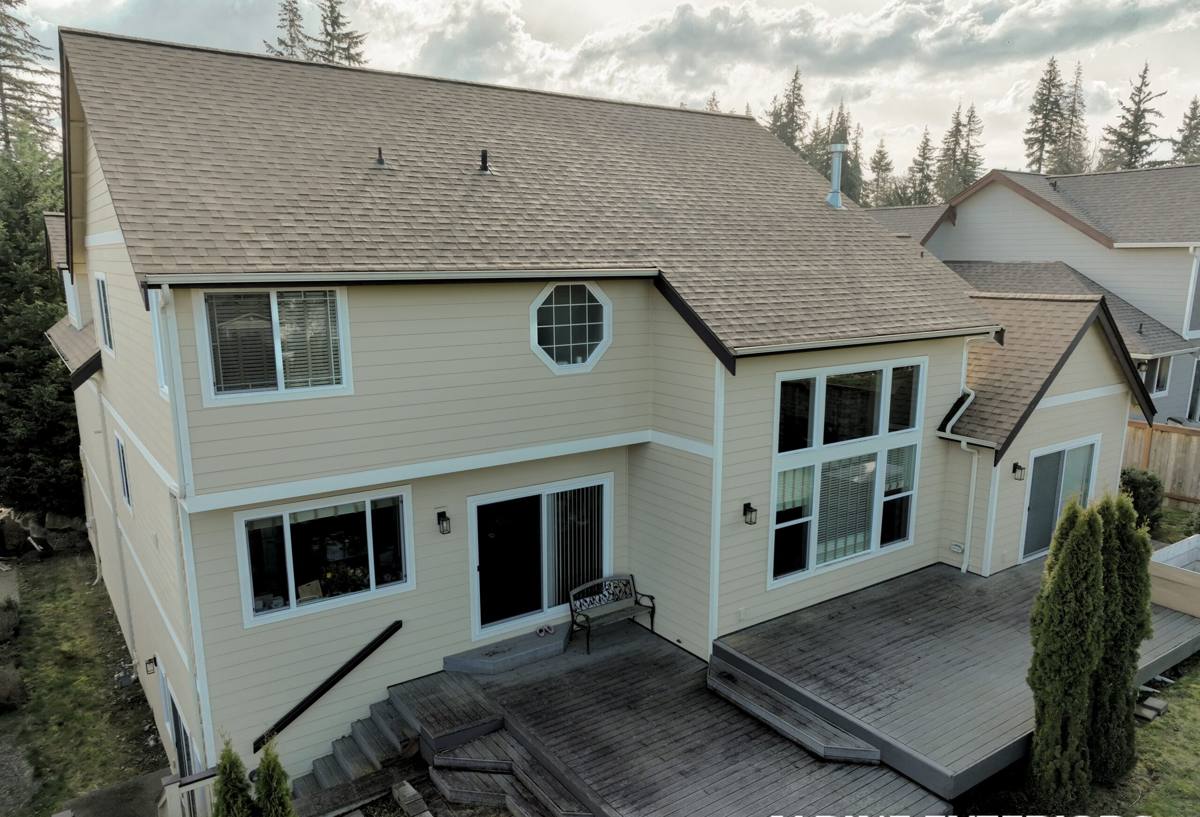
Why We Install Only James Hardie Fiber Cement
We don't install vinyl, LP SmartSide, Cemplank, Allura, primed spruce, or cedar. That's a standing decision, not a sales pitch for whatever job is in front of us. Each of those products has real strengths, but each also has a trade-off that shows up faster in a climate like this one — vinyl can warp and get brittle with UV and temperature swings and never really stops seasonal air infiltration at the seams; engineered wood products rely on their factory treatment staying intact at every cut edge, which is a hard standard to hold on every job; cedar looks great new but needs a maintenance commitment most owners don't keep up once the first repaint is due, and it's the material most susceptible to the moss and algae growth Sandy Point deals with all winter.
James Hardie fiber cement is non-combustible, dimensionally stable in wet-dry cycling, and finished at the factory under controlled conditions (ColorPlus) rather than relying on a field-applied coat that has to perform perfectly on day one. That combination is why we standardized on it, and it's why it's the only product we put on a house.
What "Correct" Installation Looks Like Here
Fiber cement siding is only as good as the assembly behind it. In a wind-driven-rain environment like Sandy Point, the details that get skipped on a rushed job are exactly the ones that cause trouble two or three winters later.
Water Management Behind the Siding
- A drainable weather-resistive barrier with proper lap and taping at every seam, not just stapled house wrap
- Correctly flashed and counter-flashed window and door openings, with head flashing that actually sheds water past the siding below it
- Rainscreen or furring where the assembly calls for it, so any moisture that does get behind the siding has somewhere to drain and dry instead of sitting against the sheathing
Fasteners and Hardware
In salt air, the wrong fastener corrodes and stains the siding face long before the siding itself fails. We use fasteners rated for the exposure and hold to Hardie's fastening specs — correct spacing, correct penetration depth, no over-driving that cracks the board edge or breaks the factory seal.
Gaps, Caulking, and Clearances
Hardie's own installation instructions call for specific gaps at trim, penetrations, and the bottom clearance above grade, decks, and roofing. Sandy Point's ground-level moisture and occasional standing water near foundations make that bottom clearance non-negotiable — it's one of the most common corner-cutting mistakes we see undone on other jobs.
Product Lines That Make Sense for This Lot
James Hardie builds different HZ (HardieZone) formulations for different climate exposures, and for a coastal-influenced Whatcom County property we generally recommend the higher-moisture-resistance HZ5 line rather than a product engineered mainly for dry-climate performance. The ColorPlus factory finish matters just as much here as the substrate — a consistent, baked-on finish resists fading and holds up to the repeated wet-dry cycling better than a field-applied paint job, and it means touch-up, when it's ever needed, is a known, matched product rather than a guess at a paint store.
Panel and lap profile choice is mostly an aesthetic call, but board thickness and installation method (face-nailed vs. blind-nailed, lap siding vs. panel) should be chosen with this exposure in mind, not just for the look on the elevation drawing.
Comparing Siding Options in a Salt-Air, High-Moisture Setting
| Factor | James Hardie Fiber Cement | Vinyl | Cedar | LP SmartSide / Engineered Wood |
|---|---|---|---|---|
| Moisture behavior | Dimensionally stable, engineered for wet-dry cycling | Doesn't rot but seams allow air/water infiltration | Absorbs moisture; needs consistent sealing | Performance depends on intact factory treatment at every cut |
| Salt air / corrosion exposure | Non-combustible substrate, unaffected by salt corrosion itself | Can become brittle over time with UV and temperature swings | No corrosion risk to the wood, but fasteners need care | Cut edges are the vulnerable point near salt exposure |
| Moss / algae resistance | Factory finish resists staining; surface sheds growth more easily | Can stay damp in folds and channels, encouraging growth | Most susceptible — natural wood texture holds moisture | Moderate; depends on coating integrity |
| Maintenance commitment | Low — occasional wash, repaint cycle measured in decades | Low, but seams and edges degrade with age | High — regular sealing/staining or repaint | Moderate — edge sealing is critical and easy to miss |
| Finish durability | Factory-baked ColorPlus finish | Color molded in, but fades and chalks over time | Field-applied stain or paint | Field-applied or factory-primed, repaint required |
Our Process for a Sandy Point Job
1. On-Site Assessment
We walk the whole exterior, not just the elevation that's visibly weathered. Wind exposure, tree cover, drainage patterns, and existing moisture damage all factor into the plan before we quote anything.
2. Scope and Product Plan
We spec the HZ line, profile, and trim package for the actual exposure of the house, and we walk the homeowner through why — not just what color was picked.
3. Tear-Off and Sheathing Check
Old siding comes off, and we inspect sheathing and framing for hidden moisture damage before anything new goes on. This step matters everywhere, but it matters more on a lot that's been absorbing salt air and driving rain for years — problems behind old siding don't announce themselves until the wall is opened up.
4. Weather-Resistive Barrier and Flashing
This is the step that determines whether the siding performs for thirty years or ten. We install and inspect the water management layer before a single piece of Hardie goes up.
5. Installation to Spec
Fastening, clearances, and joint treatment follow Hardie's published specs, not shortcuts. We schedule around weather windows rather than pushing installation into driving rain, which protects both the crew's work quality and the building paper underneath.
6. Final Walkthrough
We go over caulking, trim, and touch-up needs with the homeowner directly, including what maintenance (if any) to expect going forward.
Maintenance a Sandy Point Homeowner Should Actually Expect
- An annual rinse-down (garden hose is enough) to clear salt residue and prevent moss/algae buildup before it takes hold
- A yearly look at caulking around windows, doors, and trim joints — this is the first place wind-driven rain finds a way in
- Keeping gutters and downspouts clear so roof runoff isn't dumping extra water onto siding runs
- Trimming back vegetation and tree cover that keeps siding shaded and damp longer than it needs to be
- A periodic check of the bottom clearance above grade, decks, and walkways to make sure nothing (mulch, landscaping, snow piles) has crept up over time
Why Local Experience With This Neighborhood Matters
A crew that's worked Sandy Point before already knows the wind exposure varies house to house depending on which direction the lot faces, knows what the moss growth pattern looks like on a north-facing wall by year two versus year five, and knows which flashing details actually get tested by this specific stretch of Whatcom County weather. That's not something you can fully substitute with a generic installation manual. It shows up in small decisions — where to add extra flashing attention, which elevation needs the most careful joint treatment, how aggressive to be about drainage behind the siding — that add up to a job that holds up rather than one that looks right on installation day and starts showing problems in three winters.
Get a Straight Answer for Your House
Every Sandy Point property faces the weather a little differently depending on its orientation, tree cover, and age of construction. If you're dealing with aging siding, visible moss and algae staining, or you're planning ahead for a home in this neighborhood, we're happy to take a look and give you a straightforward assessment — no pressure, no upsell to a product we don't stand behind. Request a free estimate using the form below and we'll walk the property with you.