 Ferndale
 Building Decks That Can Handle Sumas Weather
A deck in Sumas has to do more than look good on a dry August afternoon. It has to survive a wet season that runs most of the year, hold up under a moss load that never really goes away, and keep doing its job through freeze-thaw cycles that loosen fasteners and shift footings over time. Whatcom County's marine-influenced climate — the salt-tinged air moving in off the Salish Sea, the driving rain, and the long moss season that follows it inland toward Sumas — is hard on any exterior structure, but decks take the worst of it because they're horizontal, exposed on every side, and built low to the ground where moisture lingers longest.
We build decks for homeowners throughout this area and see the same failure patterns over and over on decks that weren't built with this climate in mind. This page is about what a deck actually needs to hold up here, what correct construction looks like underneath the surface, and how we approach the job from first estimate to final walkthrough.
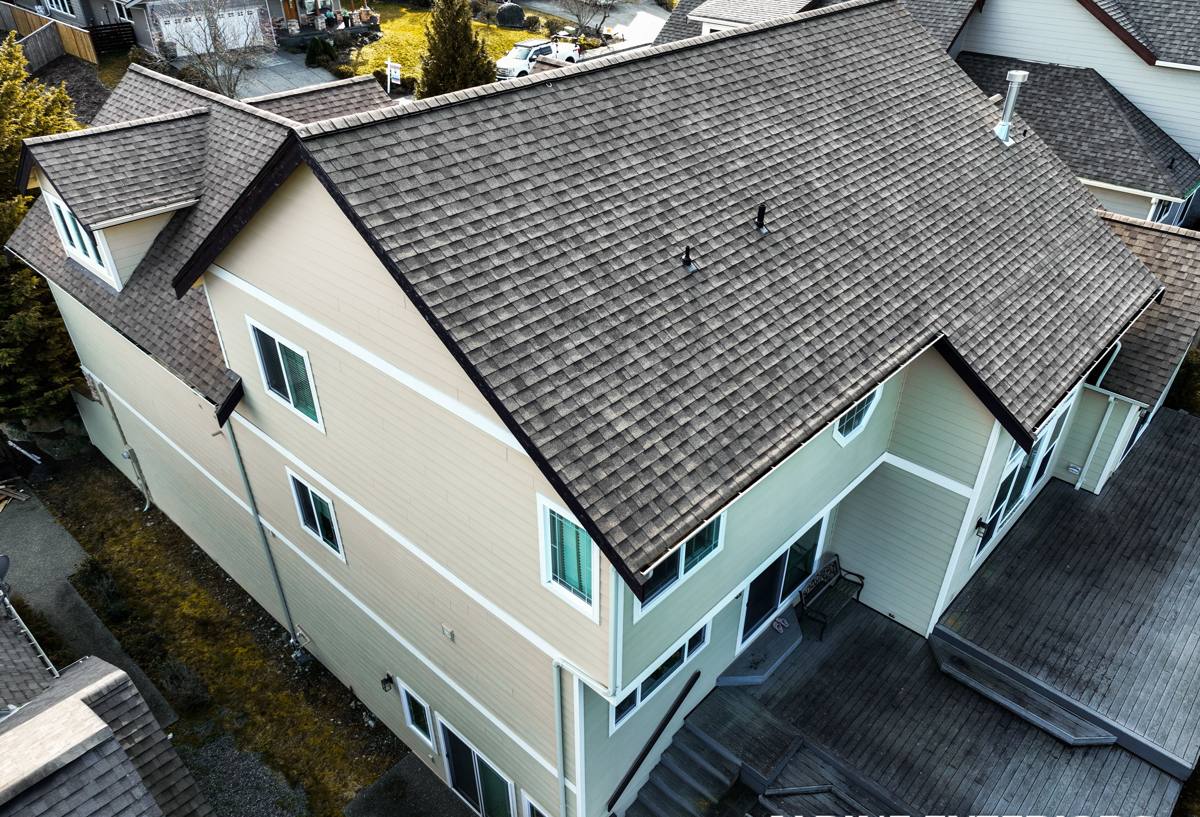
What This Climate Does to a Deck Over Time
Understanding the failure modes is the first step to avoiding them. Most deck problems we're called out to inspect in this region trace back to one of three things.
Moss and Constant Moisture
Moss doesn't just make a deck slippery — it holds moisture directly against wood and fasteners, which accelerates rot and corrosion in exactly the spots you can't see until the damage is done: under boards, around post bases, and in the gaps between decking planks. A deck with poor airflow underneath or boards installed tight together with no drainage path will grow moss faster and hold rot longer than one built with proper spacing and ventilation.
Driving Rain and Wind-Driven Wetting
Rain here doesn't just fall straight down. Wind-driven rain gets pushed sideways into ledger connections, under railing posts, and into any gap where flashing was skipped or done poorly. Over a few wet seasons, water finds every shortcut in the build and starts working on the framing from the inside, long before it shows up as a visible problem on the surface.
Freeze-Thaw and Ground Movement
Whatcom County gets enough freeze-thaw cycling each winter to matter. Footings that aren't poured below frost depth, or posts that sit on grade instead of a proper footing, can heave and settle unevenly year after year. That's how you end up with a deck that develops a lean, squeaks in new spots, or pulls slightly away from the house — none of which show up in year one, but all of which show up eventually.
Choosing the Right Decking Material for Sumas Conditions
There's no universally "best" decking material — there's the right material for how a homeowner wants to use the deck and how much upkeep they're willing to do, weighed against how this climate treats each option. Here's how the common choices actually compare once you factor in year-round wet weather and moss pressure.
| Material | How It Handles Moisture & Moss | Maintenance | Typical Lifespan Here |
|---|---|---|---|
| Pressure-treated wood | Resists rot when properly sealed, but end grain and fastener holes need attention; moss grows readily if not cleaned | Annual cleaning and re-sealing recommended | 15-20 years with upkeep |
| Cedar | Naturally moisture- and insect-resistant, but still needs finish maintenance to hold its color and resist surface moss | Periodic cleaning and staining | 20-25 years with upkeep |
| Composite decking | Won't rot, but can still grow surface moss/mildew in shaded, low-airflow areas — needs occasional washing | Low; occasional cleaning | 25-30+ years, brand warranty dependent |
| PVC/capped polymer | Fully moisture-resistant surface; best resistance to moss staining of the common options | Lowest; simple washing | 25-30+ years, brand warranty dependent |
Composite and PVC boards cost more up front but remove a lot of the seasonal maintenance burden that wood decking demands in a climate like this. Wood costs less initially and can look excellent, but it only performs as well as the maintenance schedule behind it — if a deck gets neglected for a couple of seasons here, wood shows it faster than composite or PVC will.
The Structure Underneath: Where Decks Actually Fail
The decking surface is the part everyone sees, but it's rarely the part that fails first. Almost every deck problem we diagnose starts below the boards.
Ledger Board Attachment and Flashing
The ledger board — where the deck bolts to the house — is the single most important connection on the entire structure, both structurally and for moisture control. It has to be lag-bolted or through-bolted correctly, and it has to be flashed so that water sheds away from the house rather than running behind the siding at the deck-to-house joint. A ledger that's improperly flashed is one of the most common sources of hidden rot we find, because the damage happens behind the wall where nobody looks until there's a real problem.
Footings and Frost Depth
Footings need to be sized and set to local code depth so they sit below the frost line and on undisturbed, load-bearing soil. Skipping this — or using undersized footings to save time — is exactly what leads to the heaving and settling problems that show up as squeaks, gaps, and slow leaning over several winters.
Joist Protection and Fastener Choice
Joists and beams should be protected with joist tape or a comparable flashing membrane at every point where decking fasteners penetrate, since that's where water intrusion starts. Fasteners themselves need to be rated for treated lumber and exterior exposure — using the wrong grade of screw or bracket in a wet climate is a slow-motion corrosion problem that eventually costs a lot more to fix than it would have to do right the first time.
Our Deck Building Process
Every deck starts with an honest look at the site, the house, and how the homeowner actually plans to use the space — entertaining, grilling, a quiet spot for morning coffee, or all three. From there, our process looks like this:
- Site visit and design conversation — we look at drainage, sun exposure, existing structure condition, and how the deck will tie into the house before anything is drawn up.
- Material and layout selection — we walk through the real tradeoffs between wood, composite, and PVC options based on budget, maintenance appetite, and how the deck will be used.
- Permitting — we handle the permit application and inspection scheduling required for the jurisdiction, so the homeowner isn't the one chasing paperwork.
- Footings and framing — footings poured to code depth, ledger properly bolted and flashed, framing built square and to span tables for the decking and load it will carry.
- Decking, railing, and stairs — installed with correct spacing for drainage and airflow, and hardware appropriate to the material and this climate.
- Final walkthrough — we go over the finished deck together, cover any maintenance the material requires, and make sure everything meets what was discussed at the start.
Permits and Code Requirements
Deck construction in Whatcom County generally requires a permit once a deck exceeds a certain height or size threshold, and inspections typically happen at the footing stage and again at final. Requirements can vary depending on the exact jurisdiction a property falls under near Sumas, including setback distances from property lines and guardrail height and spacing rules for any deck built above a certain elevation. We handle this process as part of the job rather than leaving it for the homeowner to sort out, because a deck built without the required permit can create real problems later — at resale, at insurance claim time, or if the structure is ever questioned during another project on the property.
Cost Factors to Expect
Deck pricing depends on more than square footage. The factors below are what actually move the number up or down on most projects.
| Factor | Why It Matters |
|---|---|
| Decking material | Pressure-treated wood costs least up front; composite and PVC cost more but reduce long-term maintenance |
| Height and footing depth | Taller decks and deeper frost-depth footings mean more excavation, concrete, and structural framing |
| Railing style | Basic wood or composite railing costs less than metal cable or glass-panel systems |
| Stairs and landings | Multiple stair runs or landings add framing, footings, and labor |
| Site access and grading | Sloped or hard-to-access sites take longer to excavate and frame |
| Roof or cover addition | A partial or full roof over the deck adds real cost but also cuts down on moss and moisture exposure |
We give homeowners a straightforward walk-through of which of these are driving their specific number rather than a single lump figure with no explanation behind it.
Keeping a Sumas Deck Looking Good Year After Year
Whatever material a deck is built from, a little seasonal attention goes a long way in this climate. A simple maintenance routine we recommend to homeowners:
- Sweep debris and standing leaves off the deck regularly, especially in fall — trapped organic matter is what feeds moss and holds moisture against the boards.
- Rinse or lightly wash the surface once or twice a year to knock back moss and algae growth before it takes hold.
- Check railing posts and stair connections annually for looseness — this is often the first sign of a fastener or footing issue.
- Keep gutters and downspouts near the deck clear so roof runoff isn't dumping extra water onto or under the structure.
- For wood decking, plan on re-sealing on the schedule the finish manufacturer recommends — don't wait until the wood looks gray and dry.
- Look underneath the deck once a year for any signs of standing water, soft wood, or corrosion at fastener points.
Why Hire a Crew That Already Works in Sumas
A deck built to a generic spec sheet from a drier climate doesn't perform the same way here. Crews that already work in Sumas and the surrounding Whatcom County area know which details actually matter locally — the flashing details that keep water out of a ledger connection through a wet winter, the footing depth that holds through freeze-thaw, and the spacing and airflow choices that keep moss from taking over a deck's first few years. That local familiarity isn't guesswork; it comes from having built and later inspected decks through multiple wet seasons in this exact climate and seeing firsthand what holds up and what doesn't.
It also means faster, more accurate estimates, because we're not translating a design built for a different region — we're starting from what already works here.
Get a Straightforward Estimate
If you're planning a new deck or replacing one that's showing its age, we're happy to come take a look and walk you through your options honestly — no pressure, no upsell, just a clear picture of what your project needs and what it will cost. Use the form below to request a free estimate.