 Ferndale
 Why Decks Take a Beating Out Here
A deck in the Sumas area doesn't fail the way one does in a dry climate. It fails from the bottom up and the inside out. Whatcom County gets months of steady, low-intensity rain, a marine air layer that keeps everything damp longer than it looks, and a moss season that can stretch from fall through spring. None of that is dramatic on its own, but stacked together year after year, it's exactly the combination that rots ledger boards, rusts fasteners, and turns a deck surface slick and green faster than most homeowners expect.
We're based in Ferndale and have been out to the Sumas area often enough to know the pattern: decks built to a generic spec — the kind that would hold up fine in a drier region — tend to show soft spots and hidden rot at the 8-to-12-year mark, sometimes sooner around the ledger and stair stringers. Decks built with this climate in mind last considerably longer. The difference isn't the brand of lumber. It's the flashing, the fasteners, the airflow underneath, and a handful of details that either get done right the first time or get papered over with a fresh coat of stain.
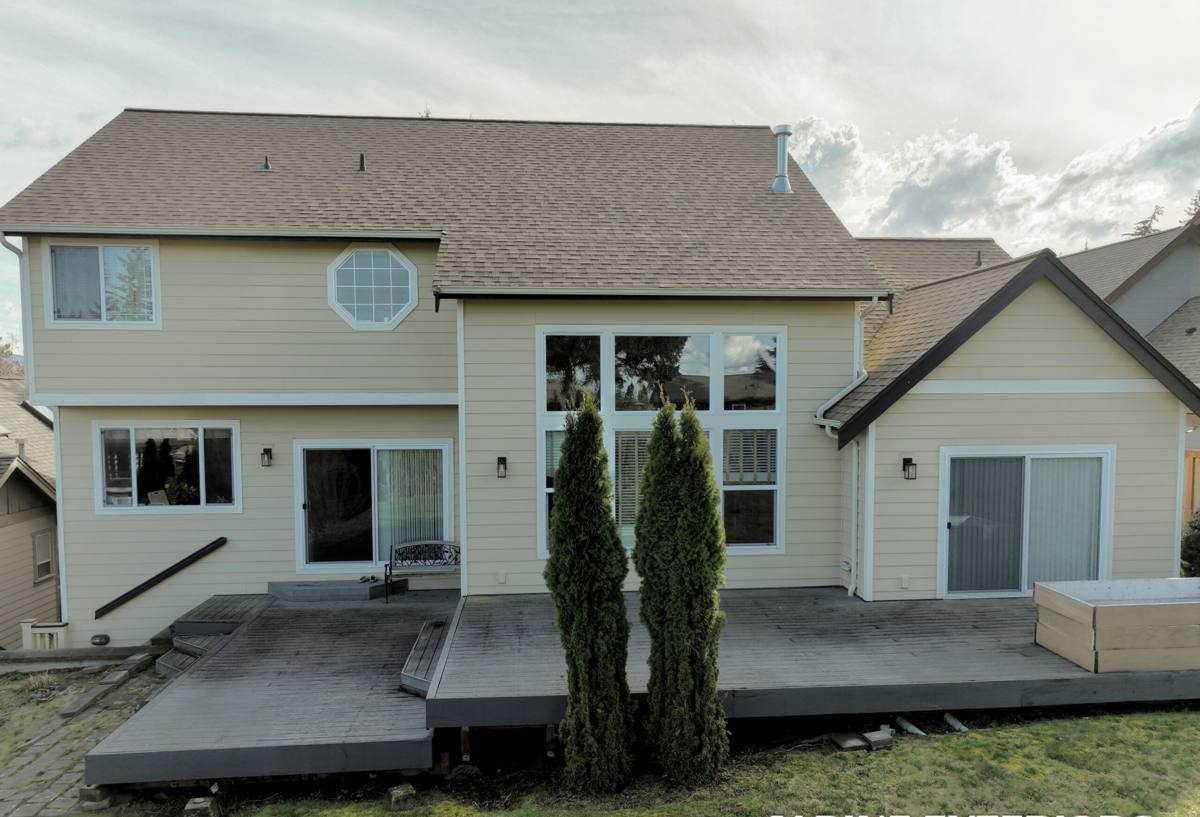
Repair or Replace? Reading the Warning Signs
Not every deck needs a full tear-out. But there's a point where patching individual boards stops being a repair and starts being a delay tactic. Here's how we sort it out on a walkthrough:
- Surface graying or moss film — usually just needs cleaning and refinishing, not replacement.
- A few soft or cupped boards — often a board-by-board repair if the framing underneath is sound.
- Soft or spongy spots near the ledger board (where the deck meets the house) — this is the one we take most seriously, because it usually means water has been getting behind the flashing and into the house-side framing, not just the deck itself.
- Rust streaks around fasteners or visibly corroded hardware — a sign the original fasteners weren't rated for ground contact or coastal-adjacent moisture.
- Wobble in the railing posts or stairs — often a post-attachment or footing issue, which is a structural problem, not a cosmetic one.
- Visible rot when you press a screwdriver into the wood and it sinks in easily — that board, and likely its neighbors, are done.
If the framing, ledger connection, and footings are still sound, we'll tell you that and price a repair or resurface instead of pushing a full replacement. If the substructure is compromised, resurfacing over it just hides the problem for another season.
What a Correct Deck Replacement Actually Involves
A deck replacement isn't just new boards on the old frame. Done right, it's a rebuild of everything a deck depends on to survive our wet season, most of which you never see once it's finished.
The Ledger Board and Flashing
This is where a deck attaches to the house, and it's the single most common failure point we find in this climate. Correct flashing — installed so water is directed out and away from the house rather than trapped behind the ledger — is non-negotiable. We treat this connection as a waterproofing detail first and a structural detail second, because in Whatcom County the two problems usually show up together.
Framing and Joists
Joists need to be rated for exterior/ground-contact exposure, properly spaced for the decking material you choose, and set up with enough airflow underneath that moisture doesn't just sit and stagnate. Poor ventilation under a deck is one of the quiet causes of premature rot — it's not always the rain itself, it's rain that never gets a chance to dry out.
Footings and Posts
Footings need to be sized and set to local frost depth and soil conditions, with post bases that keep wood off standing water rather than sitting directly in it. This is also where permitting and inspection come in for most replacement projects — it's not paperwork for its own sake, it's the check that keeps the structure sound.
Fasteners and Hardware
Coated or stainless fasteners rated for ground contact, hot-dip galvanized or stainless structural hardware — this is a small line item that makes an outsized difference over ten-plus years of damp exposure. Mismatched or under-rated hardware is one of the most common shortcuts we see on decks that failed early.
Decking Material Options for This Climate
There's no single "best" decking material — there's a best fit for your budget, your maintenance appetite, and how much moisture exposure the deck actually gets (a shaded, tree-covered deck behaves differently than one in full sun). Here's how the common options actually compare for a Whatcom County application:
| Material | Upfront Cost | Maintenance | How It Handles Our Wet Season |
|---|---|---|---|
| Pressure-treated lumber | Lowest | Needs re-staining/sealing every 1-3 years | Good if sealed regularly; end grain and fastener points are the vulnerable spots |
| Cedar | Mid-range | Regular sealing to hold color and resist checking | Naturally decay-resistant, but still needs upkeep to shed moisture well |
| Composite decking | Higher upfront | Low — occasional washing, no staining | Won't rot or splinter, but can stay damp-looking and grow surface moss/algae if it doesn't get sun or airflow |
| PVC decking | Highest | Lowest | Fully moisture-proof surface, but still requires correctly built, ventilated framing underneath |
We'll walk through the trade-offs honestly rather than push whatever has the best margin. Composite and PVC reduce your maintenance workload considerably, which matters if you don't want to be out there scrubbing moss every spring — but they're not a substitute for good framing and drainage underneath. A composite deck built over a poorly ventilated frame will still trap moisture; it just won't show it on the surface the way wood does, which can actually delay you noticing a problem.
Our Deck Replacement Process
- On-site assessment. We check the ledger connection, framing, footings, and posts before quoting anything, so the estimate reflects what's actually there, not a guess.
- Honest repair-vs-replace recommendation. If a repair genuinely solves the problem, we'll say so.
- Permitting. Most full deck replacements in Whatcom County require a permit; we handle that process rather than leaving it to you.
- Tear-out. Full removal of decking, and framing/ledger/footings as needed based on what the assessment found.
- Rebuild. Correct ledger flashing, rated framing lumber, footings to local code, and ground-contact-rated hardware throughout.
- Decking installation in the material you've chosen, with attention to spacing for drainage and expansion.
- Final walkthrough so you know what maintenance (if any) your new deck needs going forward.
Why a Crew That Already Works the Sumas Area Matters
Deck work in this part of Whatcom County isn't generic outdoor construction — it's construction that has to account for a specific set of pressures: sustained rain, a long moss and mildew window, salt-influenced marine air moving through the region, and soil and drainage conditions that vary quite a bit from lot to lot. A crew that's done this work repeatedly in and around Ferndale and Sumas isn't guessing at flashing details or fastener specs; those choices are already dialed in from experience with what actually fails locally.
There's also a practical scheduling side to it. Deck tear-out and framing work needs reasonable weather windows, and a local crew can plan around this region's rain patterns rather than working from a generic construction calendar that doesn't account for how wet a Pacific Northwest fall or spring actually gets. That matters for both the timeline and the quality of the finished work — rushing framing or flashing installation between rain systems is how corners get cut.
Keeping Your New Deck Looking Good
Even a well-built deck needs some ongoing attention in this climate. A short seasonal routine goes a long way toward protecting the investment:
- Sweep leaves and debris off regularly — trapped organic matter holds moisture and feeds moss growth.
- Rinse the surface a few times a year, especially shaded sections, to slow moss and algae buildup.
- Check that gaps between boards stay clear so water can drain through rather than pool.
- Re-seal wood decking on the schedule appropriate to the product (typically every 1-3 years).
- Glance under the deck once a year for standing water, debris buildup against framing, or signs of moisture staying trapped.
- Have fastener and railing connections checked periodically — loose hardware is easier to fix before it becomes a structural issue.
Let's Take a Look at Your Deck
If your deck is showing soft spots, rust stains, or just isn't holding up the way it used to, we're happy to come take a look and give you a straight answer on repair versus replacement — no pressure, no upsell. Use the form below to request a free estimate.