 Ferndale
 Why Birch Bay Homes Wear Out Siding Faster
Birch Bay sits close enough to the water that salt-laden air is a constant, not an occasional nuisance. Combine that with the driving, wind-blown rain that comes off the Strait of Georgia in the fall and winter, and a shady season where moss and algae have months to take hold on north-facing walls, and you get a climate that is genuinely harder on exterior siding than most inland Whatcom County neighborhoods experience. None of this is dramatic on its own. It's the accumulation over years that causes the problem: salt residue holding moisture against a wall, rain finding its way behind loose or failing panels, and moss roots working into seams and fastener holes that were never sealed correctly in the first place.
That's why siding replacement in Birch Bay isn't just about swapping old material for new. It's about correcting the details that let the old siding fail in this specific environment, so the replacement doesn't repeat the same slow decline in another fifteen years.
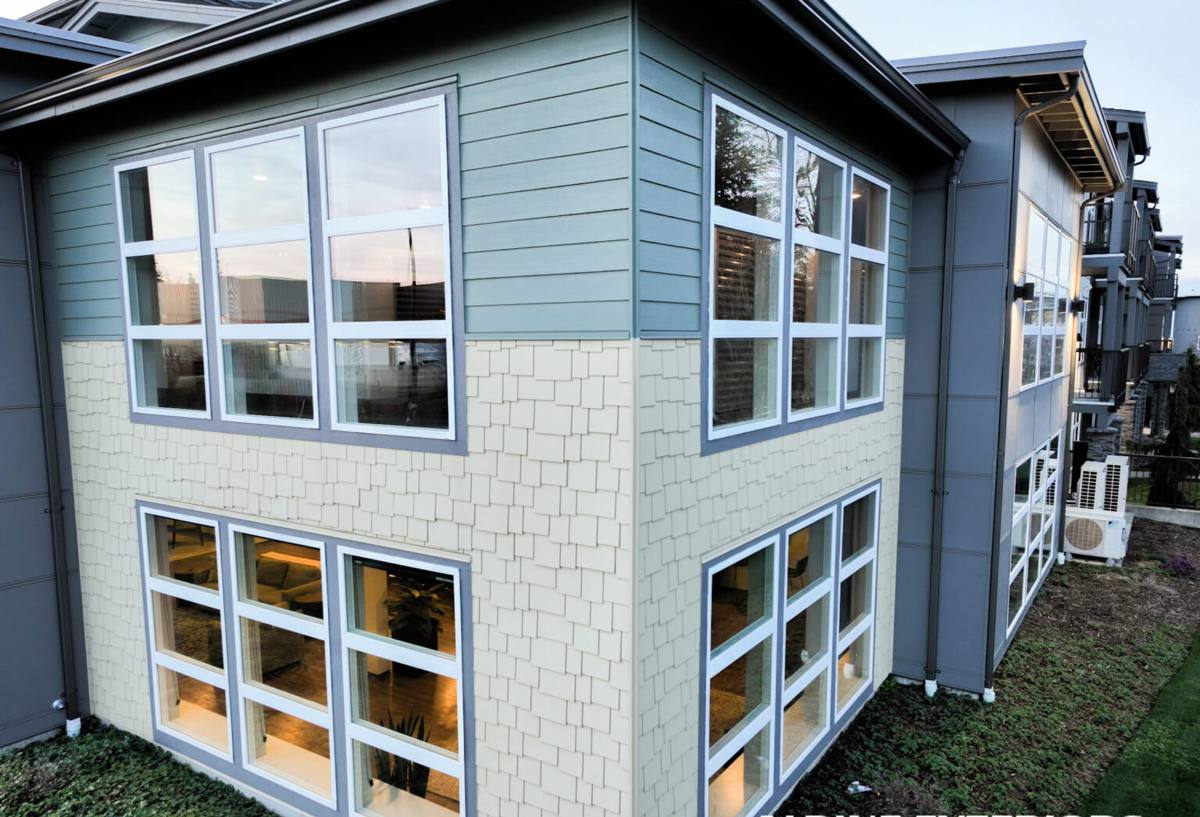
Signs a Birch Bay Home Needs Siding Replacement, Not Another Patch
Coastal homes often get patched for years before an owner considers full replacement. Patching has its place, but there's a point where it stops being cost-effective and starts masking a bigger problem underneath. Watch for:
- Soft or spongy spots when you press on the siding, especially near the bottom courses and around window trim
- Persistent moss or dark streaking that comes back within a season or two of cleaning
- Paint that's failing in patches rather than evenly across the wall — often a sign moisture is pushing out from behind
- Visible cupping, warping, or separated seams, common on older wood or engineered wood products in wet climates
- A noticeable rise in heating bills that coincides with siding that's clearly no longer sealing the wall properly
If more than one of these shows up on the same wall, that's usually a sign the water-resistive barrier underneath has also been compromised, which changes the scope of the job from cosmetic to structural.
What a Correct Siding Replacement Actually Involves
A Real Tear-Off, Not a Cover-Up
Installing new siding over old is sometimes marketed as a time-saver, but it buries whatever moisture damage or rot already exists behind the old material. On a coastal property like Birch Bay, where hidden moisture is the most common cause of failure, that's a risk not worth taking. A correct replacement means removing the old siding down to the sheathing, so the crew can actually see what condition the wall is in before closing it back up.
The Water-Resistive Barrier and Flashing
This is the part of the job that never shows up in a photo but matters more than the siding itself. A properly lapped water-resistive barrier, correctly integrated flashing at every window, door, and penetration, and a drainage plane that lets any incidental moisture escape rather than pool — these details are what separate siding that lasts thirty-plus years from siding that fails again in ten. In a climate that sees as much driving rain as this stretch of Whatcom County does, cutting corners here is the single biggest cause of early siding failure, regardless of what brand of product goes over the top of it.
Installing to the Manufacturer's Actual Specification
Every siding product has an installation manual with specific requirements for fastener placement, clearances above grade and roofing, gaps at joints, and caulking or sealant use. Skipping these steps doesn't just risk premature wear — it can void the manufacturer's warranty entirely, leaving a homeowner with no recourse if the siding fails early. We install to spec every time, not as an upsell, but because it's the only way the product performs the way it's designed to.
Why We Install James Hardie Fiber Cement in Birch Bay
We install James Hardie fiber cement siding exclusively. We don't install vinyl, LP SmartSide, Cemplank, Allura, or primed wood products, and that's a deliberate standard, not a limitation of what we're capable of installing. Fiber cement is non-combustible, dimensionally stable, and doesn't swell or delaminate the way engineered wood products can when they take on repeated moisture — a real consideration in a climate where wet weather is the norm for much of the year.
James Hardie also engineers its siding by climate zone. Homes in this part of Washington typically use Hardie's HZ5 product line, formulated for regions with significant moisture exposure rather than extreme freeze-thaw cycles, which matches the Pacific Northwest's wet, moderate climate profile. The factory-applied ColorPlus finish is baked on before the boards ever reach the jobsite, which means better color retention and adhesion than field-applied paint has to offer — a meaningful advantage against the fading and streaking that salt air and grime can cause on a south- or west-facing wall.
None of this means fiber cement is maintenance-free. It still needs to be installed correctly and cared for, but it holds up to this coastline's combination of salt, rain, and moss better than the alternatives we chose not to install.
Our Process, From Estimate to Finished Wall
- On-site assessment. We look at existing siding condition, trim, flashing, and any moisture staining or soft spots before quoting anything.
- Written estimate. A clear scope of work, product selection, and price — no vague allowances that turn into surprises later.
- Tear-off and sheathing inspection. Old siding comes off, and any damaged sheathing or framing is identified and addressed before anything new goes up.
- Water-resistive barrier and flashing installation. This step gets done to spec, every time, regardless of whether it's visible in the finished product.
- Hardie fiber cement installation. Installed per manufacturer clearance and fastening requirements to keep the product warranty intact.
- Final walkthrough. We review the completed work with the homeowner before calling the job done.
What Siding Replacement Costs Depend On
Every Birch Bay property is different, so a real number only comes from an on-site look. But the factors that move the price are consistent:
| Cost Factor | Why It Matters |
|---|---|
| Home size and wall complexity | More corners, dormers, and trim details mean more labor and material cuts |
| Condition of existing sheathing | Rot or moisture damage found during tear-off adds repair work before new siding can go up |
| Siding profile and accessories | Lap width, trim style, and corner details all affect material cost |
| Height and access | Multi-story walls or difficult site access require more equipment and time |
| Existing moisture barrier condition | A failing barrier means it gets replaced too, not just patched around |
Homeowners are often surprised that the sheathing condition, not the siding material itself, ends up being the biggest cost swing on older coastal homes — which is exactly why a real tear-off and inspection matters more than a quick over-clad.
Why Hiring a Crew That Already Works Birch Bay Matters
Siding installation isn't identical everywhere. A crew that mostly works drier, inland climates may not think twice about details that matter a great deal on a property exposed to salt air and near-constant winter rain. Knowing which walls in Birch Bay take the worst weathering, how much clearance to leave near grade given the moisture in the soil here, and how aggressively moss and algae take hold on shaded elevations all come from working this specific stretch of Whatcom County repeatedly, not from a general contracting background.
It also matters for warranty support. If a manufacturer warranty claim ever comes up, having a contractor who installed the siding correctly the first time — and who's still doing business in the area — makes that process straightforward instead of a headache.
Caring for New Siding After Installation
Fiber cement siding is durable, but a little seasonal attention keeps it looking and performing its best in this climate:
- Rinse off salt residue and grime periodically, especially on walls facing the water or prevailing wind
- Keep gutters clear so overflow doesn't run down the siding face repeatedly
- Trim back vegetation and tree cover that keeps shaded walls damp and encourages moss growth
- Address any caulking or trim gaps promptly rather than letting water find a way behind the siding
- Have flashing and trim checked periodically, particularly after major storms
If you're weighing whether it's time to replace the siding on a Birch Bay home, we're happy to take a look and give you a straight answer — no pressure, no inflated quote to scare you into a decision. A free estimate is the easiest way to find out what your home actually needs.