 Ferndale
 Window Replacement in Cordata: Built for Whatcom County's Wet Side
Cordata sits in the north end of the Ferndale area, and like the rest of Whatcom County, homes here take a steady beating from the marine climate year-round. It's a mix of newer construction and older homes with original or first-generation replacement windows, and both categories run into the same problem eventually: windows are the part of a house with the most seams, the most moving hardware, and the most chances for water to get in if the install wasn't done right the first time. Salt-tinged air off the Sound, driving rain that comes in sideways rather than straight down, and a moss season that can run most of the year all put more pressure on window seals, frames, and flashing than a typical manufacturer's installation guide assumes.
We work on siding, roofing, windows, and decks throughout Ferndale and the surrounding Whatcom County area, and on window replacement specifically, we treat the flashing and installation detail as at least as important as the window unit itself. A premium window installed with rushed flashing will eventually leak in this climate. A solid, mid-grade window installed correctly — with flashing that actually ties into the surrounding wall and siding — will usually last longer and cost less to own over time.
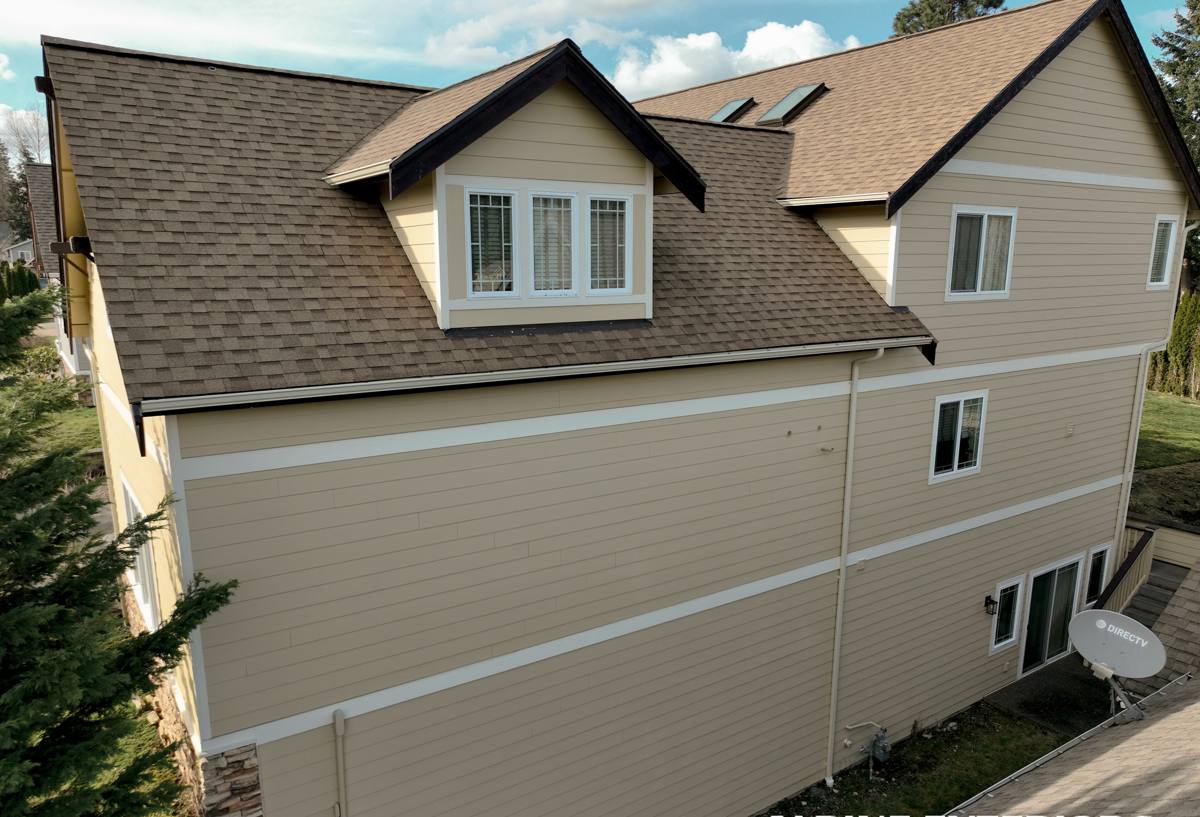
What This Coastal Climate Does to Windows Over Time
Wind-Driven Rain
Storms in this part of Whatcom County don't just fall — wind drives the rain sideways into wall assemblies, window trim, and lap joints. That matters because wind-driven rain reaches gaps and seams that would stay dry in a calmer climate. The window unit is only half the equation; flashing that laps correctly with the weather-resistive barrier and siding around it is what actually keeps that water out of the wall.
Salt Air and Hardware Corrosion
Cordata doesn't sit right on the water, but it's close enough that salt-laden marine air moves through the area regularly. That air speeds up corrosion on lower-grade window hardware, fasteners, and frame components. Budget hardware that would hold up fine in a dry inland climate tends to show pitting, stiffness, or failed seals noticeably sooner here.
A Moss Season That Doesn't Really End
Mild temperatures and near-constant moisture from fall through spring give moss and mildew a long growing season across Whatcom County. Window sills, trim, and the framing around older units are common places it takes hold, especially on shaded elevations or under eaves with poor drainage. Anywhere water sits instead of draining becomes a growth surface eventually, and once moss or mildew is established against a sill, it holds moisture there longer than open air would.
Condensation From Temperature Swings
The gap between a heated interior and a cold, wet exterior during a Whatcom County winter puts real condensation pressure on glass and frames. Older single-pane windows and early double-pane units show this constantly — fogging, moisture trapped between panes, or water pooling on interior sills. That's usually a sign a seal has failed, not just a cosmetic nuisance.
Signs a Cordata Home Needs Window Replacement
- Fogging or visible moisture trapped between the panes of a double-pane window
- Noticeable drafts or cold spots near the frame even with the window fully closed and locked
- Sills or trim that feel soft, look discolored, or show visible rot
- Windows that stick, won't stay open, or are hard to lock the way they used to
- Visible daylight or gaps where the frame meets the siding
- Paint or finish peeling or bubbling faster on window trim than on the rest of the exterior
- A noticeable rise in heating costs without any other obvious cause
Repair vs. Replacement: How We Make the Call
Not every window on a Cordata property needs to come out. A window with a failed seal but a sound frame and working hardware is often a reasonable repair or reglaze candidate. A window with rotted framing, a warped sash, or hardware that's been failing for years usually isn't — at that point, the labor spent patching it keeps adding up until a proper replacement would have cost less overall.
| Condition | Repair Usually Makes Sense | Replacement Usually Makes Sense |
|---|---|---|
| Fogged glass, sound frame | Yes — reglaze or seal replacement | Only if the frame is also compromised |
| Stiff or broken hardware | Yes — hardware replacement | Not on its own |
| Soft or rotted wood framing | Rarely a lasting fix | Yes |
| Persistent drafts despite sealing | Sometimes, if flashing is the actual cause | Yes, if the unit itself is the source |
| Single-pane, no storm window | Possible short-term patch | Yes, for real energy and comfort gains |
What a Correct Window Replacement Job Involves
Assessment and Measurement
We start by checking each window's frame condition, seal integrity, hardware function, and how the existing flashing ties into the siding around it. Measurements are taken in the field, not estimated from old plans, since older Cordata-area homes don't always match what a set of original drawings would suggest.
Removal and Opening Prep
Pulling the old unit is also when hidden problems usually surface — soft framing, old flashing that was never lapped correctly, or caulk that was doing a job it was never designed to do. We address those issues before the new window goes in, not after, because sealing a new window over a compromised opening just hides the problem for a while.
Flashing and Weatherproofing
This is the step that determines whether a window replacement holds up for decades or starts leaking within a few wet seasons. Correct installation means flashing laps properly with the weather-resistive barrier and siding around it, water is directed out and away from the rough opening instead of trapped behind it, and every seam is sealed with materials rated for sustained moisture exposure. That's standard practice on every window we install, not an upgrade homeowners have to ask for.
Setting, Sealing, and Trim
The new unit is set square and level, shimmed correctly so it isn't relying on the fasteners alone to hold shape, and sealed on a schedule that matches the flashing plan rather than a generic bead of caulk around the perimeter. Exterior trim is finished to match the surrounding siding so the result looks intentional, not patched in.
Choosing the Right Window for This Climate
We install vinyl and fiberglass window systems suited to the Pacific Northwest's wet, mild conditions, and we walk homeowners through the real trade-offs rather than pushing one brand as the only correct answer. What matters most for a Cordata home is a tight, well-engineered frame, glazing that performs for both energy efficiency and condensation resistance, and hardware rated to hold up under sustained marine air exposure — not a specific name printed on the frame.
- Frame material: Vinyl frames are generally more affordable and hold up well in this mild, wet climate. Fiberglass frames tend to be more dimensionally stable through temperature swings and can be painted later if a homeowner wants to change color. Both resist rot in a way uncladded wood frames don't.
- Glazing package: Double-pane windows with a low-E coating cover most homes here well; triple-pane adds cost and weight and usually makes more sense for a specific noise or exposure concern than as a default upgrade.
- Hardware grade: Corrosion-resistant hardware holds up longer against Whatcom County's marine-influenced air than standard-grade hardware, and it shows in how smoothly locks and cranks operate years down the road.
- Warranty structure: A manufacturer's product warranty is only as good as the installation behind it. We stand behind our installation work separately from the window manufacturer's warranty on the unit itself.
What Drives the Cost
We won't quote a number without seeing the windows in question, but the factors that move price on a Cordata window replacement job are consistent from house to house.
| Factor | Why It Matters |
|---|---|
| Number of windows | A full-house project typically has better per-unit pricing than replacing one or two windows at a time |
| Frame material and glazing | Vinyl, fiberglass, and different glazing packages carry different material costs |
| Opening condition | Rot, old flashing failures, or out-of-square framing add repair work before the new unit goes in |
| Standard vs. custom size | Non-standard openings, common in older homes, cost more and take longer to order than stock sizes |
| Access and story height | Second-story or hard-to-access windows take more labor time and equipment |
| Trim and finish scope | Matching new exterior trim to existing siding adds material and labor beyond the window unit itself |
Our Process, Start to Finish
- On-site assessment — we check frame condition, seal integrity, hardware, and how existing flashing ties into the siding around each window
- Honest recommendation — repair or replace, explained window by window, not a blanket answer for the whole house
- Written scope and ordering — a clear scope of work, with realistic lead times since window orders can take several weeks depending on size
- Removal and opening prep — old units come out carefully, and any hidden framing or flashing issues get corrected before the new window goes in
- Installation and flashing — the new unit is set, shimmed, and flashed to a sequence built for this climate, not a bare-minimum standard
- Trim and finish — exterior trim is matched to the surrounding siding for a clean, finished result
Why a Crew That Already Works Cordata Matters
A contractor who works Ferndale and the surrounding Whatcom County area regularly already knows how wind-driven rain and marine air behave here compared to a drier, more sheltered climate. That shows up in the small decisions — how much lap a flashing detail gets, whether caulk is treated as a real seal or just a backup, which hardware grade gets specified for a given exposure. Those are the details that decide whether a window replacement is still performing cleanly in fifteen years or showing drafts and soft trim in five. It also means fewer surprises around permitting and realistic scheduling through the wetter months, since we're not learning the local conditions on your project.
Windows also don't fail in isolation. A replacement done without attention to the surrounding siding, trim, and drainage plane can look fine for a season or two and still leak, because water that gets past a poorly integrated window travels into the wall assembly instead of showing up where anyone can see it. We handle siding, roofing, windows, and decks as connected trades rather than standalone jobs, which means the person handling your window flashing understands exactly how it needs to tie into the siding around it.
A Few Questions Worth Asking Before You Hire
- Ask specifically how they handle flashing integration with the existing siding, not just which window brand they sell
- Confirm current Washington contractor licensing and active liability insurance
- Get a written scope that separates the product warranty from the installation warranty
- Ask for a repair-or-replace recommendation on each window individually, not a blanket answer for the house
- Ask about realistic lead times, since custom or non-standard sizes can take several weeks to arrive
If you're dealing with drafty, foggy, or stubborn windows on a Cordata-area property — or you're just not sure whether repair or replacement is the right call — we're happy to take a look and give you a straightforward, no-pressure read. Use the form below for a free estimate.